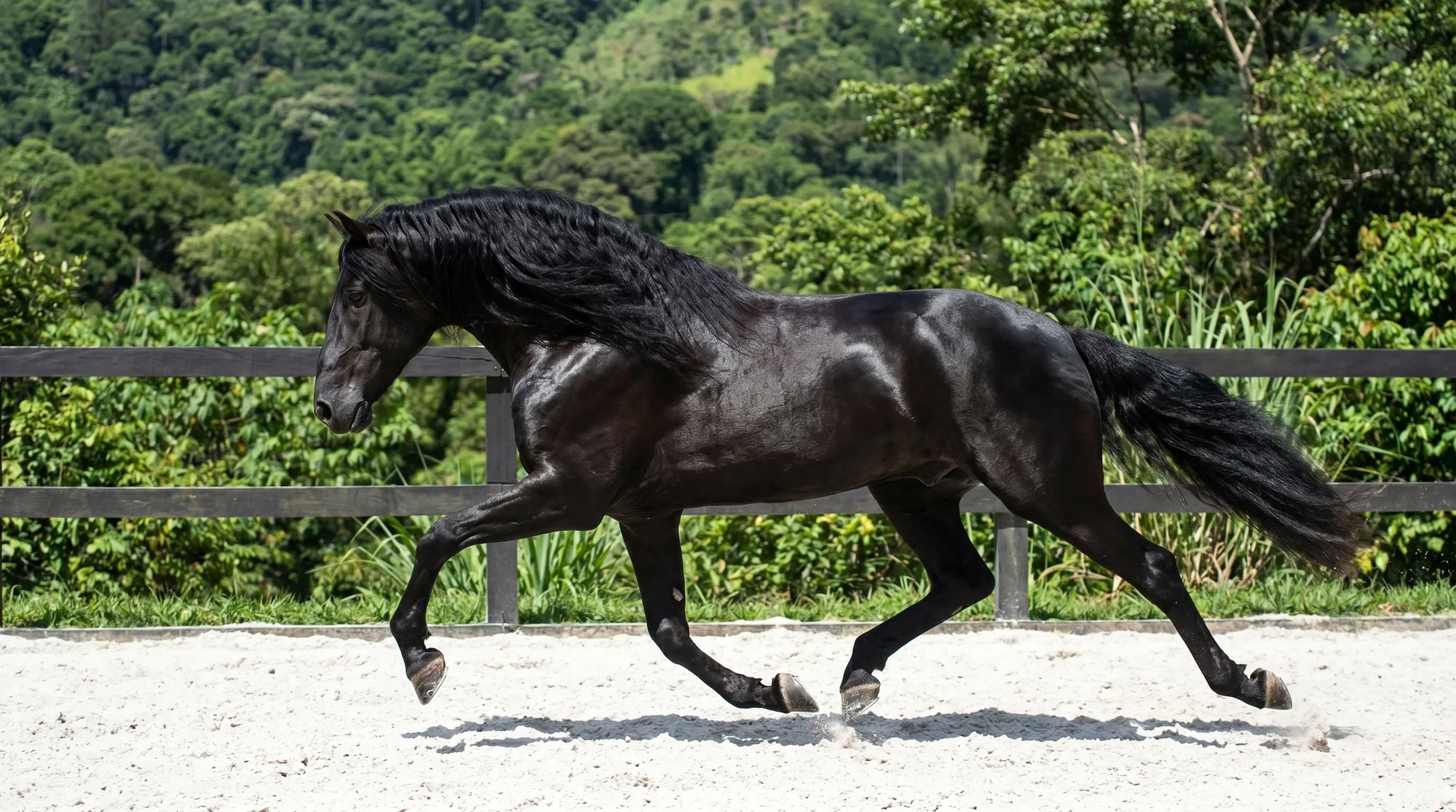
Breed History
The Science of Elegance: History of the Spanish Purebred
The Pura Raza Español (PRE) is not simply a horse breed. It is a living archive of more than five thousand years of Mediterranean history: present in the caves of Altamira, in Roman mosaics, in Velázquez's paintings and on the Olympic arena of the 21st century. This article reviews and expands that history with verifiable academic sources.
Infographic · Origin
The Three Ancestral Pillars of the PRE
01The Three Ancestral Pillars
1.1 The Primitive Iberian Horse
The oldest ancestor of the PRE is Equus ferus hispanicus, a wild equid that inhabited the Iberian Peninsula during the Pleistocene. The caves of Altamira (Cantabria) and El Castillo (Puente Viesgo) document its presence from at least 15,000 BC. Research published in the Journal of Archaeological Science (Lira et al., 2010) confirms through mitochondrial DNA analysis that Iberian horse populations already showed distinct genetic characteristics from those of central Europe and Asia more than 10,000 years ago.
Verified historical correction
The PRE does not descend from the Arab horse. Genomic studies (Promerová et al., 2014) demonstrate that Arab gene flow in the PRE is minimal and post-dates the 15th century. The genetic base of the PRE is predominantly Iberian and Berber. The PRE is, genetically, older than Islam.
1.2 The Sorraia
The Sorraia, identified by Portuguese zoologist Ruy d'Andrade in 1937, is considered a possible survivor of the primitive Iberian equid. DNA analysis by Jansen et al. (2002) identified mitochondrial haplogroup D as characteristic of Iberian horses, present with high frequency in both the Sorraia and the modern PRE.
1.3 The Barb Horse
The third pillar is the Barb horse from North Africa. Its influence arrived with the Arab-Berber invasion of 711 AD. Seven hundred and eighty years of coexistence enriched the Iberian genetic heritage without erasing its identity. The dominant African component is Berber, not Eastern Arab — a fundamental distinction that many sources confuse.
* * *
02From Rome to the Renaissance: Forging a Breed
Polybius and Livy describe the Iberian cavalry during the Punic Wars (264–146 BC) as superior to any other equestrian force in the Mediterranean. Hannibal recruited thousands of Iberian horsemen because, in Livy's words, no cavalry soldier in the known world matched their skill. After the Roman conquest, the Iberian horse was massively exported to the heart of the Empire.
During the Middle Ages, the Arab-Berber cavalry of Al-Andalus developed the jineta, a technique of short gallop and rapid turn, which deeply influenced the handling of the Iberian horse. This tradition is the direct origin of the high school of equitation, the basis of classical dressage and contemporary working equitation. In 1492, the Catholic Monarchs issued the Pragmatic on Horses, the first systematic regulation of horse breeding in Spain.
Infographic · Timeline
Five Thousand Years of PRE History
03Philip II and the Golden Age of the Spanish Horse
On 6 December 1567, Philip II signed in El Escorial the Royal Pragmatic founding the Royal Stables of Córdoba — the institutional birth certificate of the modern PRE. The Stables housed more than 1,800 mares and 300 stallions selected under strict criteria: harmonious conformation, noble temperament, cadenced movement and natural elevation.
The 17th century was the century of the Spanish horse. The most prestigious equestrian academies in Europe — Versailles, Naples, Vienna — were founded or reformed with Spanish instructors and Iberian horses. The Lipizzaner, the breed associated with the Spanish Riding School of Vienna, originated as a cross of Spanish horses with Italian mares from the Karst region.
«The Spanish horse is not merely a war or parade animal: it is the measure of the civilisation that breeds it.»— Juan Suárez de Peralta, Tractado de la Caballería de la Gineta y Brida, ca. 1580
04The Institutional Guardian: Spain's Military Horse Breeding Service
No institution has been more decisive in the preservation of the PRE than Spain's Military Horse Breeding Service. Its roots go back to the Catholic Monarchs' pragmatics of 1492, but it was during the 19th century that the institution took its modern form.
In 1847, the Military Stud of Jerez de la Frontera was founded, establishing the first systematic genealogical register of horses in Spain, including the PRE. In 1864, the Military Horse Breeding Service was formally constituted under the Cavalry Corps. In 1893, the Moratalla Stud (Córdoba) was founded, one of the main genetic reservoirs of the PRE during the 20th century.
Today, the Directorate of Military Horse Breeding (DCCFAS), under the Ministry of Defence, jointly manages the PRE Stud Book with ANCCE. This collaboration between a military institution and a breeders' association is unique in the world equestrian landscape and largely explains the robustness of the PRE register internationally.
Verifiable source
Ministry of Defence — DCCFAS, History section: defensa.gob.es/ccfas/HISTORIA/. The official publication Military Horse Breeding. 150 Years of Service documents this trajectory in detail.
05Crisis and Survival: The 18th and 19th Centuries
The 18th century brought a profound crisis: the Thoroughbred fashion from Philip V's Bourbon court, and the devastation of the Wars of Succession and Independence threatened the breed's purity. The Mendizábal Disentailment (1835) dispersed the Carthusian stud of Jerez, but Andalusian private breeders preserved the pure lines. On 23 January 1972, the founding of ANCCE in Jerez marked the beginning of the modern era.
⬥ La Cartuja Stud Farm — Hierro del Bocado
Since 1475, the Carthusian monks had bred horses on the Fuente del Suero estate beside their monastery of Santa María de la Defensión in Jerez. Applying the same monastic patience they brought to illuminating manuscripts, they fixed a unique genetic line in freedom — the so-called Carthusian horse. When Napoleon invaded Spain, clergyman Pedro José Zapata bought sixty mares and three stallions in 1810 — the finest specimens — and hid them in «Breña del Agua» while the monks fled to Cluny. To identify these rescued animals he created the Hierro del Bocado (the bit brand), still used today to mark this bloodline. The 1835 Disentailment definitively expelled the monks, but the bloodline was already safe.
Since 1990 it is managed by the public company EXPASA under the State Patrimony. In March 1998 the Carthusian monks themselves handed EXPASA the original bell-shaped iron, closing a five-century circle. Today more than 200 specimens live freely on the Fuente del Suero estate, designated in 2019 as the National Reference Centre for Zootechnics (CENRE): the world's largest genetic reserve and DNA bank for the Spanish horse. Visits are open to the public in Jerez de la Frontera.
06The Royal Andalusian School: Don Álvaro Domecq and Art Made Institution
In May 1973, then Prince Juan Carlos I awarded the Jerez horseman Don Álvaro Domecq Romero the Golden Horse, the highest honour in the Spanish equestrian world. In recognition of this award, Domecq presented for the first time his spectacle «How the Andalusian horses dance», the founding moment of what is today the Royal Andalusian School of Equestrian Art in Jerez de la Frontera.
Since 1987, King Juan Carlos I has been honorary president of the institution, giving it its Royal title. The school works exclusively with PRE horses and stages more than 150 performances a year for international audiences. Don Álvaro Domecq Romero, the soul of the institution, passed away on 18 November 2025, leaving a legacy that transcends the equestrian world.
Two of the most brilliant names in the history of the PRE in international sport are directly linked to the Royal School: Rafael Soto Andrade and Ignacio Rambla Algarín, both from Jerez and both masters of the institution. The Royal School was the ecosystem that made their Olympic achievements possible: the training, the horses and the support of Don Álvaro Domecq gave them the tools to bring the PRE to the highest world level.
07The PRE at the Olympics: Soto, Rambla and the Olympic Achievements
Rafael Soto and Invasor
Rafael Soto Andrade competed for more than a decade with Invasor, a grey PRE stallion, qualifying for and competing in two consecutive Olympic Games: Sydney 2000 and Athens 2004, reaching the individual dressage final at both events. In Sydney, Soto and Invasor finished fourth individually, just off the podium in a discipline dominated by Central European warmbloods.
Silver Medal · Athens 2004 · Team Dressage
Spain's first Olympic dressage medal in the modern era
Rafael Soto / Invasor · Ignacio Rambla / Oleaje · Juan Antonio Jiménez / Guizo · Beatriz Ferrer-Salat / Beauvalais
«Invasor was not simply my horse: he was an ambassador of the breed. Every score we achieved was a score for the PRE.»— Rafael Soto Andrade
Ignacio Rambla, Evento and Oleaje
Ignacio Rambla Algarín built with two PRE horses a career that consolidated the breed's place in elite sport. With Evento, his first great international competition PRE, Rambla competed on the FEI circuit with top-level results: his Kür with Evento in Verden is documented as one of the most moving and technically accomplished performances of the era. At the World Equestrian Games in Jerez 2002, Rambla was part of the Spanish team that won the team bronze medal.
It was with Oleaje that Rambla reached the summit: as part of the historic silver medal team at Athens 2004, and again at the London 2012 Olympic Games, cementing himself as the PRE rider with the greatest Olympic presence in history. As a faculty member of the Royal Andalusian School of Equestrian Art, Rambla remains active, passing on the equestrian philosophy that Don Álvaro Domecq established.
Infographic · World Distribution
The PRE in the World: 291,138 Specimens in 60+ Countries
08The PRE Today: A Breed in Global Expansion
As of December 31, 2024, the Stud Book records 290,407 living specimens — 143,728 mares and 146,679 stallions — belonging to 50,188 active breeders in 71 countries. In that year alone 12,615 new specimens were registered and 2,775 new breeders joined, 39% of them international, with particular strength in the USA, Italy and the Netherlands. The PRE accounts for 70% of all registered equids in Spain, with Andalusia concentrating 43% of the national census with around 78,500 specimens.
Blood purity is guaranteed through mandatory DNA verification since 1995: no horse obtains its PRE passport without a genetic analysis confirming parentage. Stud Book management falls jointly to ANCCE and the Directorate of Horse Breeding of the Armed Forces (DCCFAS), continuing the supervisory model born in the 19th century. In the competitive arena, the PRE is fully recognised by the FEI in classical dressage and working equitation. SICAB in Seville, the world's premier PRE show, brings together breeders from five continents each year and is the breed's international showcase. The export market focuses mainly on the USA, Mexico, Italy and France, consolidating the PRE as one of the most valuable cultural and economic assets of the Spanish agricultural sector.
09Myths and Realities of the PRE
Infographic · Scientific Verification
What Science and History Confirm
The PRE descends from the Arab horse brought by the Moors
Reality: The dominant African component in the PRE is Berber, not Arab. The PRE is, genetically, older than Islam. Source: Promerová et al., 2014.
The PRE is not suited for high-level competition
Reality: The silver medal at Athens 2004 with two PRE horses in the team, and three Olympic Games attended by Soto and Rambla, definitively disprove this myth.
The Carthusian and the PRE are two distinct breeds
Reality: The term Carthusian designates a line within the PRE. The Ministry of Agriculture recognises only one breed: the Spanish Purebred. Source: Royal Decree 662/2007.
* * *
10Timeline: Fourteen Essential Milestones
| Date | Milestone |
| c. 15.000 a.C. | Iberian caves — Altamira, El Castillo |
| 218 a.C. | Punic Wars: Iberian cavalry, best in the Mediterranean |
| 711 d.C. | Arab-Berber invasion — Berber contribution to the Iberian genome |
| 1492 | Catholic Monarchs' Pragmatic — first systematic regulation |
| 1567 | Philip II — Royal Stables of Córdoba. PRE institutional birth certificate |
| 1847 | Military Stud of Jerez — first official PRE genealogical register |
| 1893 | Moratalla Stud (Córdoba) — key genetic reservoir for the PRE |
| 1972 | ANCCE founded in Jerez — modern Stud Book |
| 1973 | Don Álvaro Domecq founds the Royal Andalusian School of Equestrian Art |
| 2000 | Sydney — Rafael Soto / Invasor, 4th in the Olympic individual final |
| 2002 | WEG Jerez — Rambla / Evento, team bronze |
| 2004 | 🥈 Athens — Team Silver. Soto / Invasor + Rambla / Oleaje |
| 2012 | London — Rambla / Oleaje at the Olympic Games |
| 2024 | +291,000 registered specimens in 60+ countries |
11Sources and Verifiable Bibliography
- Lira, J. et al. (2010). Ancient DNA reveals traces of Iberian Neolithic and Bronze Age lineages in modern Iberian horses. Molecular Ecology, 19(20), 4423–4436. DOI: 10.1111/j.1365-294X.2010.04785.x
- Jansen, T. et al. (2002). Mitochondrial DNA and the origins of the domestic horse. PNAS, 99(16), 10905–10910.
- Promerová, M. et al. (2014). Worldwide frequency distribution of the Gaitkeeper DMRT3 mutation. Animal Genetics, 45(2), 274–282.
- Warmuth, V. et al. (2012). Reconstructing the origin and spread of horse domestication. PNAS, 109(21), 8202–8206.
- ANCCE (2024). Éxitos deportivos del PRE. ancce.es
- Ministerio de Defensa — DCCFAS. Historia de Cría Caballar. defensa.gob.es/ccfas/HISTORIA/
- Real Escuela Andaluza del Arte Ecuestre. Historia. realescuela.org
- Fundación Andalucía Olímpica. Ignacio Rambla Algarín. fundacionandaluciaolimpica.org
- Real Decreto 662/2007, de 25 de mayo, sobre selección y reproducción de ganado equino de razas puras. BOE n.º 139.
- Archivo General de Simancas, fondo Mercedes y Privilegios: documentación sobre caballerizas reales, siglos XV–XVII.
Interested in the PRE's history? If you are looking to acquire a horse of this breed with full guarantees, we work exclusively for the buyer with a transparent approach.
Book your free first consultation · WhatsApp Our services