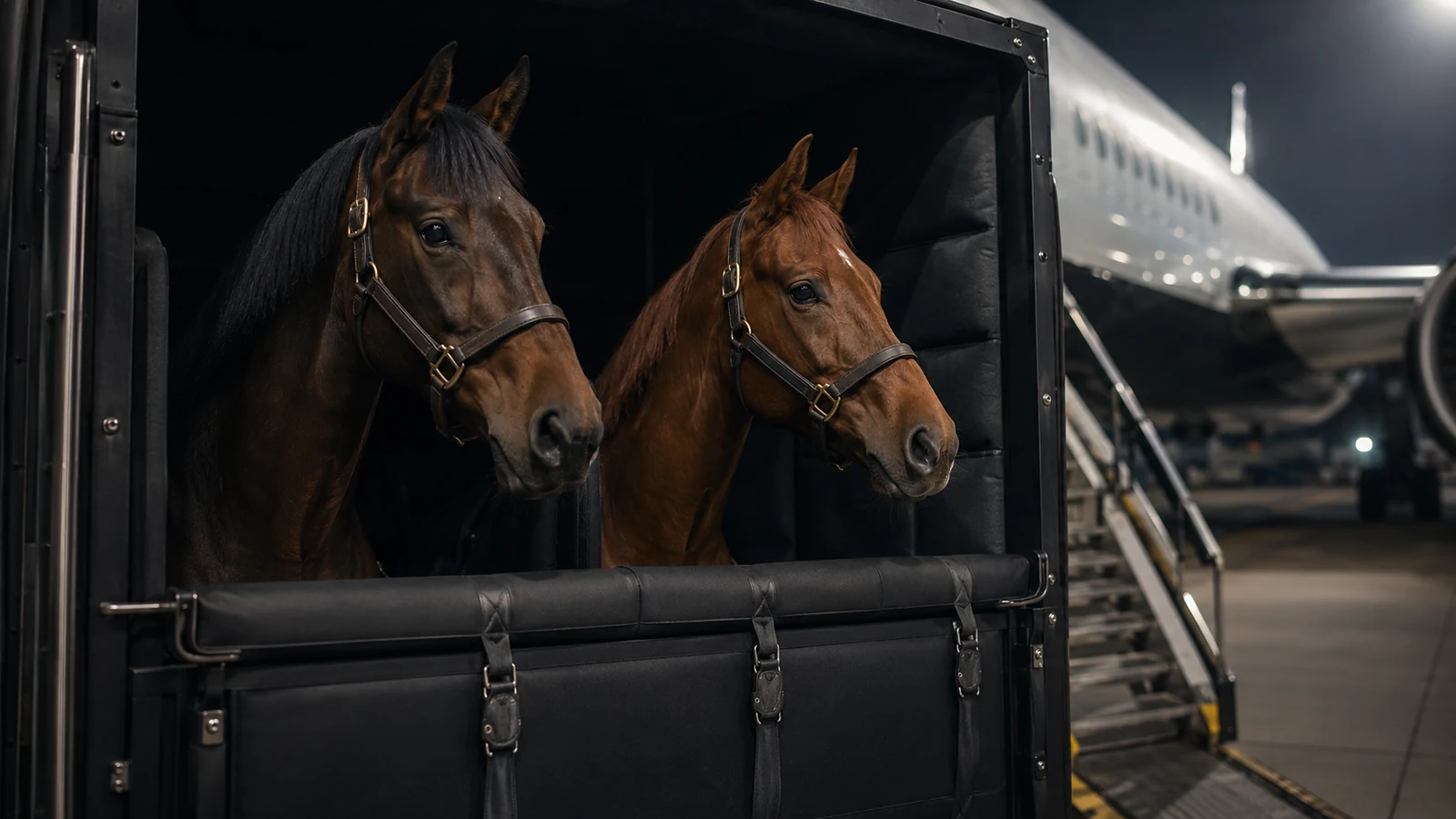
Exportar un caballo desde España: información sobre la piroplasmosis y documentación

Exporting a Horse from Spain: Piroplasmosis Testing and Export Documentation

Ein Pferd aus Spanien exportieren: Piroplasmose-Tests und Exportdokumentation

La piroplasmosis equina es una enfermedad parasitaria de la sangre que condiciona la exportación de caballos españoles y portugueses a varios mercados internacionales. No es una enfermedad que impida competir en España — es el requisito sanitario que piden Estados Unidos, México, Colombia, Chile, Argentina o El Salvador antes de aceptar la entrada de un caballo ibérico. Esta guía explica, con cifras fechadas y con fuente, qué es la piroplasmosis, cómo la controla cada país de destino y cómo se planifica la exportación con antelación para que la documentación esté en orden.

01 Piroplasmosis: qué es y por qué condiciona la exportación

La piroplasmosis equina es una enfermedad parasitaria de la sangre, no contagiosa, causada por dos agentes: Theileria equi (antes clasificada como Babesia equi) y Babesia caballi. Ambos destruyen los glóbulos rojos desde dentro, provocando una anemia de gravedad variable. No se transmiten de caballo a caballo por el aire ni por contacto directo — necesitan una garrapata que actúe de vector, principalmente de los géneros Dermacentor, Hyalomma y Rhipicephalus, plenamente establecidos en la Península Ibérica.

Esa densidad de vectores es exactamente la razón por la que España arrastra un problema estructural de piroplasmosis para la exportación. No es un reflejo de mal manejo ganadero — es geografía y clima.

24% De la cabaña equina española es seropositiva
animalshealth.es, feb. 2020
2 Parásitos causantes
T. equi y B. caballi — OMSA
5 Mercados de exportación en esta guía
EE. UU., MX, CO, CL, AR, SV

Como Estados Unidos y la mayoría de destinos hispanoamericanos son países libres de la enfermedad o mantienen zonas de control estricto, tratan la seronegatividad como una condición de entrada innegociable, no como un trámite más. La edad también importa: la exposición a garrapatas es acumulativa, así que la probabilidad de que un caballo dé positivo aumenta cada año que pasa en pastos españoles. Por eso planificar la exportación desde que el caballo es joven resulta muchísimo más sencillo que hacerlo una vez cerrada la venta.

02 Manifestaciones clínicas y diagnóstico de laboratorio

El periodo de incubación es de aproximadamente 10 a 30 días para Babesia caballi y de 12 a 19 días para Theileria equi. La mayoría de los caballos de deporte y cría que se exportan son portadores crónicos asintomáticos, no animales visiblemente enfermos — precisamente por eso todos los países de destino exigen una prueba serológica, no solo un examen clínico. Un caballo puede moverse, competir y tener un aspecto perfecto y aun así ser seropositivo.

Cuando la enfermedad clínica sí aparece, va desde una forma hiperaguda poco frecuente (muerte súbita en 24 a 72 horas, asociada a cargas altas de T. equi) pasando por formas aguda y subaguda —fiebre, decaimiento, anemia, ictericia, edema en extremidades— hasta una forma crónica con signos inespecíficos como baja tolerancia al ejercicio y pérdida de peso. Nada de esto determina, sin embargo, la aptitud para exportar: lo que decide es el resultado de laboratorio.

El estándar diagnóstico: cELISA

La identificación microscópica directa del parásito en un frotis sanguíneo solo es fiable en fase aguda, y los portadores asintomáticos no muestran parásitos visibles en el frotis. Para el comercio internacional, todos los países de esta guía exigen una prueba serológica indirecta: Fijación del Complemento, Inmunofluorescencia Indirecta (IFI) o, la más habitual, el Ensayo Inmunoenzimático Competitivo (cELISA) — el estándar de referencia para detectar portadores de anticuerpos con la sensibilidad que exigen los reguladores internacionales.

El manejo de la muestra importa más de lo que suele pensarse: los laboratorios suelen requerir unos 5 ml de sangre entera o 1 ml de suero, refrigerados a aproximadamente 4°C y procesados dentro de las 24 a 36 horas siguientes a la extracción, ya que la hemólisis por congelación, calor o manipulación brusca puede invalidar el resultado. Una muestra mal gestionada puede costar una ventana de embarque tanto como un resultado positivo.

03 Exportación a Estados Unidos: requisitos USDA/APHIS

El USDA declaró el país libre de piroplasmosis en 1988, pero brotes posteriores de T. equi en Florida, California, Georgia, Colorado, Oklahoma y Texas han llevado a tratarla como una enfermedad bajo control federal activo — regulada por el 9 CFR 93.300–93.314 y aplicada por APHIS (el Servicio de Inspección de Sanidad Animal y Vegetal).

Antes de que el caballo salga de España

  • Permiso de importación: se solicita a través del sistema APHIS eFile, generalmente con un mínimo de 7 días hábiles de antelación al embarque, con una validez de unos 14 días para équidos vivos.
  • Examen veterinario y certificado de exportación: un veterinario oficial español debe examinar al caballo el mismo día en que se emite el certificado, certificando la ausencia de signos clínicos de enfermedad infecciosa. El certificado debe ser un documento original en papel, en inglés o acompañado de traducción jurada, firmado por un inspector oficial.
  • Ventana sin vacunar antes de la salida: no se admiten vacunas vivas, atenuadas ni inactivadas en los días inmediatamente previos al embarque — confirma el plazo exacto en la atestación ASE-2221/ASE-2222 vigente antes de programar el viaje, porque es uno de los detalles donde más se equivocan los compradores.
  • Aislamiento previo — no es un periodo fijo, pero sí una realidad para la mayoría: EE. UU. no exige por regulación un aislamiento previo obligatorio en España, pero en la práctica solo los potros y castrados menores de 24 meses salen en cuestión de días (análisis de sangre + certificado). Los caballos mayores de 24 meses permanecen entre 3 y 4 semanas en las instalaciones de origen mientras se completan las 3 tomas de Metritis Contagiosa Equina (MCE) y se esperan los resultados. Golden Horses trabaja con Equus Export, centro de concentración equina homologado por el MAPA en Alicante.

ASE-2221 frente a ASE-2222: el certificado que decide tu cuarentena de MCE

Como España se considera un país afectado por la Metritis Contagiosa Equina (MCE), qué certificado se aplica cambia por completo el calendario posterior a la llegada:

CertificadoSe aplica aCuarentena de MCE posterior a la llegada
ASE-2221 Sementales/yeguas PRE mayores de 731 días, registrados en ANCCE, que nunca hayan sido destinados a reproducción, con adenda del veterinario oficial de origen Exento de la cuarentena de MCE ampliada, siempre que el registro genealógico de ANCCE confirme la ausencia de historial reproductivo
ASE-2222 El resto de équidos — castrados de cualquier edad, cualquier raza menor de 731 días, sementales/yeguas no PRE mayores de 731 días, o PRE mayores de 731 días ya utilizados en reproducción Cuarentena estatal de MCE obligatoria tras la liberación del AIC federal: yeguas ≈15 días con hisopos bacteriológicos; sementales hasta 5 semanas, incluyendo lavado genital diario con clorhexidina al 2% durante 5 días consecutivos

El umbral de 731 días son exactamente dos años — y no admite matices. Cualquier hueco o incoherencia en el registro reproductivo de ANCCE invalida la exención ASE-2221 y traslada al caballo a la vía ASE-2222, con las semanas y el coste adicionales que eso implica.

A la llegada: el Centro de Importación de Animales

Todo caballo procedente de la Península Ibérica desembarca en un puerto autorizado de EE. UU. (Miami, Nueva York, Los Ángeles y otros), es inspeccionado por un veterinario del USDA y trasladado a un Centro de Importación de Animales (AIC) aprobado para una cuarentena federal obligatoria de al menos 3 días (72 horas). Allí se extrae sangre que se envía bajo cadena de custodia a los National Veterinary Services Laboratories (NVSL) de Ames, Iowa, para cuatro pruebas que deben dar negativo antes de autorizar la salida:

  • Piroplasmosis equina — cELISA para T. equi y B. caballi
  • Anemia Infecciosa Equina — Test de Coggins (AGID)
  • Muermo (Burkholderia mallei) — Fijación del Complemento
  • Durina (Trypanosoma equiperdum) — Fijación del Complemento

Los resultados suelen estar disponibles al tercer día. Un resultado positivo o reactor en cualquiera de estas cuatro pruebas implica el rechazo automático: repatriación o, en el peor caso, sacrificio bajo control oficial — con todos los costes a cargo del exportador o importador, nunca de la administración.

04 Exportación a Hispanoamérica, país por país

Cada destino negocia su propio protocolo bilateral con el Ministerio de Agricultura español (MAPA), formalizado como atestación ASE oficial a través de CEXGAN. La lógica sobre piroplasmosis se repite en todos ellos —aislamiento previo, prueba serológica negativa dentro de una ventana de muestreo, certificado de validez corta— pero los detalles varían lo suficiente como para pillar a quien asuma que las reglas de un país sirven para el siguiente.

México — SENASICA (ASE-2528)

Reabierto tras un cierre comercial prolongado desde 2015, el protocolo mexicano exige cuarentena oficial en la explotación de origen durante 28 días antes de la salida, sin ninguna vacuna viva o atenuada en los 30 días previos. La piroplasmosis se analiza mediante Fijación del Complemento, IFI o cELISA durante esa cuarentena.

El requisito genuinamente distintivo de México es la identificación genómica: el 100% de los caballos exportados se somete a un perfil de ADN en el Laboratorio Central de Veterinaria de Algete (Madrid), con un panel de 20 marcadores microsatélites (AHT4, AHT5, ASB17, ASB2, ASB23, CA425, HMS1, HMS2, HMS3, HMS6, HMS7, HTG10, HTG4, HTG6, HTG7, LEX27, LEX3, LEX33, VHL20 y AME), cotejado con el libro genealógico oficial de la raza. Otras pruebas obligatorias incluyen Coggins/ELISA para Anemia Infecciosa Equina (válida hasta 6 meses), tres cultivos bacteriológicos de MCE con unos 7 días de intervalo (exentos los menores de dos años y los castrados), serología de Arteritis Viral Equina y, tras los brotes recientes de EHV-1, una PCR negativa obligatoria para rinoneumonitis equina realizada durante la cuarentena.

Colombia — ICA (ASE-1031)

Para proteger la pureza genética y sanitaria de razas nacionales como el Paso Fino Colombiano, el ICA exige un mínimo de 30 días de aislamiento previo, con la piroplasmosis (IFI o cELISA) y la ausencia de garrapatas confirmadas ambas dentro de los 30 días anteriores al embarque. Tras un brote de EHV-1 originado en un centro ecuestre de Valencia, España, Colombia reforzó de forma notable la vigilancia sobre cualquier caballo que hubiera participado recientemente en eventos ecuestres europeos — quien venga de circuitos de competición activos debe esperar controles adicionales y confirmar con Golden Horses las restricciones vigentes antes de dar por hecho un calendario sencillo.

Chile — SAG (ASE-2749)

Chile aplica uno de los protocolos más minuciosos de esta guía: un periodo mínimo de aislamiento de 21 días, sin signos clínicos de piroplasmosis en la explotación durante 90 días y un ELISA o IFI negativo dentro de los 30 días previos al embarque. Esa misma ventana de 30 días se aplica al muermo, la leptospirosis y el virus del Nilo Occidental, y a la prueba de salmonelosis para sementales enteros mayores de dos años y hembras mayores de dieciocho meses (los castrados están exentos). Las vacunas atenuadas están prohibidas en los 90 días previos al viaje; la influenza y la rinoneumonitis equina, con vacuna inactivada, se exigen dentro de ventanas concretas antes de la salida, y el tratamiento antiparasitario de amplio espectro es obligatorio en los últimos 7 días.

Argentina — SENASA

La Región Pampeana argentina —el corazón de su industria ecuestre— presenta una de las prevalencias de piroplasmosis más bajas de la región: en torno al 5% en los años ochenta según cifras históricas, y hoy estimada entre el 0,3% y el 0,5% para T. equi, según datos publicados por la Federación Ecuestre Argentina. Esa base tan baja es precisamente el motivo por el que SENASA trata a cualquier animal reactor como de alto riesgo, prohibiendo la entrada de seropositivos a las zonas bajo control activo. Tras los brotes europeos de EHV-1, Argentina exige además una PCR negativa realizada durante la cuarentena de origen, además de un aislamiento posterior a la llegada de al menos 15 días con monitorización clínica diaria y registro de temperatura rectal.

El Salvador — aislamiento previo y un certificado más largo (ASE-3645)

El Salvador exige al menos 60 días de residencia continua en el país de origen y al menos 30 días de aislamiento previo a la exportación, con pruebas diagnósticas —incluida la piroplasmosis por Fijación del Complemento, ELISA o IFI— tomadas dentro de los 30 días previos al embarque. La vacunación de gripe equina (para caballos mayores de seis meses) se exige dentro de los 60 días previos al viaje, y el tratamiento antiparasitario dentro de los 15 días. El certificado de exportación en sí tiene una validez de 30 días desde su emisión, ampliable a 45 con autorización previa si el animal permanece sano y aislado — sensiblemente más flexible que los calendarios de EE. UU. o Chile.

05 La exención de la OMSA: una vía para caballos de deporte seropositivos

No todo caballo seropositivo queda excluido para siempre de la competición internacional. El Artículo 12.7.3 del Código Sanitario para los Animales Terrestres de la OMSA (Organización Mundial de Sanidad Animal) permite a los países importadores autorizar la entrada temporal de caballos de competición reactores, siempre que se apliquen medidas estrictas de bioseguridad vectorial — es el mecanismo que permite a caballos de deporte de máximo nivel competir en el extranjero pese a dar positivo en su país de origen.

Para acogerse a esta vía, el caballo debe viajar con un pasaporte oficial que cumpla el formato internacional OMSA/FEI, y el certificado veterinario del país exportador debe confirmar la ausencia de signos clínicos de piroplasmosis el día del embarque, además de un tratamiento acaricida e ixodicida eficaz en los 7 días previos a la salida. A su llegada, el caballo se confina en un perímetro con control de garrapatas, es inspeccionado periódicamente por veterinarios oficiales del país importador, y solo puede competir o entrenar bajo ese régimen de aislamiento — separado de la cabaña equina local durante toda su estancia.

06 Panorama comparativo: cuarentenas, certificados y pruebas

La siguiente cuadrícula resume, país por país, el certificado ASE, el aislamiento previo en España y la técnica diagnóstica exigida para piroplasmosis. Los plazos y la validez de las atestaciones se revisan periódicamente — trátese como una referencia de planificación, no como sustituto de comprobar el certificado vigente en la fecha de tu embarque.

ESTADOS UNIDOS 3–4 semanas Potros y castrados <24 meses: solo días · cuarentena en Alicante (Equus Export, homologado MAPA) · ASE-2221 / ASE-2222 · cELISA (NVSL)
MÉXICO 28 días ASE-2528 · Fij. Complemento, IFI o cELISA
COLOMBIA ≥30 días ASE-1031 · IFI o cELISA
CHILE ≥21 días ASE-2749 · ELISA o IFI
ARGENTINA Sin días fijos La duración la fija el protocolo de la explotación exportadora, no una norma general · Fij. Complemento, IFI o ELISA
EL SALVADOR ≥30 días ASE-3645 · Fij. Complemento, ELISA o IFI

07 Directrices estratégicas para una exportación limpia

Golden Horses trabaja en exclusiva para el comprador, lo que significa que nuestro incentivo en cada exportación es el mismo que el tuyo: cero sorpresas en la frontera. Estas son las disciplinas que evitan que la piroplasmosis descarrile una compra.

  • Pre-testing antes que nada. Antes de iniciar ningún trámite oficial, solicitar permisos o comenzar el aislamiento físico, realiza un cELISA y una IFI privados en un laboratorio de referencia. Detectar pronto a un caballo seropositivo evita pagar transporte, permisos y aranceles por un animal que será rechazado en destino — es el paso de mayor impacto de todo el proceso, y debe ocurrir antes de comprometerte con un caballo, no después.
  • Prioriza caballos jóvenes cuando el objetivo sea exportar. Como el riesgo de seroconversión se acumula con la edad y la exposición a garrapatas, un caballo joven y bien gestionado tiene, estadísticamente, más probabilidades de dar negativo que uno mayor de la misma explotación.
  • Verifica pronto el registro reproductivo de ANCCE en sementales PRE. Si el plan pasa por ASE-2221, cualquier discrepancia en el historial reproductivo invalida la exención de MCE — confírmalo con meses, no días, de antelación al embarque.
  • Trata la bioseguridad como innegociable durante el aislamiento. El control ambiental de garrapatas en cuadras y paddocks, junto con material veterinario y de manejo estrictamente desechable, cierra la vía de transmisión iatrogénica accidental entre caballos a la espera de exportación.
  • Construye el calendario hacia atrás desde la validez del certificado. Como varios certificados de destino solo son válidos unos pocos días desde la firma, los resultados de laboratorio, la firma en CEXGAN y la inspección física deben programarse para coincidir exactamente con el transporte sellado y el vuelo internacional — nunca al revés.

Aviso: la normativa sanitaria y aduanera cambia con el tiempo. Las cifras de este artículo están verificadas y fechadas frente a las fuentes oficiales citadas, pero antes de programar un envío verifica siempre los requisitos vigentes con Golden Horses o con la atestación ASE oficial correspondiente.

Note: sanitary and customs regulations change over time. The figures in this article are verified and dated against the official sources cited, but before scheduling any shipment, always confirm current requirements with Golden Horses or the applicable official ASE attestation.

Hinweis: Gesundheits- und Zollvorschriften ändern sich mit der Zeit. Die Zahlen in diesem Artikel sind anhand der zitierten offiziellen Quellen geprüft und datiert — bestätigen Sie vor jedem Transport dennoch die aktuell gültigen Anforderungen bei Golden Horses oder der zuständigen offiziellen ASE-Atestation.

Golden Horses Spain · Asesoría Internacional

Coordinamos tu exportación, de principio a fin.

Los análisis de piroplasmosis, los certificados ASE y los plazos de cuarentena son exactamente el tipo de detalle que hace fracasar o triunfar una compra internacional. Coordinamos la evaluación previa, la documentación y la exportación de principio a fin, trabajando solo para ti.

Fuentes y referencias

  1. OMSA — Organización Mundial de Sanidad Animal. Piroplasmosis equina y Código Sanitario para los Animales Terrestres, Capítulo 12.7 (Artículo 12.7.3). woah.org
  2. USDA APHIS. Importing Live Equines and Equine Germplasm into the United States. aphis.usda.gov/live-animal-import/equine
  3. USDA APHIS. Import Horses from Spain (European Union). aphis.usda.gov/live-animal-import/import-horses-spain
  4. MAPA / CEXGAN. Nota informativa — Exportación de équidos a EEUU. servicio.mapa.gob.es/cexgan
  5. MAPA / CEXGAN. Atestación ASE-2221 (EEUU, PRE vírgenes) y ASE-2222 (EEUU, general). servicio.mapama.gob.es/cexgan
  6. MAPA / CEXGAN. Atestación ASE-2528 (México / SENASICA). servicio.mapama.gob.es/cexgan
  7. MAPA / CEXGAN. Atestación ASE-1031 (Colombia / ICA). servicio.mapama.gob.es/cexgan
  8. MAPA / CEXGAN. Atestación ASE-2749 (Chile / SAG). servicio.mapama.gob.es/cexgan
  9. MAPA / CEXGAN. Atestación ASE-3645 (El Salvador). servicio.mapama.gob.es/cexgan
  10. Federación Ecuestre Argentina. Resolución sobre Piroplasmosis. fedecuarg.com.ar
  11. Equus Export. Cuarentena de caballos para exportación: la antesala obligatoria de tu envío. equus-export.com
  12. EquiJet. Travel Process — CEM Quarantine Protocol. equijet.com
  13. Animal's Health. El 24% de los caballos de España no podría exportarse por piroplasmosis (6 feb. 2020). animalshealth.es

Seguir leyendo

Encontrar el caballo correcto, con un experto de tu lado
Guía para comprar un caballo PRE en España sin riesgos

Equine piroplasmosis is a blood-borne parasitic disease that shapes the export of Spanish and Portuguese horses to several international markets. It is not a disease that stops a horse from competing in Spain — it is simply the sanitary requirement that the United States, Mexico, Colombia, Chile, Argentina or El Salvador ask for before accepting an Iberian horse. This guide explains, with sourced and dated figures, what piroplasmosis is, how each destination country tests for it, and how an export is planned so the documentation is in order.

01 Piroplasmosis: What It Is and Why It Blocks Export

Equine piroplasmosis is a non-contagious blood parasite disease caused by two organisms: Theileria equi (formerly classified as Babesia equi) and Babesia caballi. Both destroy red blood cells from inside, causing anaemia of variable severity. They do not spread horse-to-horse through the air or by contact — they need a tick to carry them from one animal to another, principally hard ticks of the genera Dermacentor, Hyalomma and Rhipicephalus, all well established across the Iberian Peninsula.

That vector density is exactly why Spain carries a structural piroplasmosis problem for export. It is not a reflection of poor horse husbandry — it is geography and climate.

24% Of Spain's horse population is seropositive
animalshealth.es, Feb 2020
2 Causative parasites
T. equi & B. caballi — WOAH
5 Export markets covered in this guide
USA, MX, CO, CL, AR, SV

Because the United States and most Latin American destinations are either free of the disease or maintain strict control zones, they treat seronegativity as a non-negotiable condition of entry — not a formality. Age matters too: exposure to ticks is cumulative, so the probability of a horse testing seropositive rises with every year it spends on Spanish pasture. This is one of the reasons export planning is dramatically easier when it starts early in a horse's life rather than after a sale is already agreed.

02 Clinical Signs and Laboratory Diagnosis

Incubation runs roughly 10–30 days for Babesia caballi and 12–19 days for Theileria equi. Most exported sport and breeding horses are chronic, asymptomatic carriers rather than visibly sick animals — which is precisely why serological testing, not a clinical exam alone, is what every destination country requires. A horse can look, move and compete perfectly and still be seropositive.

Clinical disease, when it does appear, ranges from a rare hyperacute form (sudden death within 24–72 hours, seen mostly with heavy T. equi loads) through acute and subacute presentations — fever, lethargy, anaemia, jaundice, swelling of the lower limbs — to a chronic form with vague signs like poor exercise tolerance and weight loss. None of that is what determines export eligibility, though: what matters is the laboratory result.

The Diagnostic Standard: cELISA

Direct microscopic identification of the parasite on a blood smear only works reliably during the acute phase, and asymptomatic carriers show no parasites on a smear at all. For international trade, every country in this guide requires an indirect serological test: Complement Fixation, Indirect Immunofluorescence (IFI) or, most commonly, the competitive Enzyme-Linked Immunosorbent Assay (cELISA) — the gold standard for detecting antibody carriers with the sensitivity international regulators demand.

Sample handling matters more than buyers usually assume: laboratories typically require around 5 ml of whole blood or 1 ml of serum, refrigerated at approximately 4°C and processed within roughly 24–36 hours of collection, since haemolysis from freezing, heat or rough handling can invalidate the result. A sloppy sample can cost a shipping window as surely as a positive result can.

03 Exporting to the United States: USDA/APHIS Requirements

The USDA declared the country free of piroplasmosis in 1988, but subsequent outbreaks of T. equi in Florida, California, Georgia, Colorado, Oklahoma and Texas mean the US now treats it as a disease under active federal control — regulated under 9 CFR 93.300–93.314, enforced by APHIS (the Animal and Plant Health Inspection Service).

Before the horse leaves Spain

  • Import permit: requested through the APHIS eFile system, generally at least 7 business days before shipping, with a validity of around 14 days for live equines.
  • Veterinary exam and export certificate: an official Spanish government veterinarian must examine the horse the same day the export certificate is issued, certifying no clinical signs of infectious disease. The certificate must be an original paper document, in English or accompanied by a certified translation, signed by an official inspector.
  • No vaccination window before departure: live, attenuated or inactivated vaccines are not permitted in the days immediately before shipment — confirm the exact cut-off on the current ASE-2221/ASE-2222 attestation before scheduling, as this window is one of the details buyers most commonly get wrong.
  • Pre-export isolation — not a fixed period, but a reality for most horses: the US does not require a mandatory pre-export isolation period by regulation, but in practice only foals and geldings under 24 months clear in a matter of days (bloodwork plus certificate). Horses over 24 months stay 3 to 4 weeks at the origin facility while the 3 Contagious Equine Metritis (CEM) tests are completed and results come back. Golden Horses works with Equus Export, a MAPA-approved equine concentration centre in Alicante.

ASE-2221 vs. ASE-2222: the certificate that decides your CEM quarantine

Because Spain is considered a Contagious Equine Metritis (CEM) affected country, which certificate applies changes everything about your post-arrival timeline:

CertificateApplies toPost-arrival CEM quarantine
ASE-2221 PRE stallions/mares over 731 days old, ANCCE-registered, that have never been used for breeding, with an addendum from the official vet of origin Exempt from the extended CEM quarantine, provided ANCCE breeding records confirm no reproductive history
ASE-2222 All other equids — geldings of any age, any breed under 731 days, non-PRE stallions/mares over 731 days, or PRE over 731 days previously used for breeding Mandatory state CEM quarantine after release from the federal AIC: mares ≈15 days with bacteriological swabs; stallions up to 5 weeks, including a daily chlorhexidine (2%) genital wash for 5 consecutive days

The 731-day threshold is exactly two years — and it is unforgiving. Any gap or inconsistency in the ANCCE breeding record invalidates the ASE-2221 exemption and pushes the horse into the ASE-2222 quarantine track, with the extra weeks and cost that implies.

On arrival: the Animal Import Center

Every horse from the Iberian Peninsula lands at an authorised US port (Miami, New York, Los Angeles and others), is inspected by a USDA veterinarian, and is transferred to an approved Animal Import Center (AIC) for a mandatory federal quarantine of at least 3 days (72 hours). Blood is drawn there and sent under chain-of-custody to the National Veterinary Services Laboratories (NVSL) in Ames, Iowa, for four tests that must all return negative before release:

  • Equine piroplasmosis — cELISA for T. equi and B. caballi
  • Equine Infectious Anaemia — Coggins test (AGID)
  • Glanders (Burkholderia mallei) — Complement Fixation
  • Dourine (Trypanosoma equiperdum) — Complement Fixation

Results are usually available on the third day. A positive or reactive result on any one of these four tests means automatic rejection: repatriation or, in the worst case, euthanasia under official supervision — with every cost falling on the exporter or importer, not the government.

04 Exporting to Latin America, Country by Country

Each destination negotiates its own bilateral protocol with Spain's Ministry of Agriculture (MAPA), formalised as an official ASE attestation via CEXGAN. The core piroplasmosis logic repeats everywhere — pre-export isolation, a negative serological test within a set sampling window, a short-validity certificate — but the details diverge enough to catch out anyone assuming one country's rules apply to the next.

Mexico — SENASICA (ASE-2528)

Reopened after a prolonged closure dating to 2015, Mexico's protocol requires official quarantine at the farm of origin for 28 days before departure, with no live or attenuated vaccine in the 30 days prior. Piroplasmosis is tested by Complement Fixation, IFI or cELISA during that quarantine window.

Mexico's genuinely distinctive requirement is genomic identification: 100% of exported horses undergo DNA profiling at the Laboratorio Central de Veterinaria in Algete (Madrid) across a panel of 20 microsatellite markers (AHT4, AHT5, ASB17, ASB2, ASB23, CA425, HMS1, HMS2, HMS3, HMS6, HMS7, HTG10, HTG4, HTG6, HTG7, LEX27, LEX3, LEX33, VHL20 and AME), cross-checked against the breed's official studbook. Other mandatory tests include Coggins/ELISA for Equine Infectious Anaemia (valid within 6 months), three CEM bacteriological cultures roughly a week apart (geldings and horses under two years are exempt), Arteritis Viral Equina serology, and — since recent EHV-1 outbreaks — a mandatory negative PCR for equine rhinopneumonitis taken during the quarantine period.

Colombia — ICA (ASE-1031)

To protect the genetic and sanitary purity of national bloodlines such as the Colombian Paso Fino, the ICA requires at least 30 days of pre-export isolation, with piroplasmosis testing (IFI or cELISA) and tick-freedom both confirmed within the 30 days before shipment. After an EHV-1 outbreak traced to an equestrian venue in Valencia, Spain, Colombia significantly tightened biosecurity around any horse that had recently attended European equestrian events — buyers coming from active competition circuits should expect extra scrutiny and confirm current restrictions with Golden Horses before assuming a straightforward timeline.

Chile — SAG (ASE-2749)

Chile runs one of the most granular protocols in this guide: a minimum 21-day isolation period, with no piroplasmosis clinical signs on the property for 90 days and a negative ELISA or IFI within 30 days of shipment. The same 30-day sampling window applies to glanders, leptospirosis and West Nile virus, and to salmonellosis testing for entire males over two years and females over eighteen months (geldings are exempt). Attenuated vaccines are banned in the 90 days before travel; inactivated influenza and rhinopneumonitis vaccines are required within defined windows before departure, and a broad-spectrum antiparasitic treatment is mandatory in the final 7 days.

Argentina — SENASA

Argentina's Pampas region — the heart of its equestrian industry — has one of the lowest piroplasmosis prevalence rates in the region, historically around 5% in the 1980s and estimated at roughly 0.3–0.5% for T. equi today, according to figures published by the Federación Ecuestre Argentina. That low baseline is exactly why SENASA treats any reactor horse as high risk, barring seropositive animals from entering zones under active control. Following European EHV-1 outbreaks, Argentina also requires a negative PCR taken during origin quarantine, plus mandatory post-arrival isolation of at least 15 days with daily clinical monitoring and rectal temperature logging.

El Salvador — pre-export isolation and a longer certificate window (ASE-3645)

El Salvador requires at least 60 days of continuous residency in the country of origin and at least 30 days of pre-export isolation, with diagnostic tests — including piroplasmosis by Complement Fixation, ELISA or IFI — taken within 30 days of shipment. Influenza vaccination (for horses over six months) is required within 60 days of travel, and antiparasitic treatment within 15 days. The export certificate itself is valid for 30 days from issue, extendable to 45 with prior authorisation if the horse remains healthy and isolated — noticeably more forgiving than the US or Chilean timelines.

05 The WOAH Exemption: A Path for Seropositive Competition Horses

Not every seropositive horse is permanently excluded from international competition. Article 12.7.3 of the WOAH (World Organisation for Animal Health) Terrestrial Animal Health Code allows importing countries to authorise the temporary entry of reactor competition horses, provided strict vector-control biosecurity is in place — this is the mechanism that lets top-level sport horses compete abroad despite testing positive at home.

To qualify, the horse must travel with an official passport meeting the WOAH/FEI international format, and the exporting country's veterinary certificate must confirm no clinical signs of piroplasmosis on the day of shipment, plus an effective tick and acaricide treatment within the 7 days before departure. On arrival, the horse is confined within a tick-controlled perimeter, inspected periodically by the importing country's official veterinarians, and permitted to compete or train only under that isolation regime — kept apart from the host country's domestic herd for the duration of its stay.

06 Comparative Snapshot: Quarantine, Certificates and Testing

The grid below summarises, country by country, the ASE certificate, the pre-export isolation period in Spain and the diagnostic technique required for piroplasmosis. Days and validity periods on official ASE attestations are revised periodically — treat this as a planning reference, not a substitute for checking the certificate current on your shipping date.

UNITED STATES 3–4 weeks Foals & geldings under 24 months: just days · quarantine in Alicante (Equus Export, MAPA-approved) · ASE-2221 / ASE-2222 · cELISA (NVSL)
MEXICO 28 days ASE-2528 · CF, IFI or cELISA
COLOMBIA ≥30 days ASE-1031 · IFI or cELISA
CHILE ≥21 days ASE-2749 · ELISA or IFI
ARGENTINA No fixed days Duration set by the exporting farm's own protocol, not a general rule · CF, IFI or ELISA
EL SALVADOR ≥30 days ASE-3645 · CF, ELISA or IFI

07 Strategic Guidelines for a Clean Export

Golden Horses works exclusively for the buyer, which means our incentive on every export is the same as yours: no surprises at the border. These are the disciplines that keep piroplasmosis from derailing a purchase.

  • Pre-testing before anything else. Before any official documentation, permit request or physical isolation begins, run a private cELISA and IFI at a reference laboratory. Identifying a seropositive horse early avoids paying for transport, permits and customs fees on an animal that will be rejected at destination — this is the single highest-leverage step in the entire process, and it should happen before you commit to a horse, not after.
  • Favour younger horses for export-driven purchases. Because seroconversion risk accumulates with age and tick exposure, a young, carefully managed horse is statistically more likely to test clean than an older one from the same yard.
  • Verify ANCCE breeding records early for PRE stallions. If ASE-2221 is the plan, any discrepancy in the reproductive history on file invalidates the CEM exemption — confirm this months, not days, before shipping.
  • Treat biosecurity as non-negotiable during isolation. Environmental tick control in stables and paddocks, plus strictly single-use veterinary and grooming equipment, closes off the accidental (iatrogenic) transmission route between horses awaiting export.
  • Build the calendar backwards from the certificate's validity window. Because several destination certificates are valid for only a handful of days from signature, laboratory results, CEXGAN sign-off and the physical inspection must be scheduled to land precisely before the sealed transport and international flight — not the other way around.

Aviso: la normativa sanitaria y aduanera cambia con el tiempo. Las cifras de este artículo están verificadas y fechadas frente a las fuentes oficiales citadas, pero antes de programar un envío verifica siempre los requisitos vigentes con Golden Horses o con la atestación ASE oficial correspondiente.

Note: sanitary and customs regulations change over time. The figures in this article are verified and dated against the official sources cited, but before scheduling any shipment, always confirm current requirements with Golden Horses or the applicable official ASE attestation.

Hinweis: Gesundheits- und Zollvorschriften ändern sich mit der Zeit. Die Zahlen in diesem Artikel sind anhand der zitierten offiziellen Quellen geprüft und datiert — bestätigen Sie vor jedem Transport dennoch die aktuell gültigen Anforderungen bei Golden Horses oder der zuständigen offiziellen ASE-Atestation.

Golden Horses Spain · International Advisory

We coordinate your export, start to finish.

Piroplasmosis testing, ASE certificates and quarantine timelines are exactly the kind of detail that makes or breaks an international purchase. We coordinate pre-purchase testing, documentation and export end to end, working only for you.

Sources and References

  1. WOAH — World Organisation for Animal Health. Equine Piroplasmosis and Terrestrial Animal Health Code, Chapter 12.7 (Article 12.7.3). woah.org
  2. USDA APHIS. Importing Live Equines and Equine Germplasm into the United States. aphis.usda.gov/live-animal-import/equine
  3. USDA APHIS. Import Horses from Spain (European Union). aphis.usda.gov/live-animal-import/import-horses-spain
  4. MAPA / CEXGAN. Nota informativa — Exportación de équidos a EEUU. servicio.mapa.gob.es/cexgan
  5. MAPA / CEXGAN. Atestación ASE-2221 (EEUU, PRE vírgenes) y ASE-2222 (EEUU, general). servicio.mapama.gob.es/cexgan
  6. MAPA / CEXGAN. Atestación ASE-2528 (México / SENASICA). servicio.mapama.gob.es/cexgan
  7. MAPA / CEXGAN. Atestación ASE-1031 (Colombia / ICA). servicio.mapama.gob.es/cexgan
  8. MAPA / CEXGAN. Atestación ASE-2749 (Chile / SAG). servicio.mapama.gob.es/cexgan
  9. MAPA / CEXGAN. Atestación ASE-3645 (El Salvador). servicio.mapama.gob.es/cexgan
  10. Federación Ecuestre Argentina. Resolución sobre Piroplasmosis. fedecuarg.com.ar
  11. Equus Export. Cuarentena de caballos para exportación: la antesala obligatoria de tu envío. equus-export.com
  12. EquiJet. Travel Process — CEM Quarantine Protocol. equijet.com
  13. Animal's Health. El 24% de los caballos de España no podría exportarse por piroplasmosis (6 Feb 2020). animalshealth.es

Related Reading

Finding the Right Horse, With an Expert on Your Side
How to buy a PRE horse in Spain without risk (2026 Guide)

Equine Piroplasmose ist eine parasitäre Bluterkrankung, die den Export spanischer und portugiesischer Pferde in mehrere internationale Märkte prägt. Sie hindert ein Pferd nicht daran, in Spanien zu starten — sie ist schlicht die gesundheitliche Voraussetzung, die die USA, Mexiko, Kolumbien, Chile, Argentinien oder El Salvador vor der Einreise eines iberischen Pferdes verlangen. Dieser Leitfaden erklärt, mit belegten und datierten Zahlen, was Piroplasmose ist, wie jedes Zielland darauf testet, und wie ein Export geplant wird, damit die Dokumentation in Ordnung ist.

01 Piroplasmose: was sie ist und warum sie den Export blockiert

Die equine Piroplasmose ist eine nicht ansteckende parasitäre Bluterkrankung, verursacht durch zwei Erreger: Theileria equi (früher als Babesia equi klassifiziert) und Babesia caballi. Beide zerstören rote Blutkörperchen von innen und verursachen eine Anämie unterschiedlichen Schweregrads. Sie werden nicht von Pferd zu Pferd über die Luft oder durch Kontakt übertragen — sie benötigen eine Zecke als Vektor, vor allem der Gattungen Dermacentor, Hyalomma und Rhipicephalus, die auf der Iberischen Halbinsel fest etabliert sind.

Genau diese Vektordichte ist der Grund, warum Spanien strukturell ein Piroplasmose-Problem beim Export hat. Das ist keine Frage schlechter Haltung — es ist Geografie und Klima.

24% der spanischen Pferdepopulation sind seropositiv
animalshealth.es, Feb. 2020
2 Erregerarten
T. equi & B. caballi — WOAH
5 Exportmärkte in diesem Leitfaden
USA, MX, CO, CL, AR, SV

Da die USA und die meisten lateinamerikanischen Zielländer entweder seuchenfrei sind oder strenge Kontrollzonen unterhalten, behandeln sie Seronegativität als nicht verhandelbare Einreisebedingung — nicht als Formalität. Auch das Alter spielt eine Rolle: Die Zeckenexposition ist kumulativ, sodass die Wahrscheinlichkeit eines positiven Befunds mit jedem Jahr auf spanischer Weide steigt. Das ist einer der Gründe, warum eine frühzeitige Exportplanung im jungen Pferdealter deutlich einfacher ist als nach einem bereits vereinbarten Verkauf.

02 Klinische Anzeichen und Labordiagnostik

Die Inkubationszeit beträgt etwa 10 bis 30 Tage bei Babesia caballi und 12 bis 19 Tage bei Theileria equi. Die meisten exportierten Sport- und Zuchtpferde sind chronische, symptomlose Träger und keine sichtbar kranken Tiere — genau deshalb verlangt jedes Zielland eine serologische Untersuchung und nicht nur eine klinische Untersuchung. Ein Pferd kann sich einwandfrei bewegen, starten und aussehen und trotzdem seropositiv sein.

Tritt die klinische Erkrankung tatsächlich auf, reicht sie von einer seltenen hyperakuten Form (plötzlicher Tod innerhalb von 24 bis 72 Stunden, meist bei starkem T. equi-Befall) über akute und subakute Verlaufsformen — Fieber, Mattigkeit, Anämie, Gelbsucht, Ödeme an den Hintergliedmaßen — bis zu einer chronischen Form mit unspezifischen Anzeichen wie geringer Belastungstoleranz und Gewichtsverlust. Für die Exporttauglichkeit ist jedoch nichts davon entscheidend — maßgeblich ist allein das Laborergebnis.

Der diagnostische Standard: cELISA

Der direkte mikroskopische Nachweis des Parasiten im Blutausstrich ist nur in der akuten Phase zuverlässig, und symptomlose Träger zeigen im Ausstrich überhaupt keine Parasiten. Für den internationalen Handel verlangt jedes Land in diesem Leitfaden einen indirekten serologischen Test: Komplementbindungsreaktion, Indirekte Immunfluoreszenz (IFI) oder, am häufigsten, den kompetitiven ELISA (cELISA) — den Goldstandard zum Nachweis von Antikörperträgern mit der von internationalen Behörden geforderten Sensitivität.

Der Umgang mit der Probe ist wichtiger, als Käufer meist annehmen: Labore verlangen in der Regel etwa 5 ml Vollblut oder 1 ml Serum, gekühlt auf rund 4°C und innerhalb von etwa 24 bis 36 Stunden nach der Entnahme verarbeitet, da eine Hämolyse durch Einfrieren, Hitze oder grobe Handhabung das Ergebnis ungültig machen kann. Eine schlecht gehandhabte Probe kann ein Verschiffungsfenster ebenso kosten wie ein positives Ergebnis.

03 Export in die USA: USDA/APHIS-Anforderungen

Das USDA erklärte das Land 1988 für piroplasmosefrei, doch spätere Ausbrüche von T. equi in Florida, Kalifornien, Georgia, Colorado, Oklahoma und Texas führten dazu, dass die USA das Land heute als aktiv bundesstaatlich kontrolliertes Gebiet behandeln — geregelt im 9 CFR 93.300–93.314 und durchgesetzt von APHIS (dem Dienst für Tier- und Pflanzengesundheitsinspektion).

Bevor das Pferd Spanien verlässt

  • Importgenehmigung: beantragt über das APHIS-eFile-System, in der Regel mindestens 7 Werktage vor dem Versand, mit einer Gültigkeit von rund 14 Tagen für lebende Equiden.
  • Tierärztliche Untersuchung und Exportzertifikat: Ein amtlicher spanischer Tierarzt muss das Pferd am selben Tag untersuchen, an dem das Exportzertifikat ausgestellt wird, und das Fehlen klinischer Anzeichen einer Infektionskrankheit bestätigen. Das Zertifikat muss ein Originaldokument in Papierform sein, in englischer Sprache oder mit beglaubigter Übersetzung, unterzeichnet von einem amtlichen Inspektor.
  • Impfverbot vor der Abreise: Lebend-, attenuierte oder inaktivierte Impfstoffe sind in den Tagen unmittelbar vor dem Versand nicht zulässig — bestätigen Sie die genaue Frist anhand der aktuell gültigen ASE-2221/ASE-2222-Atestation, bevor Sie die Reise planen, denn hier passieren Käufern die häufigsten Fehler.
  • Vorab-Isolation — kein fester Zeitraum, aber für die meisten Pferde Realität: Die USA verlangen regulatorisch keine verpflichtende Vorab-Isolation in Spanien, in der Praxis sind jedoch nur Fohlen und Wallache unter 24 Monaten in wenigen Tagen fertig (Blutuntersuchung plus Zertifikat). Pferde über 24 Monate bleiben 3 bis 4 Wochen in der Ursprungseinrichtung, während die 3 CEM-Tests (Beschälseuche) durchgeführt und die Ergebnisse abgewartet werden. Golden Horses arbeitet mit Equus Export zusammen, einem vom MAPA zugelassenen Pferde-Sammelzentrum in Alicante.

ASE-2221 versus ASE-2222: das Zertifikat, das über Ihre MCE-Quarantäne entscheidet

Da Spanien als von der Ansteckenden Metritis des Pferdes (CEM/MCE) betroffenes Land gilt, verändert sich durch das anwendbare Zertifikat der gesamte Zeitplan nach der Ankunft:

ZertifikatGilt fürMCE-Quarantäne nach Ankunft
ASE-2221 PRE-Hengste/-Stuten über 731 Tage, ANCCE-registriert, die nie zur Zucht eingesetzt wurden, mit Zusatzbescheinigung des amtlichen Tierarztes am Ursprungsort Befreit von der erweiterten MCE-Quarantäne, sofern die ANCCE-Zuchtunterlagen keine Zuchthistorie belegen
ASE-2222 Alle anderen Equiden — Wallache jeden Alters, jede Rasse unter 731 Tagen, Nicht-PRE-Hengste/-Stuten über 731 Tage oder PRE über 731 Tage mit Zuchtvergangenheit Verpflichtende bundesstaatliche MCE-Quarantäne nach Freigabe aus dem föderalen AIC: Stuten ca. 15 Tage mit bakteriologischen Abstrichen; Hengste bis zu 5 Wochen, inklusive täglicher Genitalwäsche mit 2%iger Chlorhexidinlösung über 5 aufeinanderfolgende Tage

Die Schwelle von 731 Tagen entspricht genau zwei Jahren — und lässt keinen Spielraum. Jede Lücke oder Unstimmigkeit in den ANCCE-Zuchtunterlagen macht die ASE-2221-Befreiung ungültig und verschiebt das Pferd auf den ASE-2222-Weg, mit den zusätzlichen Wochen und Kosten, die das bedeutet.

Bei der Ankunft: das Animal Import Center

Jedes Pferd von der Iberischen Halbinsel landet an einem zugelassenen US-Hafen (Miami, New York, Los Angeles und andere), wird von einem USDA-Tierarzt untersucht und in ein zugelassenes Animal Import Center (AIC) für eine verpflichtende föderale Quarantäne von mindestens 3 Tagen (72 Stunden) verbracht. Dort wird Blut entnommen und unter Chain-of-Custody an die National Veterinary Services Laboratories (NVSL) in Ames, Iowa, geschickt, für vier Tests, die alle negativ ausfallen müssen, bevor die Freigabe erfolgt:

  • Equine Piroplasmose — cELISA für T. equi und B. caballi
  • Infektiöse Anämie der Einhufer — Coggins-Test (AGID)
  • Rotz (Burkholderia mallei) — Komplementbindungsreaktion
  • Beschälseuche (Trypanosoma equiperdum) — Komplementbindungsreaktion

Die Ergebnisse liegen meist am dritten Tag vor. Ein positives oder reaktives Ergebnis bei einem dieser vier Tests bedeutet die automatische Ablehnung: Rückführung oder im schlimmsten Fall Euthanasie unter amtlicher Aufsicht — sämtliche Kosten trägt der Exporteur oder Importeur, nicht der Staat.

04 Export nach Lateinamerika, Land für Land

Jedes Zielland handelt sein eigenes bilaterales Protokoll mit dem spanischen Landwirtschaftsministerium (MAPA) aus, formalisiert als offizielle ASE-Atestation über CEXGAN. Die Grundlogik zur Piroplasmose wiederholt sich überall — Isolation vor dem Export, ein negativer serologischer Test innerhalb eines festgelegten Zeitfensters, ein kurz gültiges Zertifikat —, doch die Details unterscheiden sich genug, um jeden zu überraschen, der annimmt, die Regeln eines Landes gälten auch für das nächste.

Mexiko — SENASICA (ASE-2528)

Nach einer langen Schließung seit 2015 wieder geöffnet, verlangt das mexikanische Protokoll eine amtliche Quarantäne am Herkunftsbetrieb von 28 Tagen vor der Abreise, ohne Lebend- oder attenuierten Impfstoff in den vorangegangenen 30 Tagen. Piroplasmose wird während dieser Quarantäne mittels Komplementbindungsreaktion, IFI oder cELISA getestet.

Die wirklich eigenständige Anforderung Mexikos ist die genomische Identifizierung: 100% der exportierten Pferde werden am Laboratorio Central de Veterinaria in Algete (Madrid) genetisch profiliert, mit einem Panel von 20 Mikrosatelliten-Markern (AHT4, AHT5, ASB17, ASB2, ASB23, CA425, HMS1, HMS2, HMS3, HMS6, HMS7, HTG10, HTG4, HTG6, HTG7, LEX27, LEX3, LEX33, VHL20 und AME), abgeglichen mit dem offiziellen Zuchtbuch der Rasse. Weitere Pflichttests sind Coggins/ELISA für Infektiöse Anämie (gültig bis zu 6 Monate), drei bakteriologische MCE-Kulturen im Abstand von etwa 7 Tagen (Wallache und Pferde unter zwei Jahren sind ausgenommen), Serologie auf Virusarteritis sowie — nach den jüngsten EHV-1-Ausbrüchen — eine verpflichtende negative PCR auf equine Rhinopneumonitis, entnommen während der Quarantäne.

Kolumbien — ICA (ASE-1031)

Zum Schutz der genetischen und gesundheitlichen Reinheit nationaler Blutlinien wie des kolumbianischen Paso Fino verlangt das ICA mindestens 30 Tage Isolation vor dem Export, wobei Piroplasmose (IFI oder cELISA) und Zeckenfreiheit beide innerhalb der 30 Tage vor dem Versand bestätigt werden müssen. Nach einem EHV-1-Ausbruch, der auf ein Reitsportzentrum in Valencia, Spanien, zurückgeführt wurde, verschärfte Kolumbien die Biosicherheit für Pferde, die kürzlich an europäischen Reitsportveranstaltungen teilgenommen hatten, spürbar — wer aus aktiven Turnierzirkeln kommt, sollte mit zusätzlicher Prüfung rechnen und die aktuellen Beschränkungen vor Reisebeginn mit Golden Horses abstimmen.

Chile — SAG (ASE-2749)

Chile führt eines der detailliertesten Protokolle dieses Leitfadens: eine Mindestisolation von 21 Tagen, ohne klinische Anzeichen von Piroplasmose auf dem Betrieb während 90 Tagen und ein negatives ELISA oder IFI innerhalb von 30 Tagen vor dem Versand. Dasselbe 30-Tage-Fenster gilt für Rotz, Leptospirose und West-Nil-Virus sowie für den Salmonellose-Test bei unkastrierten Hengsten über zwei Jahren und Stuten über achtzehn Monaten (Wallache sind ausgenommen). Attenuierte Impfstoffe sind in den 90 Tagen vor der Reise verboten; inaktivierte Influenza- und Rhinopneumonitis-Impfungen sind innerhalb festgelegter Fenster vor der Abreise vorgeschrieben, und eine antiparasitäre Breitbandbehandlung ist in den letzten 7 Tagen Pflicht.

Argentinien — SENASA

Die argentinische Pampa-Region — das Herz der Reitsportindustrie des Landes — weist eine der niedrigsten Piroplasmose-Prävalenzen der Region auf: historisch rund 5% in den 1980er-Jahren, heute laut Zahlen der Federación Ecuestre Argentina auf etwa 0,3 bis 0,5% für T. equi geschätzt. Genau diese niedrige Ausgangslage ist der Grund, warum SENASA jedes reagierende Tier als Hochrisiko behandelt und seropositiven Tieren die Einreise in Zonen mit aktiver Kontrolle verweigert. Nach den europäischen EHV-1-Ausbrüchen verlangt Argentinien zudem eine während der Ursprungsquarantäne entnommene negative PCR sowie eine verpflichtende Isolation nach der Ankunft von mindestens 15 Tagen mit täglicher klinischer Überwachung und Rektaltemperaturmessung.

El Salvador — Isolation vor dem Export und ein längeres Zertifikatsfenster (ASE-3645)

El Salvador verlangt mindestens 60 Tage durchgehenden Aufenthalt im Herkunftsland und mindestens 30 Tage Isolation vor dem Export, mit diagnostischen Tests — einschließlich Piroplasmose per Komplementbindungsreaktion, ELISA oder IFI — innerhalb von 30 Tagen vor dem Versand. Die Influenza-Impfung (für Pferde über sechs Monate) wird innerhalb von 60 Tagen vor der Reise verlangt, die antiparasitäre Behandlung innerhalb von 15 Tagen. Das Exportzertifikat selbst ist 30 Tage ab Ausstellung gültig, mit vorheriger Genehmigung verlängerbar auf 45 Tage, sofern das Pferd gesund und isoliert bleibt — deutlich großzügiger als die Zeitpläne der USA oder Chiles.

05 Die WOAH-Ausnahmeregelung: ein Weg für seropositive Sportpferde

Nicht jedes seropositive Pferd ist dauerhaft vom internationalen Turniersport ausgeschlossen. Artikel 12.7.3 des Terrestrischen Tiergesundheitskodex der WOAH (Weltorganisation für Tiergesundheit) erlaubt Importländern, die vorübergehende Einreise reagierender Turnierpferde zu genehmigen, sofern eine strenge Vektorkontrolle als Biosicherheitsmaßnahme umgesetzt wird — genau dieser Mechanismus ermöglicht es Spitzensportpferden, im Ausland zu starten, obwohl sie im Heimatland positiv getestet wurden.

Um sich zu qualifizieren, muss das Pferd mit einem amtlichen Pass im internationalen WOAH/FEI-Format reisen, und das tierärztliche Zertifikat des Exportlandes muss das Fehlen klinischer Anzeichen von Piroplasmose am Tag des Versands sowie eine wirksame Zecken- und Akarizidbehandlung in den 7 Tagen vor der Abreise bestätigen. Bei der Ankunft wird das Pferd innerhalb eines zeckenkontrollierten Areals untergebracht, regelmäßig von amtlichen Tierärzten des Importlandes inspiziert und darf nur unter diesem Isolationsregime starten oder trainieren — für die Dauer seines Aufenthalts getrennt vom heimischen Pferdebestand des Gastlandes.

06 Vergleichsübersicht: Quarantäne, Zertifikate und Tests

Die folgende Übersicht fasst länderweise das ASE-Zertifikat, die Isolation vor dem Export in Spanien und das vorgeschriebene diagnostische Verfahren für Piroplasmose zusammen. Fristen und Gültigkeitsdauern amtlicher ASE-Atestationen werden regelmäßig überarbeitet — betrachten Sie dies als Planungsreferenz, nicht als Ersatz für die Prüfung des am Versanddatum gültigen Zertifikats.

USA 3–4 Wochen Fohlen & Wallache unter 24 Monaten: nur Tage · Quarantäne in Alicante (Equus Export, MAPA-zugelassen) · ASE-2221 / ASE-2222 · cELISA (NVSL)
MEXIKO 28 Tage ASE-2528 · KBR, IFI oder cELISA
KOLUMBIEN ≥30 Tage ASE-1031 · IFI oder cELISA
CHILE ≥21 Tage ASE-2749 · ELISA oder IFI
ARGENTINIEN Keine feste Dauer Die Dauer legt das Protokoll des exportierenden Betriebs fest, keine allgemeine Regel · KBR, IFI oder ELISA
EL SALVADOR ≥30 Tage ASE-3645 · KBR, ELISA oder IFI

07 Strategische Leitlinien für einen reibungslosen Export

Golden Horses arbeitet ausschließlich für den Käufer, was bedeutet, dass unser Anreiz bei jedem Export derselbe ist wie Ihrer: keine Überraschungen an der Grenze. Das sind die Disziplinen, die verhindern, dass Piroplasmose einen Kauf zum Scheitern bringt.

  • Pre-Testing vor allem anderen. Bevor überhaupt amtliche Formalitäten, Genehmigungsanträge oder die physische Isolation beginnen, lassen Sie ein privates cELISA und IFI in einem Referenzlabor durchführen. Ein früh erkanntes seropositives Pferd erspart Transport-, Genehmigungs- und Zollkosten für ein Tier, das am Zielort ohnehin abgelehnt würde — dies ist der wirkungsvollste einzelne Schritt im gesamten Prozess, und er sollte erfolgen, bevor Sie sich auf ein Pferd festlegen, nicht danach.
  • Bevorzugen Sie jüngere Pferde bei exportorientierten Käufen. Da das Serokonversionsrisiko mit Alter und Zeckenexposition zunimmt, testet ein junges, sorgfältig gemanagtes Pferd statistisch mit höherer Wahrscheinlichkeit negativ als ein älteres vom selben Betrieb.
  • Prüfen Sie die ANCCE-Zuchtunterlagen bei PRE-Hengsten frühzeitig. Ist ASE-2221 der Plan, macht jede Unstimmigkeit in der dokumentierten Zuchthistorie die MCE-Befreiung ungültig — bestätigen Sie dies Monate, nicht Tage, vor dem Versand.
  • Behandeln Sie Biosicherheit während der Isolation als nicht verhandelbar. Umweltbezogene Zeckenkontrolle in Stall und Paddock sowie ausschließlich Einwegmaterial für Tierarzt und Pflege schließen den versehentlichen (iatrogenen) Übertragungsweg zwischen auf den Export wartenden Pferden.
  • Planen Sie den Kalender rückwärts von der Zertifikatsgültigkeit aus. Da mehrere Zielland-Zertifikate nur wenige Tage ab Unterschrift gültig sind, müssen Laborergebnisse, die CEXGAN-Unterzeichnung und die körperliche Untersuchung so terminiert werden, dass sie exakt vor dem versiegelten Transport und dem internationalen Flug liegen — nicht umgekehrt.

Aviso: la normativa sanitaria y aduanera cambia con el tiempo. Las cifras de este artículo están verificadas y fechadas frente a las fuentes oficiales citadas, pero antes de programar un envío verifica siempre los requisitos vigentes con Golden Horses o con la atestación ASE oficial correspondiente.

Note: sanitary and customs regulations change over time. The figures in this article are verified and dated against the official sources cited, but before scheduling any shipment, always confirm current requirements with Golden Horses or the applicable official ASE attestation.

Hinweis: Gesundheits- und Zollvorschriften ändern sich mit der Zeit. Die Zahlen in diesem Artikel sind anhand der zitierten offiziellen Quellen geprüft und datiert — bestätigen Sie vor jedem Transport dennoch die aktuell gültigen Anforderungen bei Golden Horses oder der zuständigen offiziellen ASE-Atestation.

Golden Horses Spain · Internationale Beratung

Wir koordinieren Ihren Export, von Anfang bis Ende.

Piroplasmose-Tests, ASE-Zertifikate und Quarantänefristen sind genau die Details, die einen internationalen Kauf gelingen oder scheitern lassen. Wir koordinieren die Voruntersuchung, Dokumentation und den Export von Anfang bis Ende — und arbeiten dabei nur für Sie.

Quellen und Referenzen

  1. WOAH — Weltorganisation für Tiergesundheit. Equine Piroplasmose und Terrestrischer Tiergesundheitskodex, Kapitel 12.7 (Artikel 12.7.3). woah.org
  2. USDA APHIS. Importing Live Equines and Equine Germplasm into the United States. aphis.usda.gov/live-animal-import/equine
  3. USDA APHIS. Import Horses from Spain (European Union). aphis.usda.gov/live-animal-import/import-horses-spain
  4. MAPA / CEXGAN. Nota informativa — Exportación de équidos a EEUU. servicio.mapa.gob.es/cexgan
  5. MAPA / CEXGAN. Atestación ASE-2221 (EEUU, PRE vírgenes) y ASE-2222 (EEUU, general). servicio.mapama.gob.es/cexgan
  6. MAPA / CEXGAN. Atestación ASE-2528 (México / SENASICA). servicio.mapama.gob.es/cexgan
  7. MAPA / CEXGAN. Atestación ASE-1031 (Colombia / ICA). servicio.mapama.gob.es/cexgan
  8. MAPA / CEXGAN. Atestación ASE-2749 (Chile / SAG). servicio.mapama.gob.es/cexgan
  9. MAPA / CEXGAN. Atestación ASE-3645 (El Salvador). servicio.mapama.gob.es/cexgan
  10. Federación Ecuestre Argentina. Resolución sobre Piroplasmosis. fedecuarg.com.ar
  11. Equus Export. Cuarentena de caballos para exportación: la antesala obligatoria de tu envío. equus-export.com
  12. EquiJet. Travel Process — CEM Quarantine Protocol. equijet.com
  13. Animal's Health. El 24% de los caballos de España no podría exportarse por piroplasmosis (6. Feb. 2020). animalshealth.es

Weiterlesen

Das richtige Pferd finden – mit einem Experten an Ihrer Seite
Ein PRE-Pferd in Spanien sicher kaufen (Leitfaden 2026)