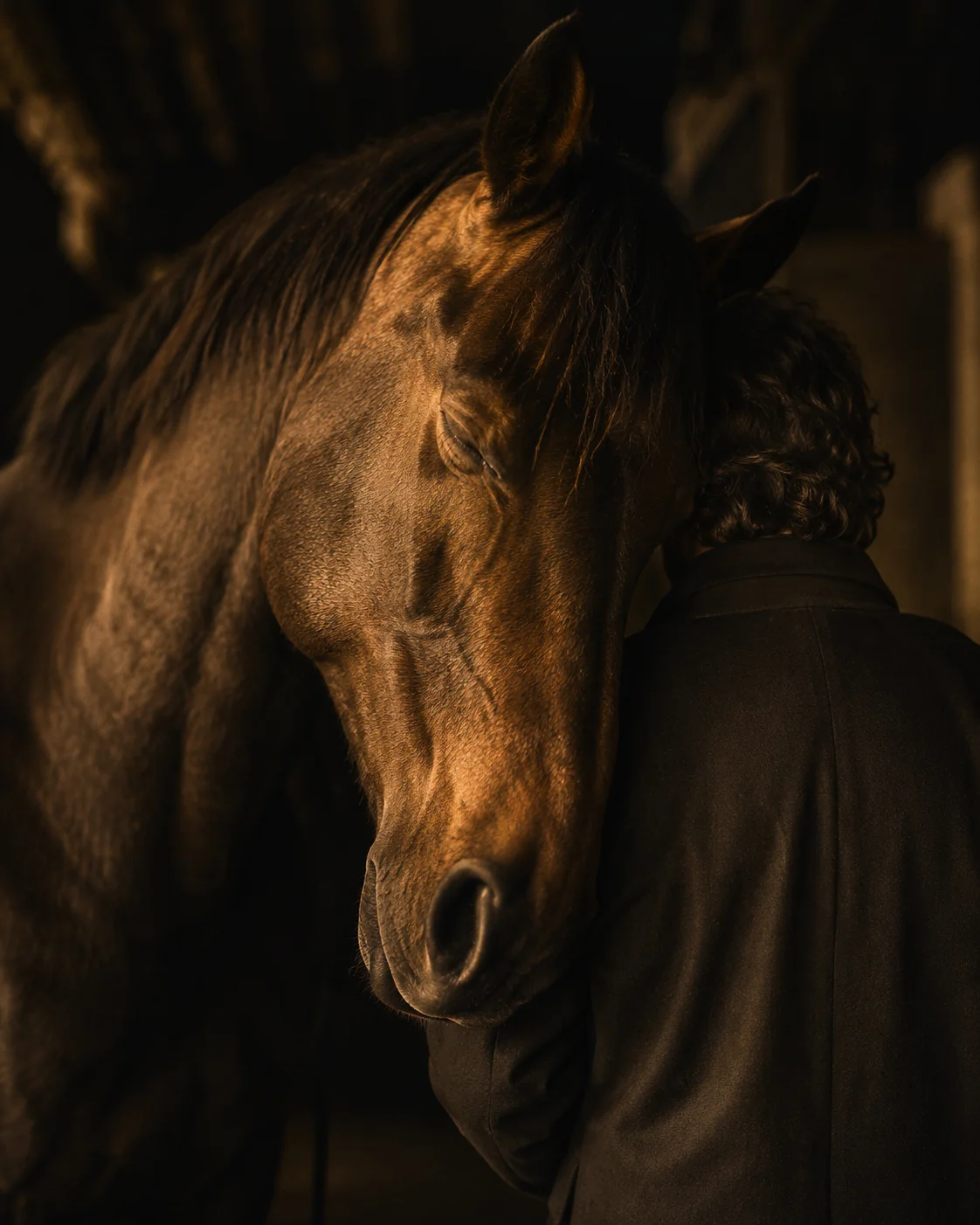
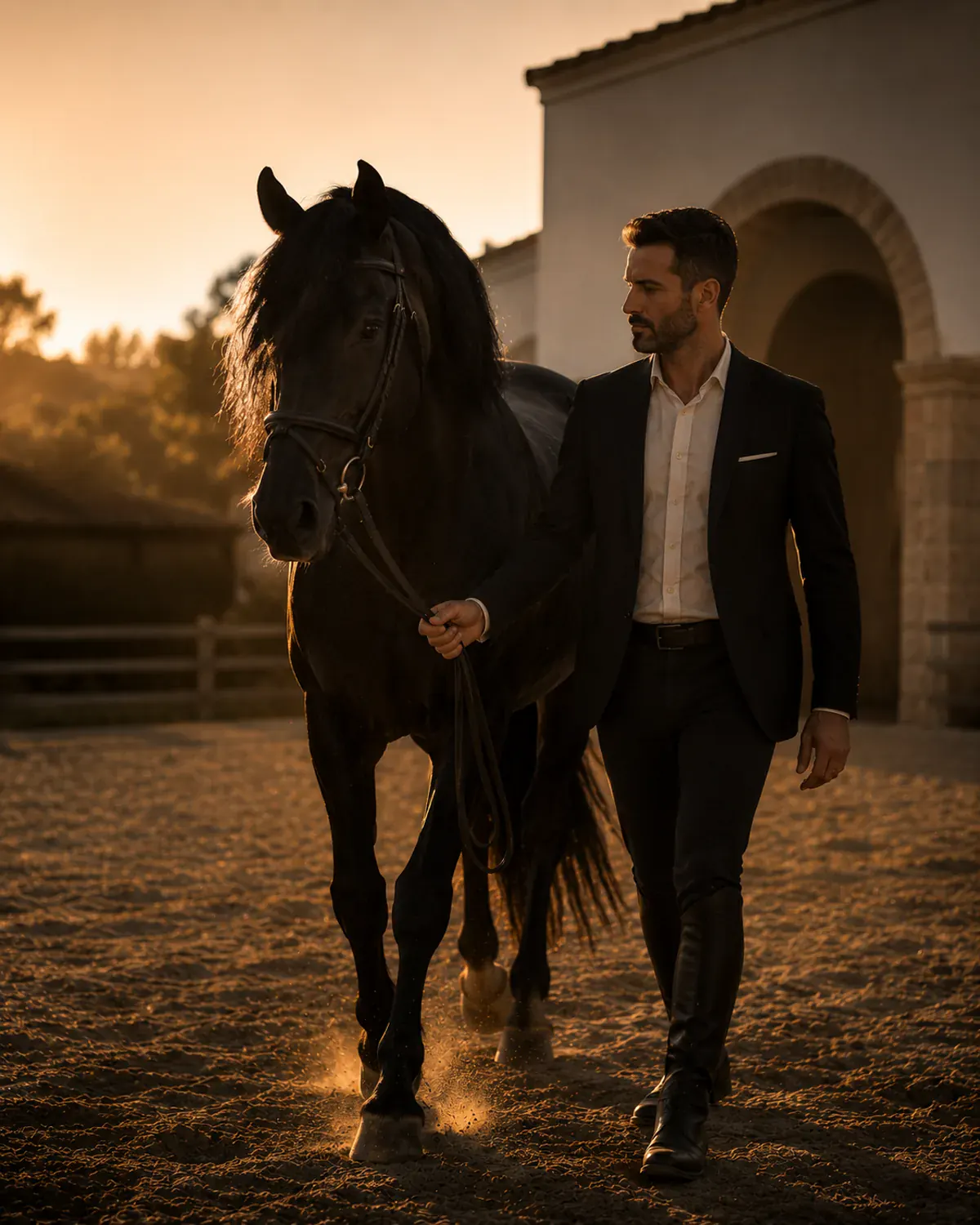
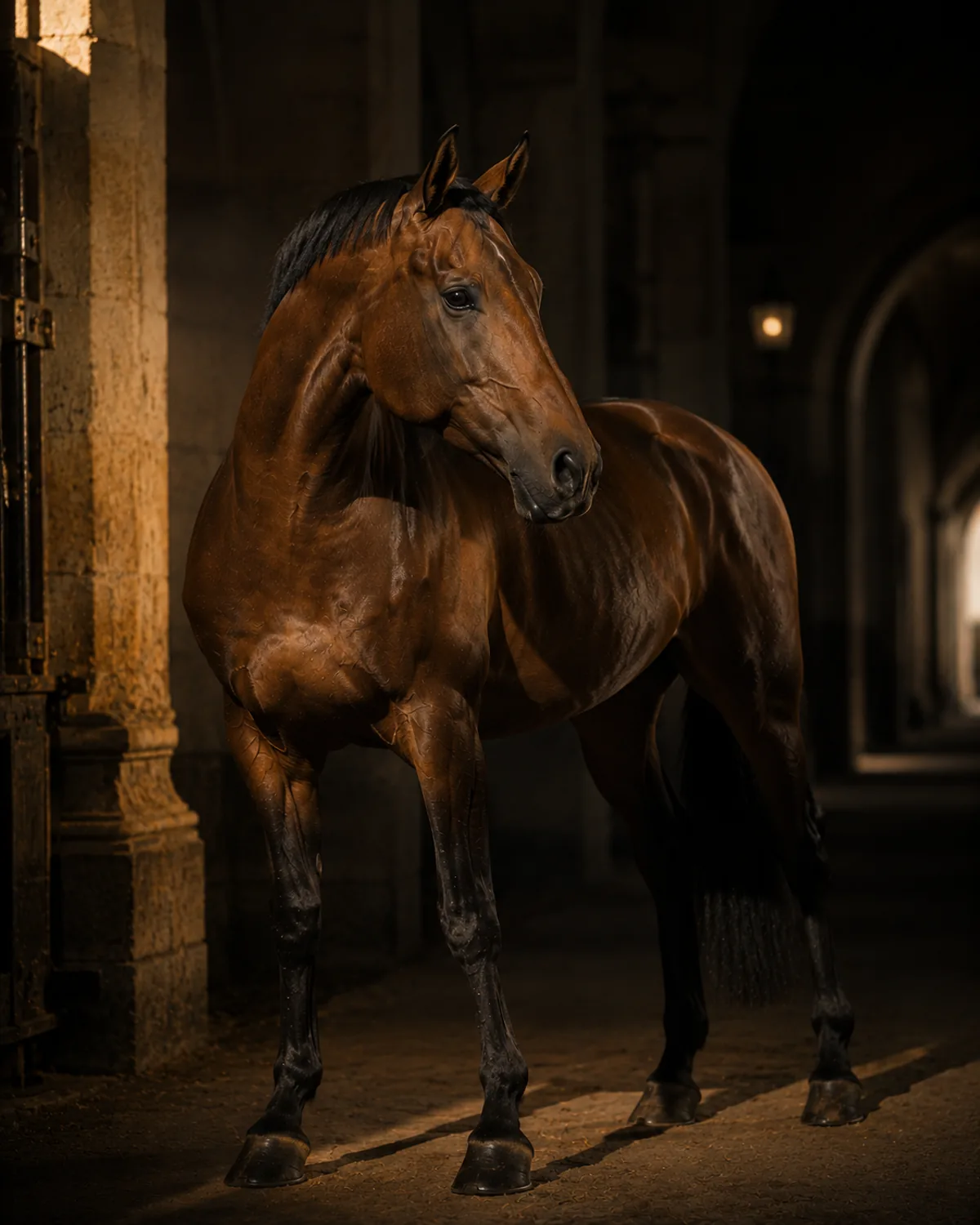
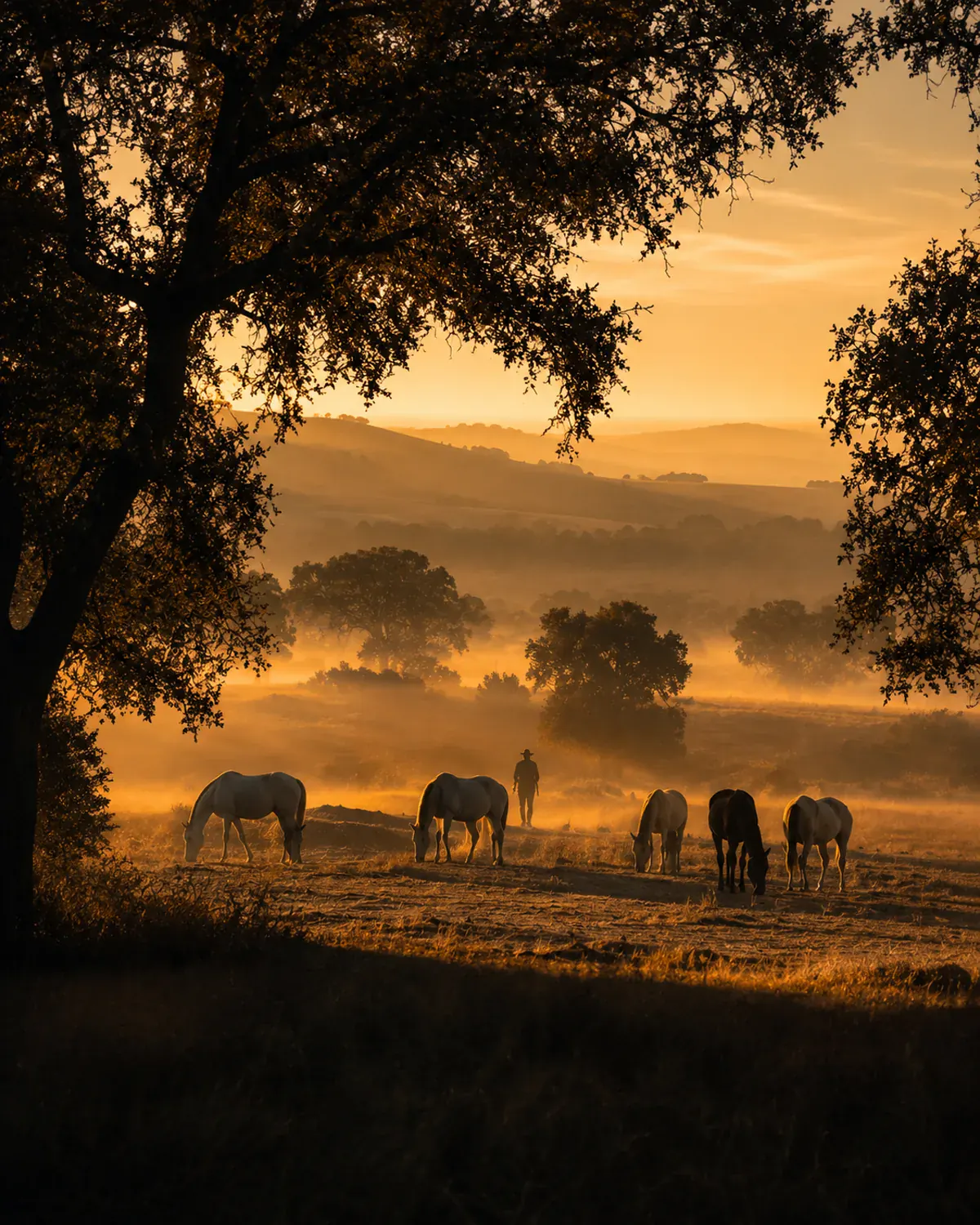
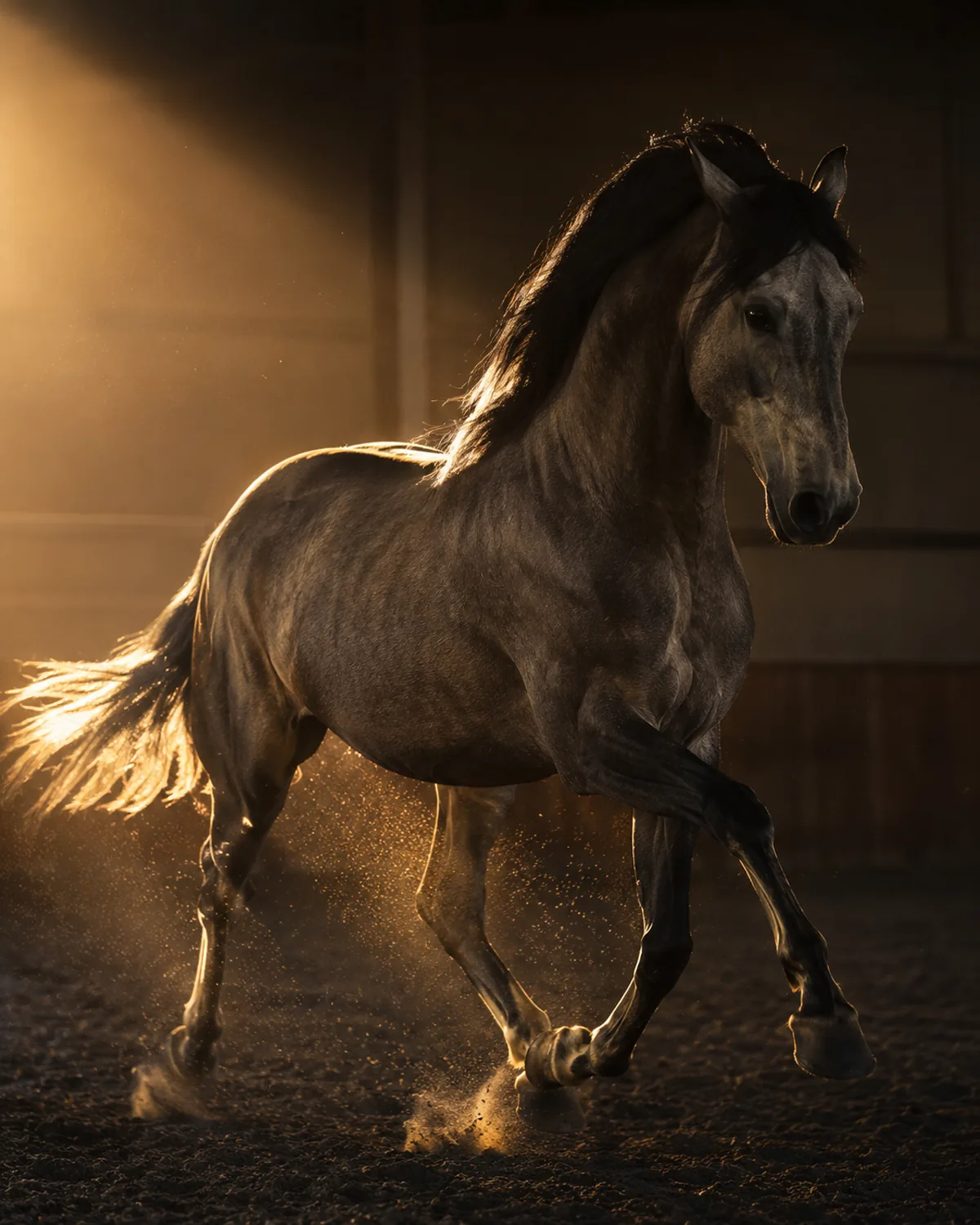
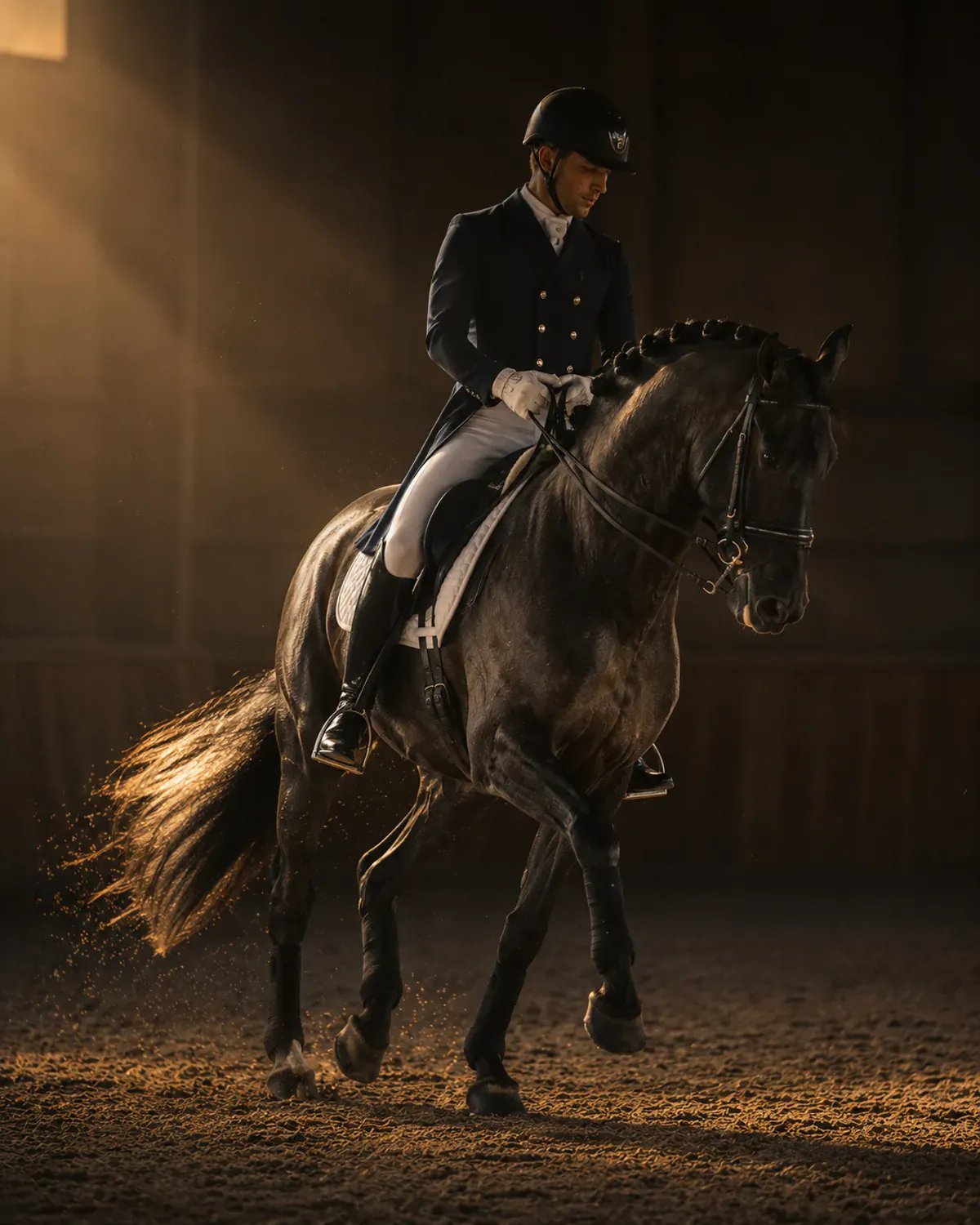
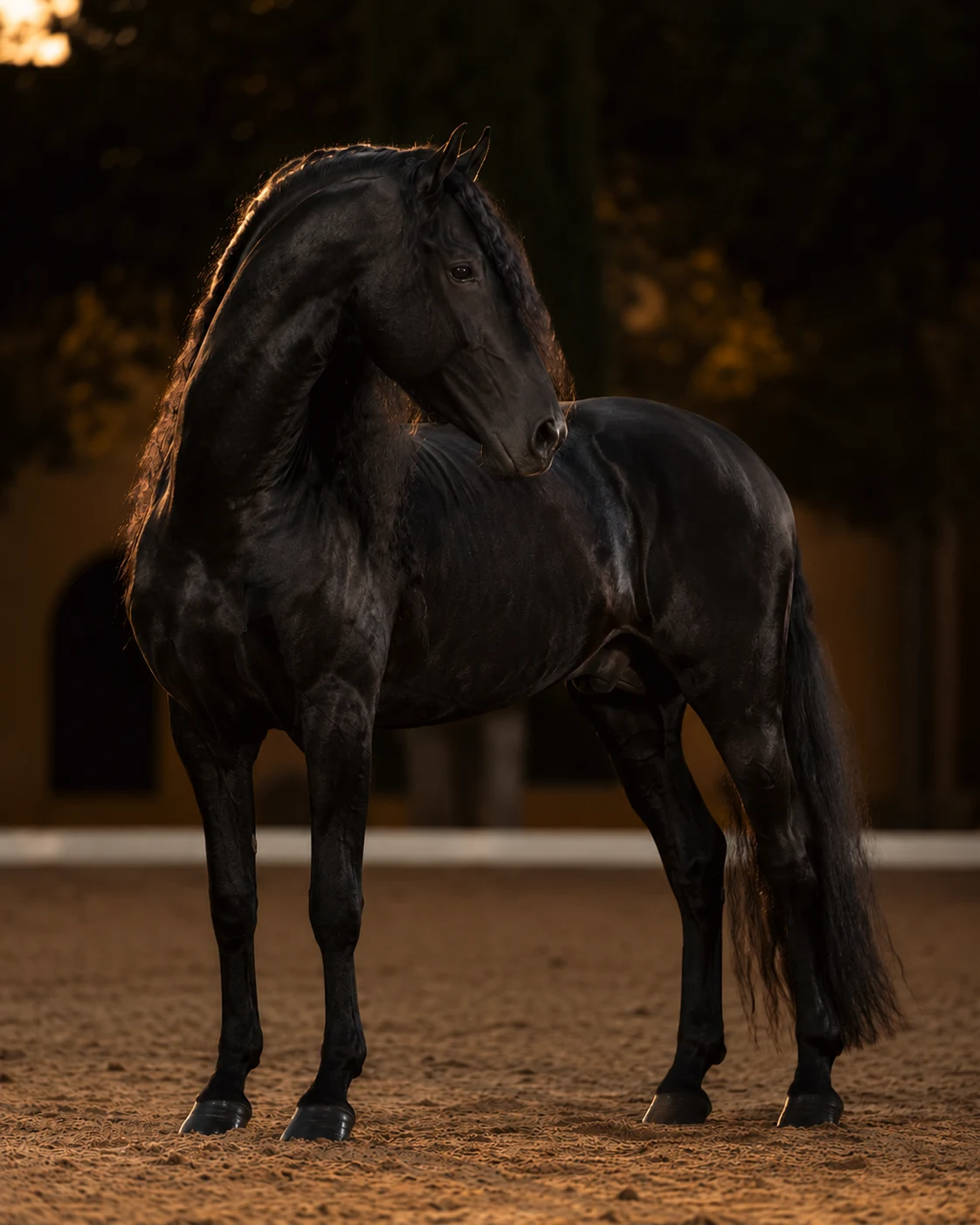
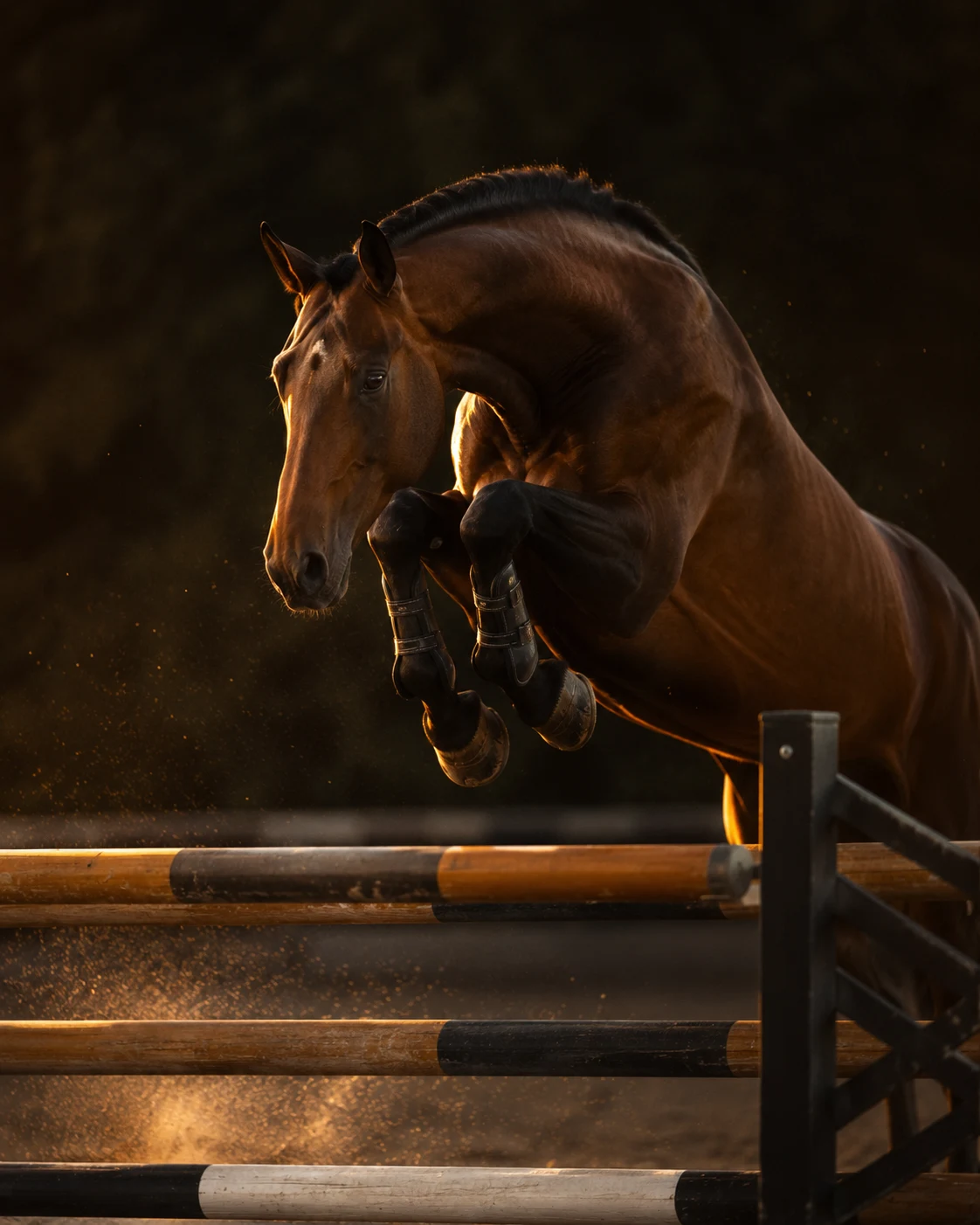
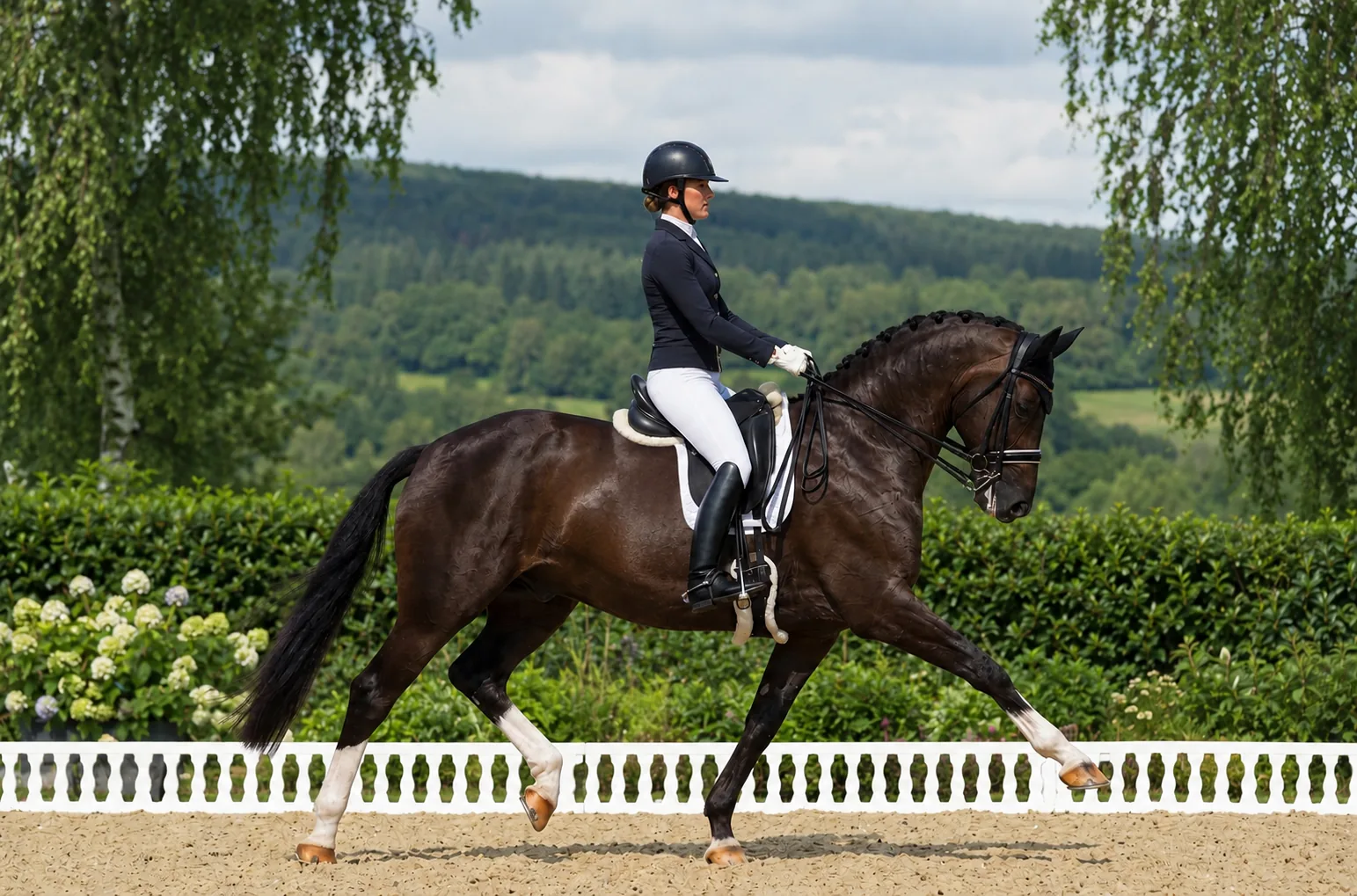
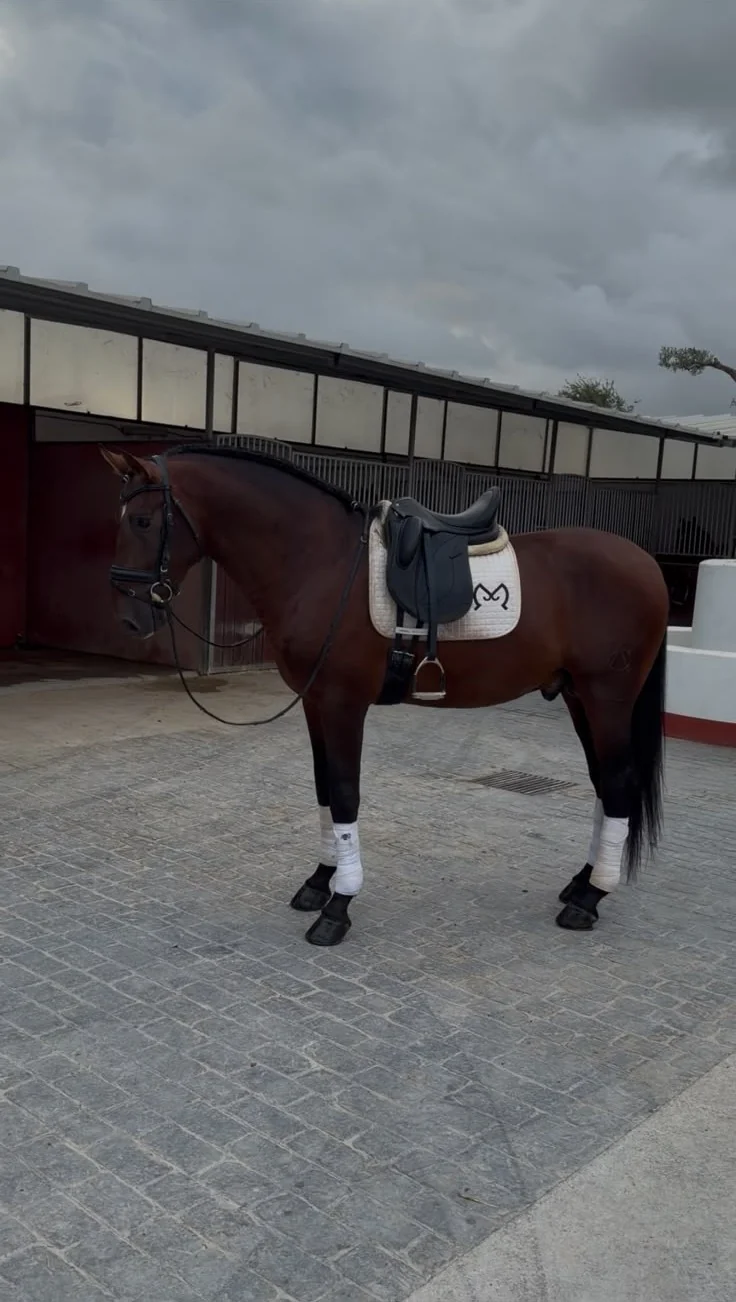
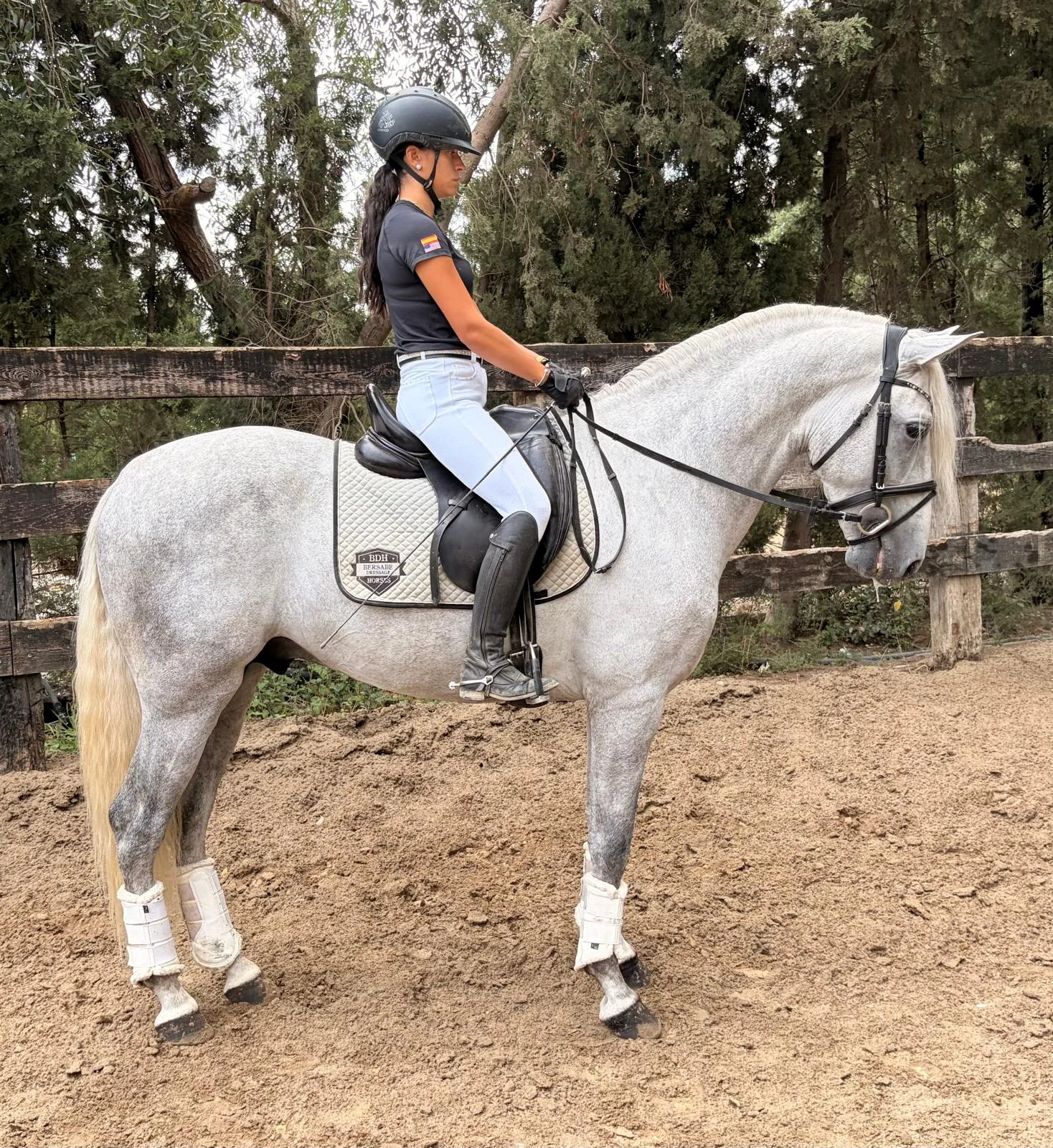
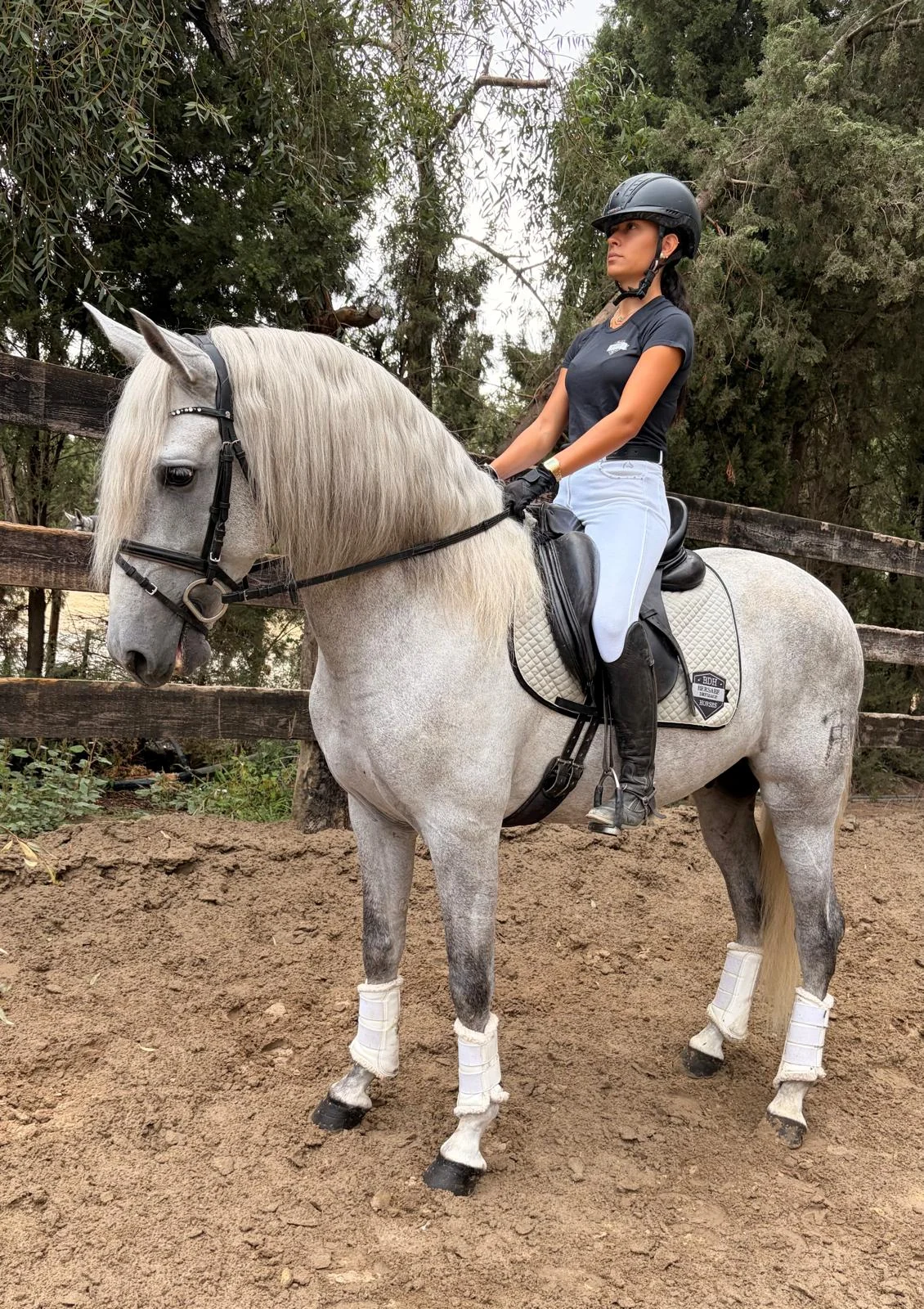
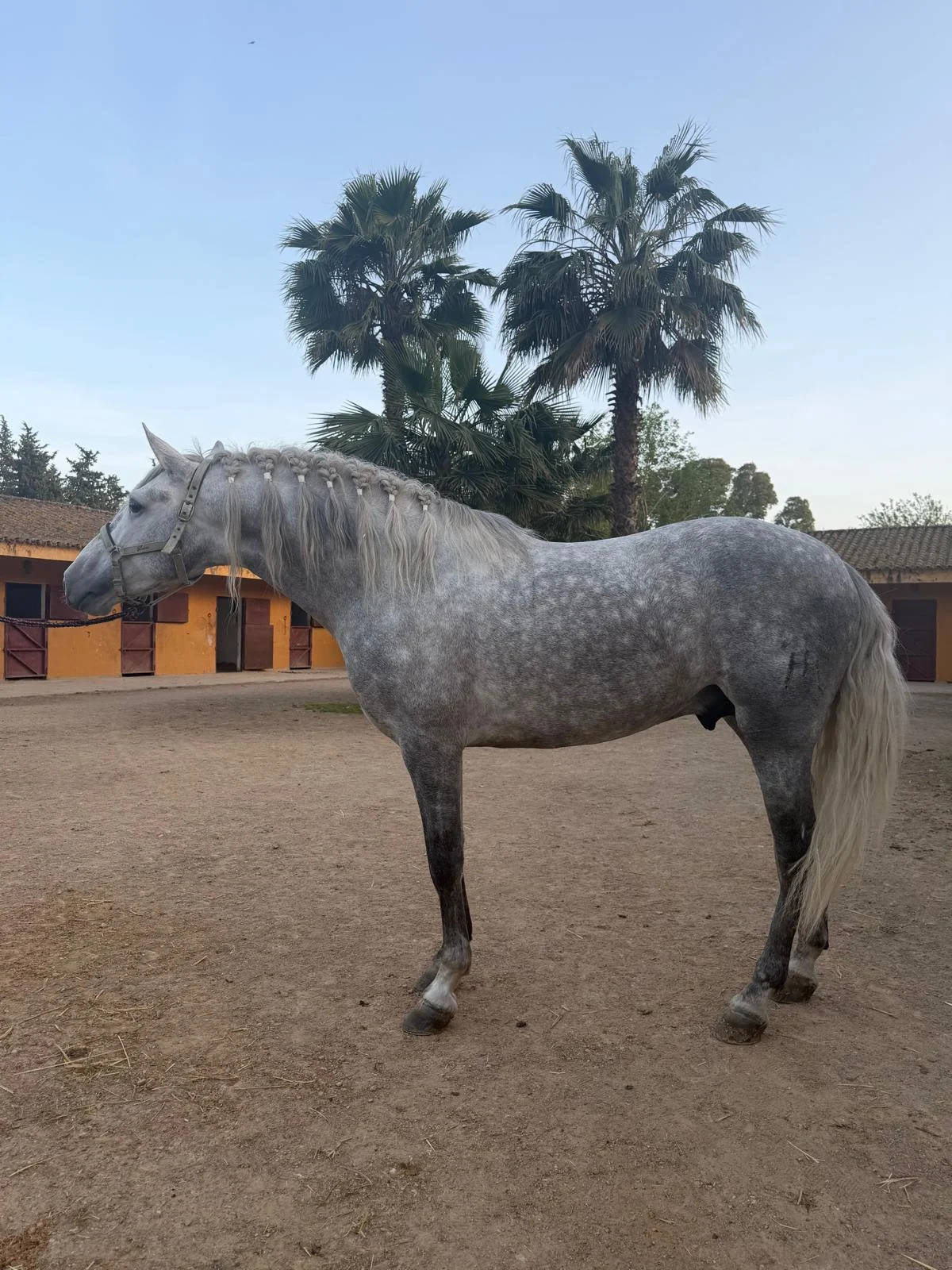
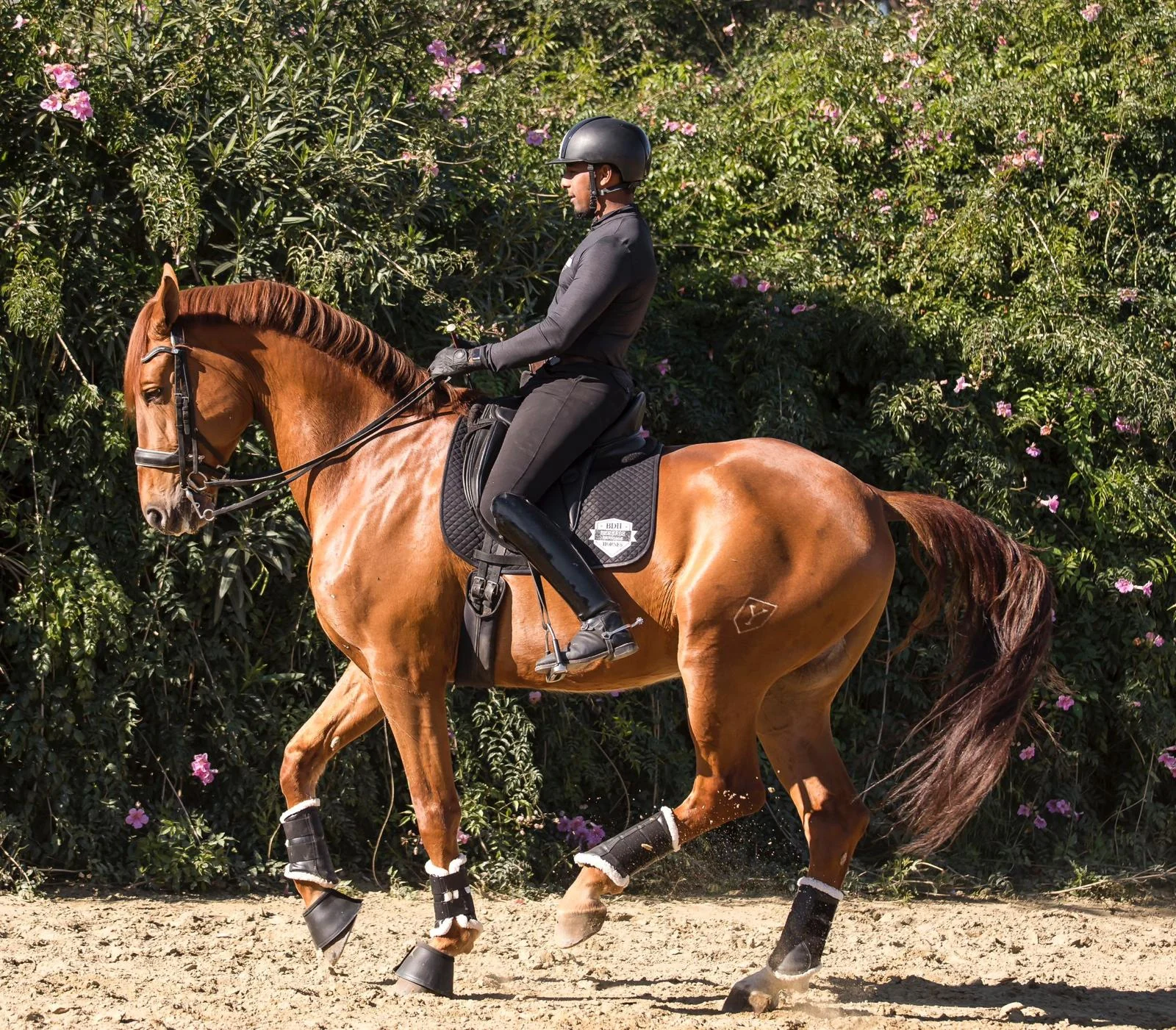
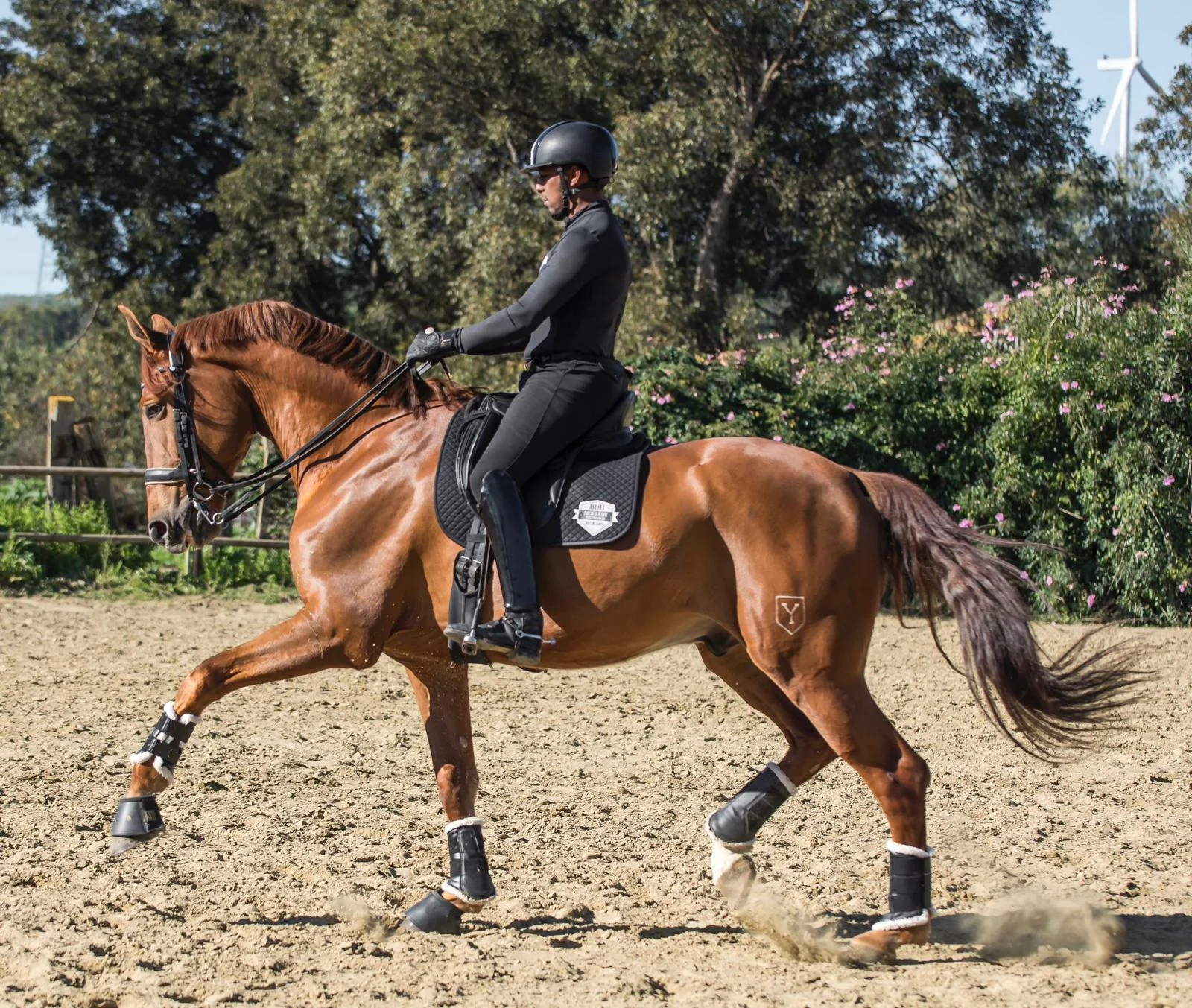
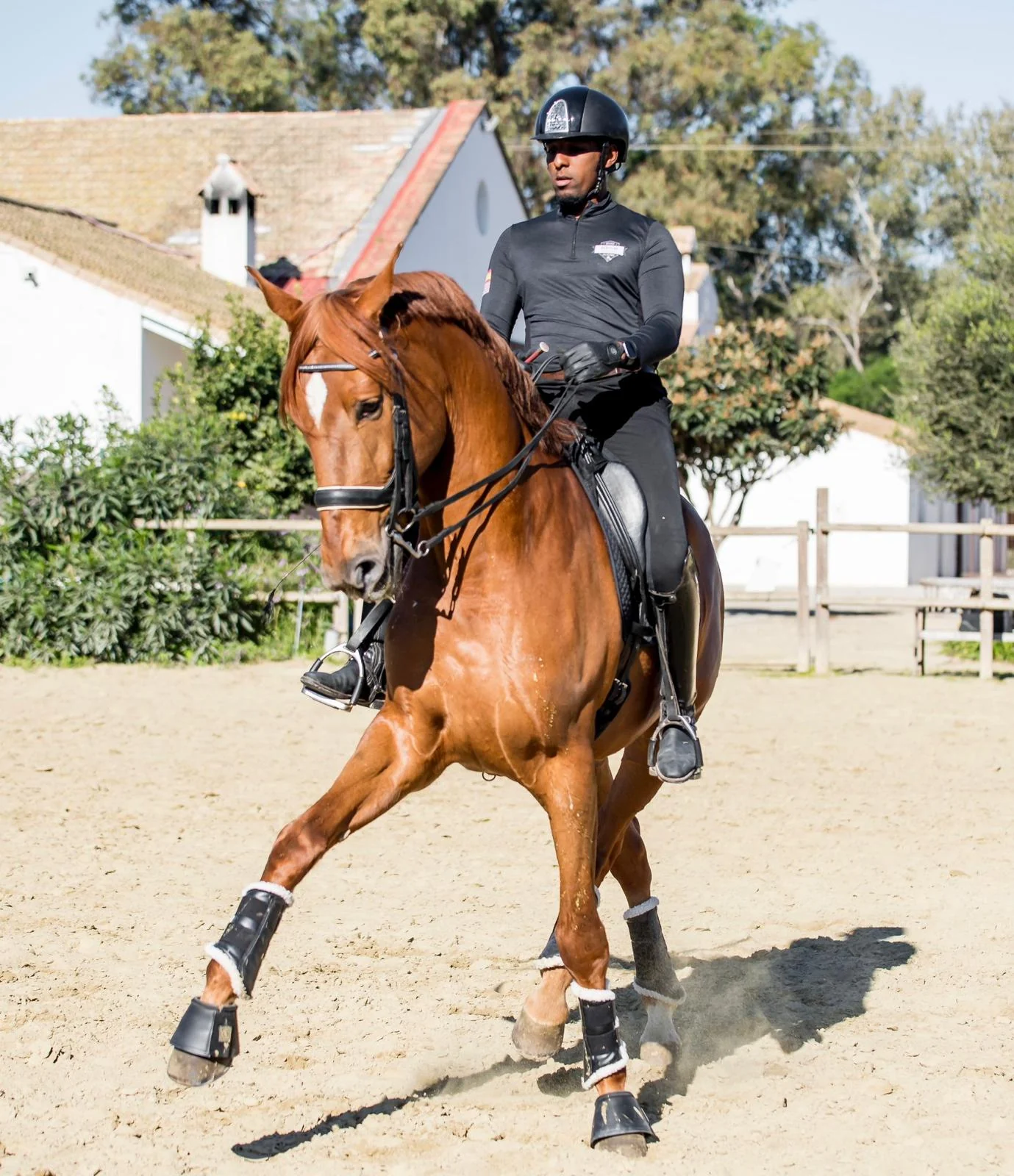
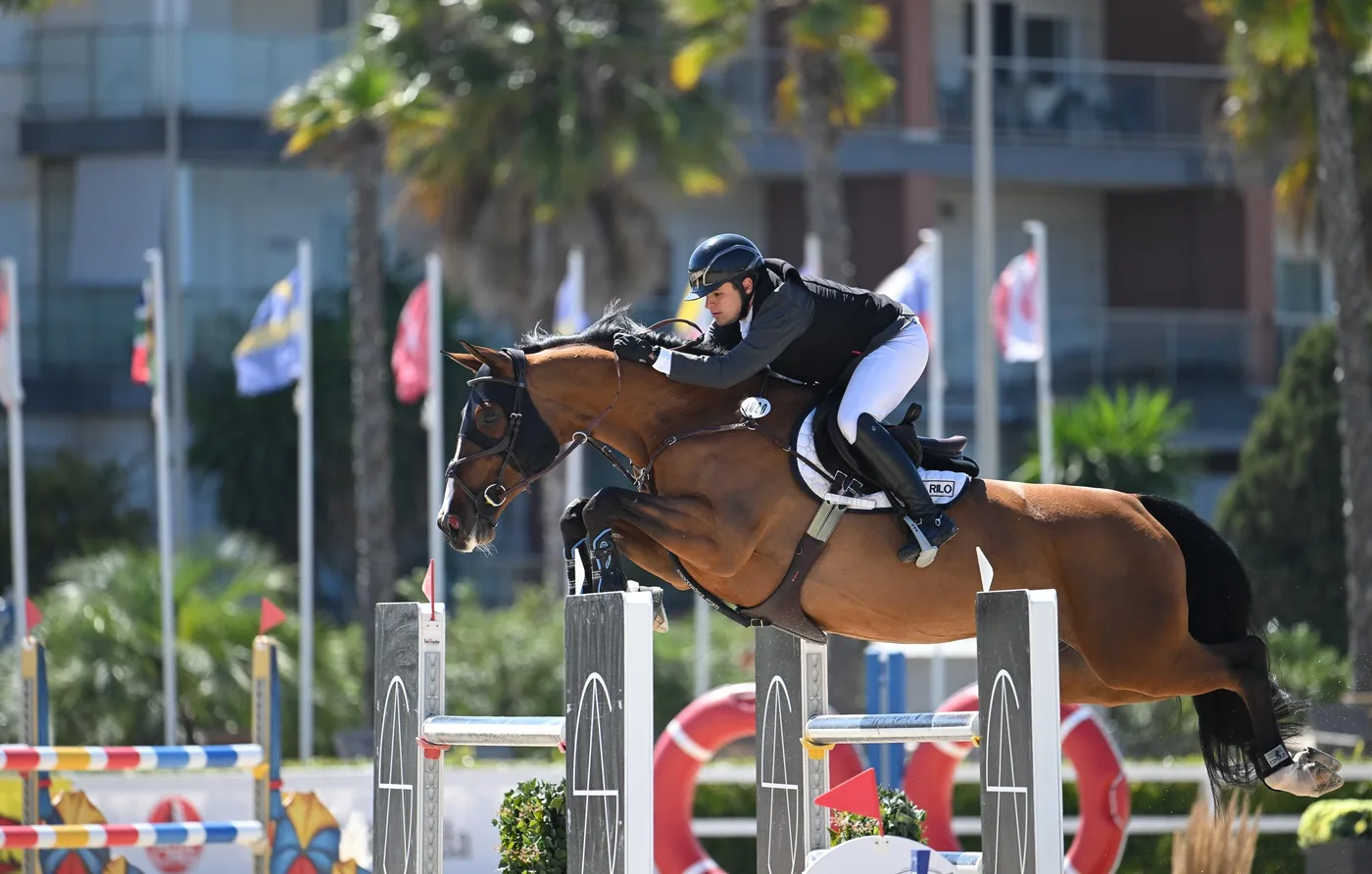
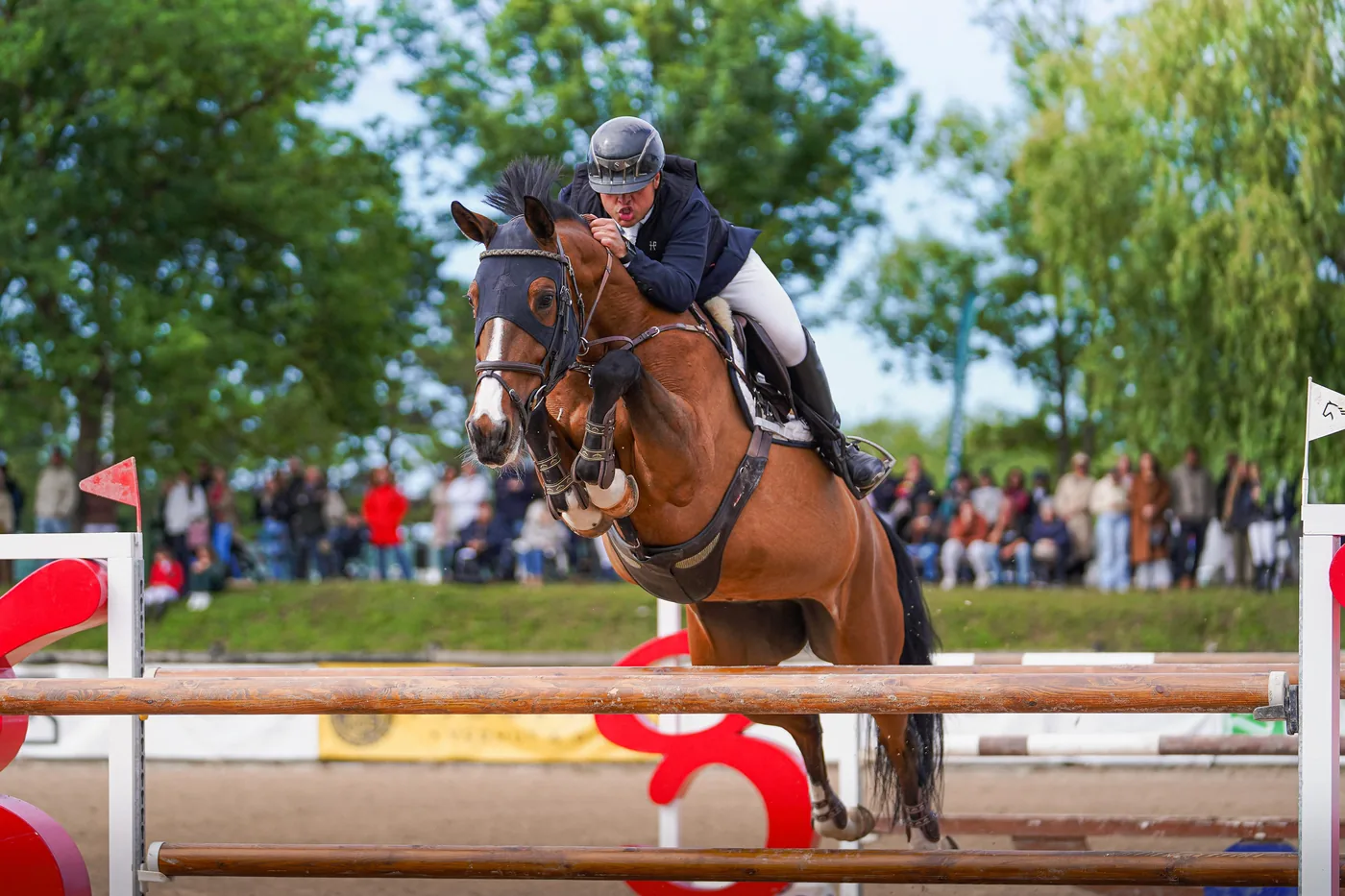
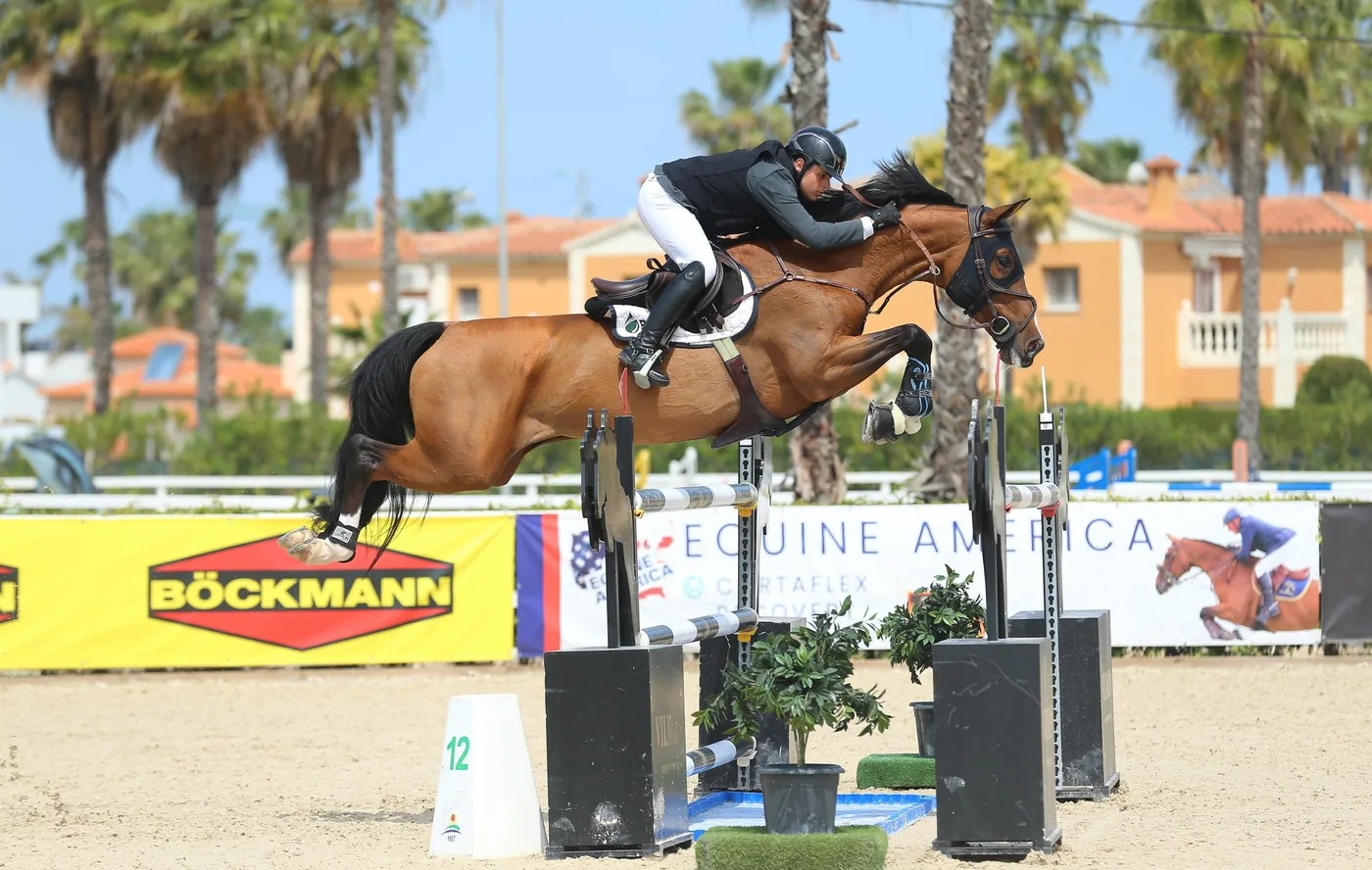
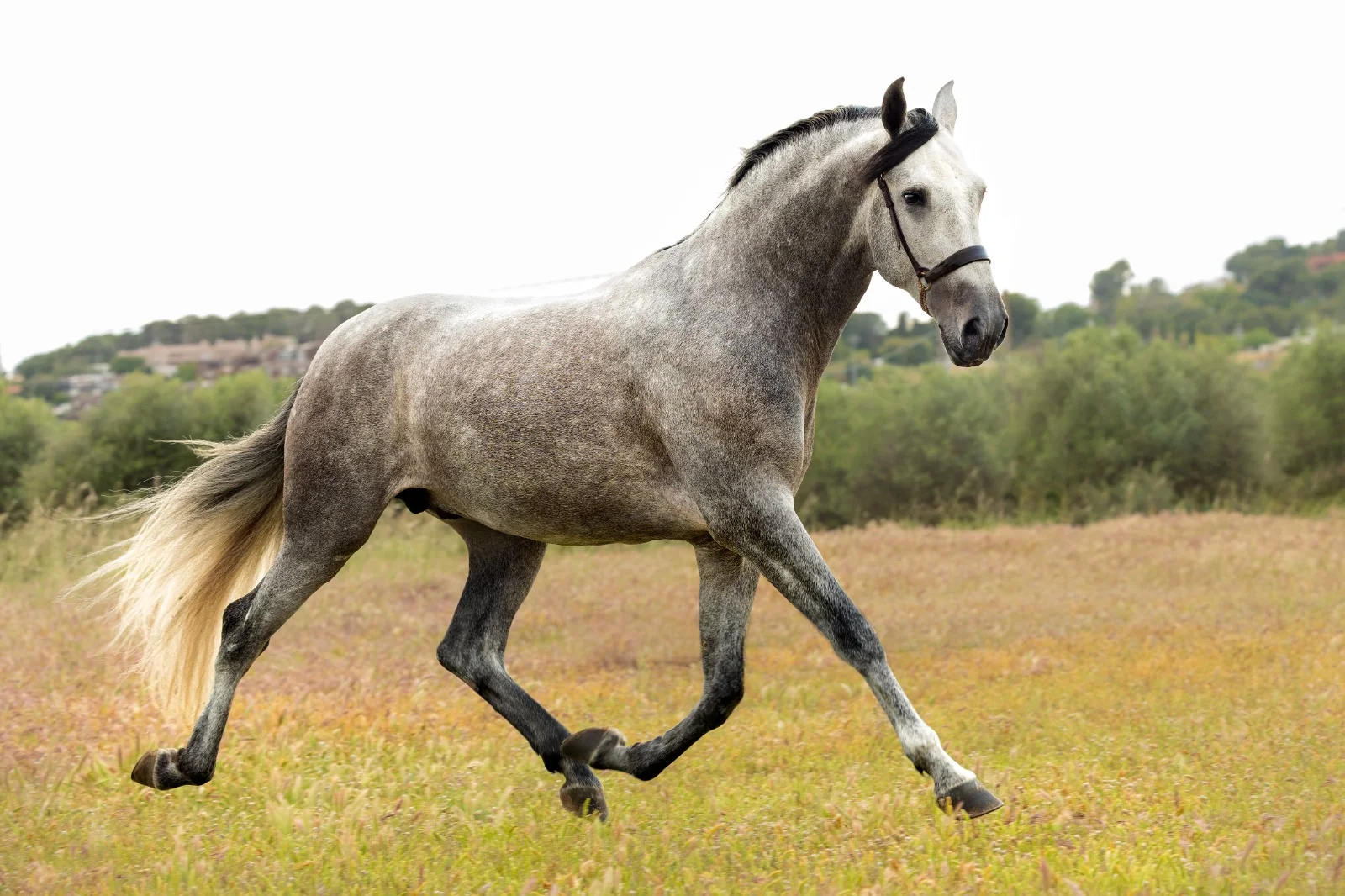
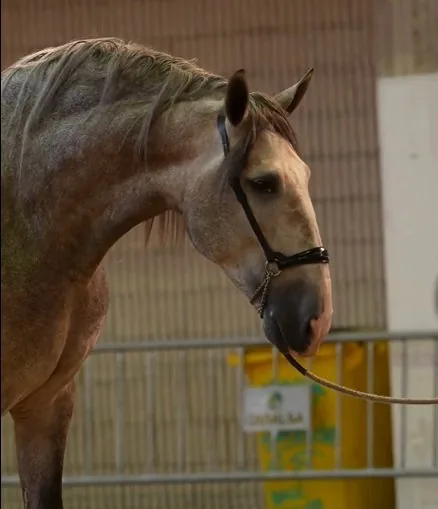
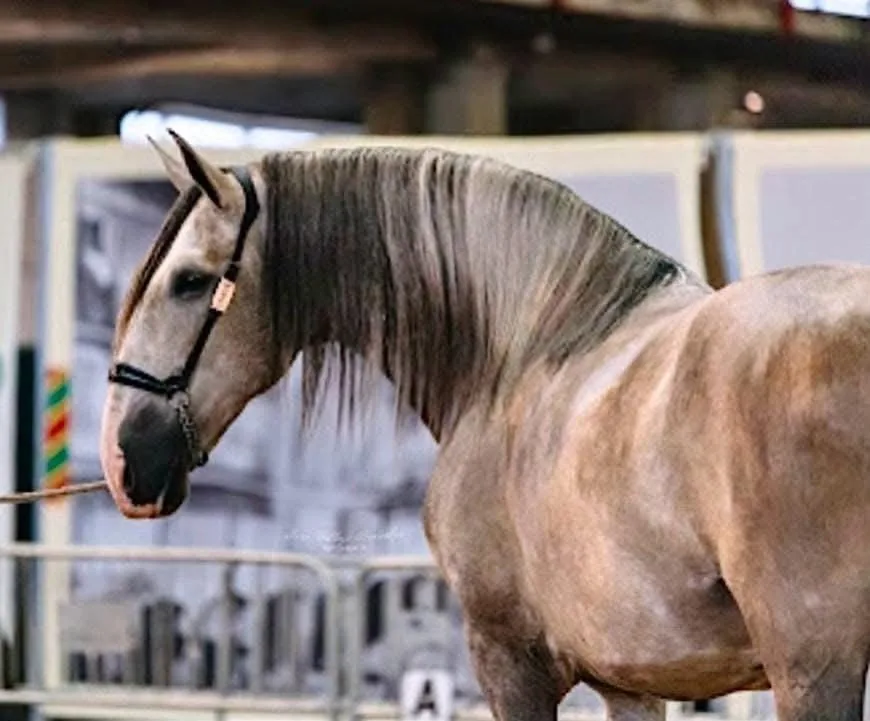
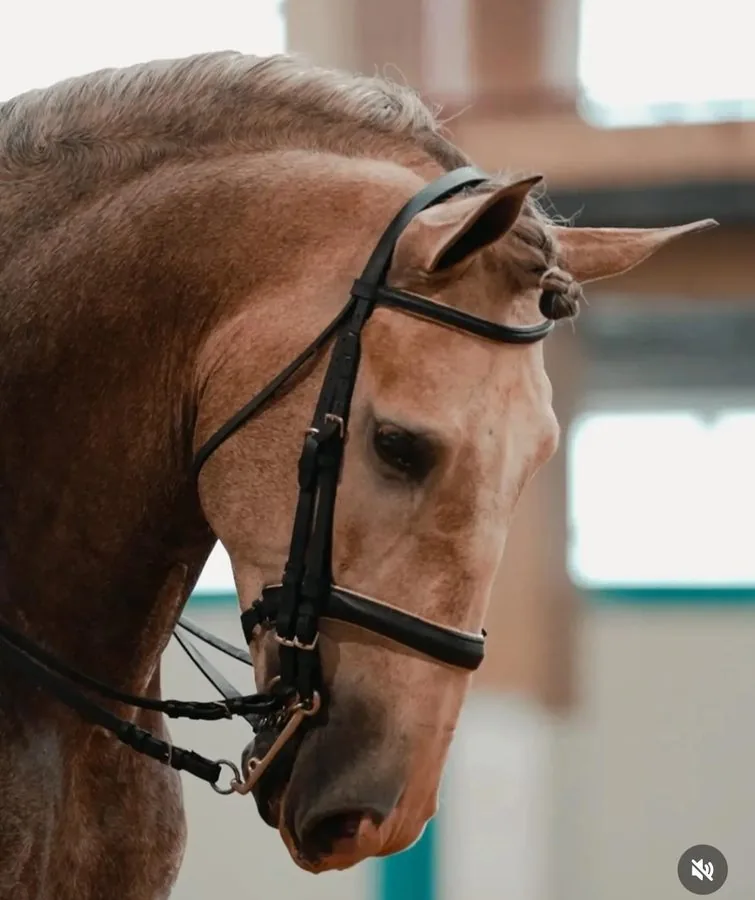
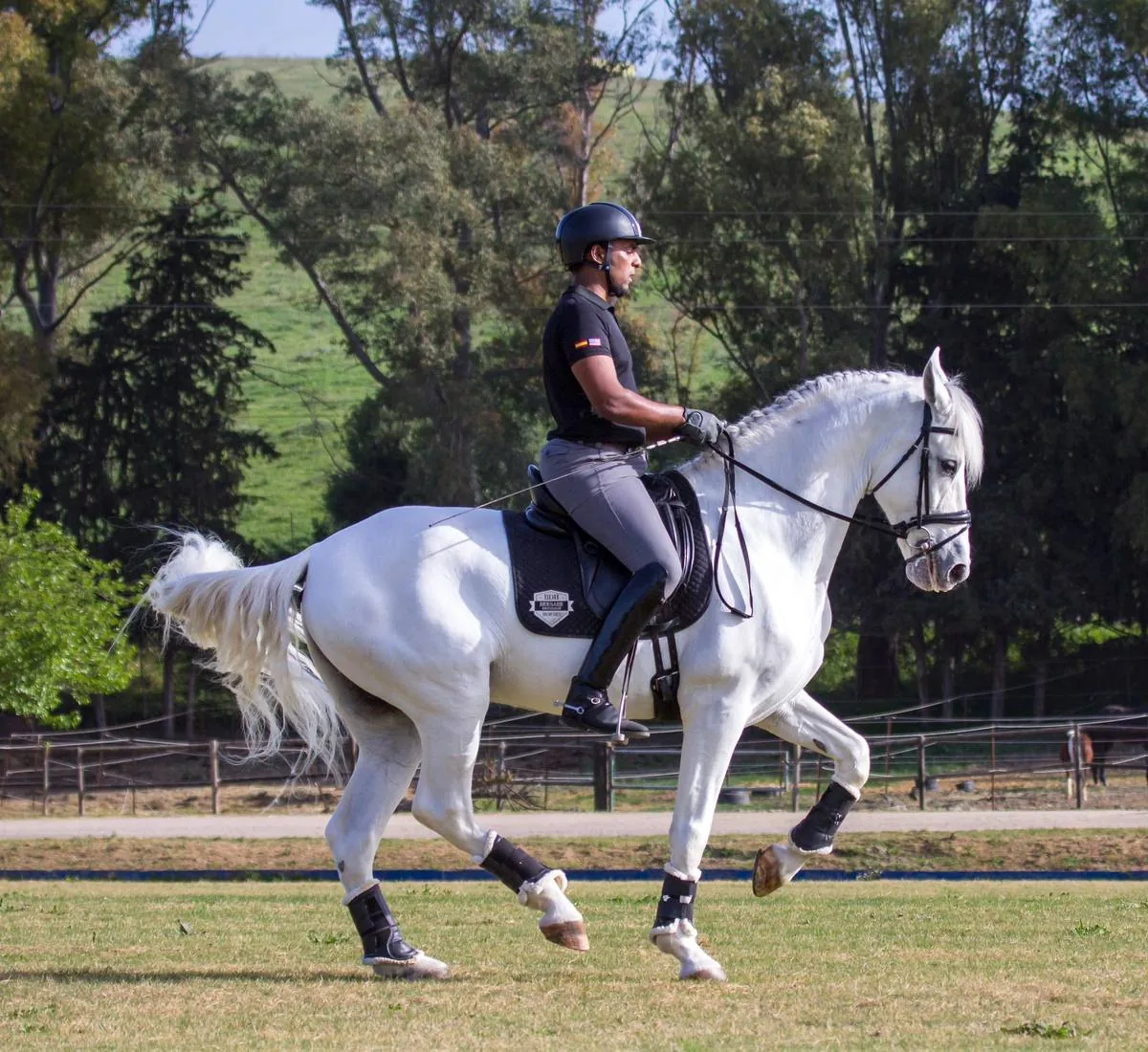
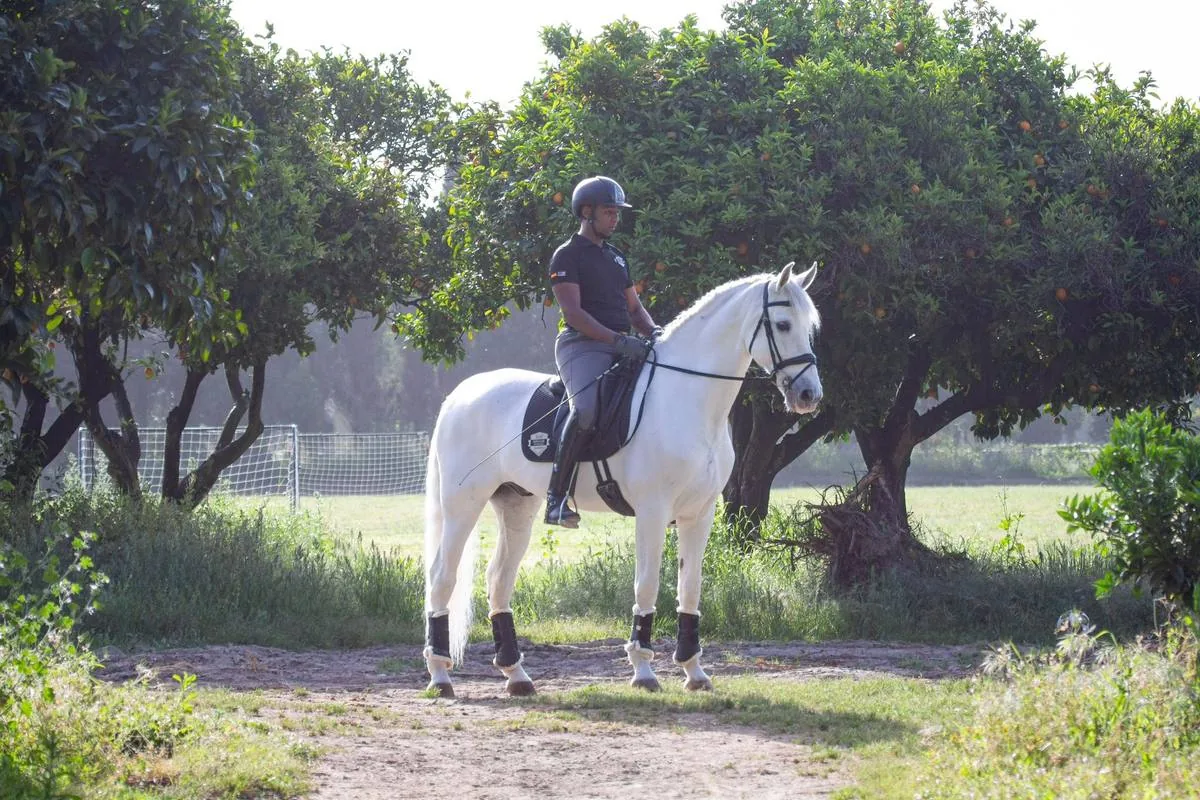
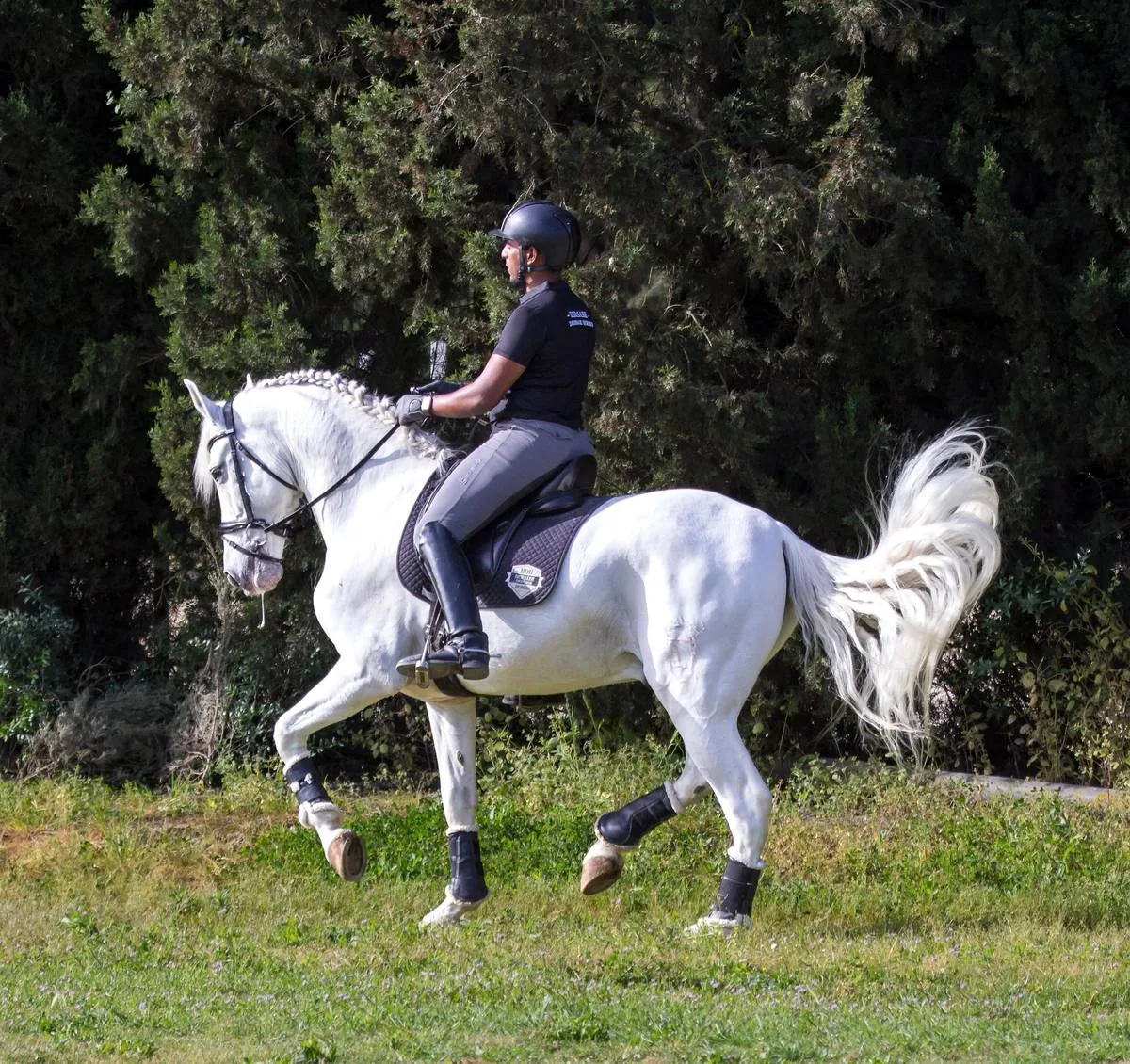
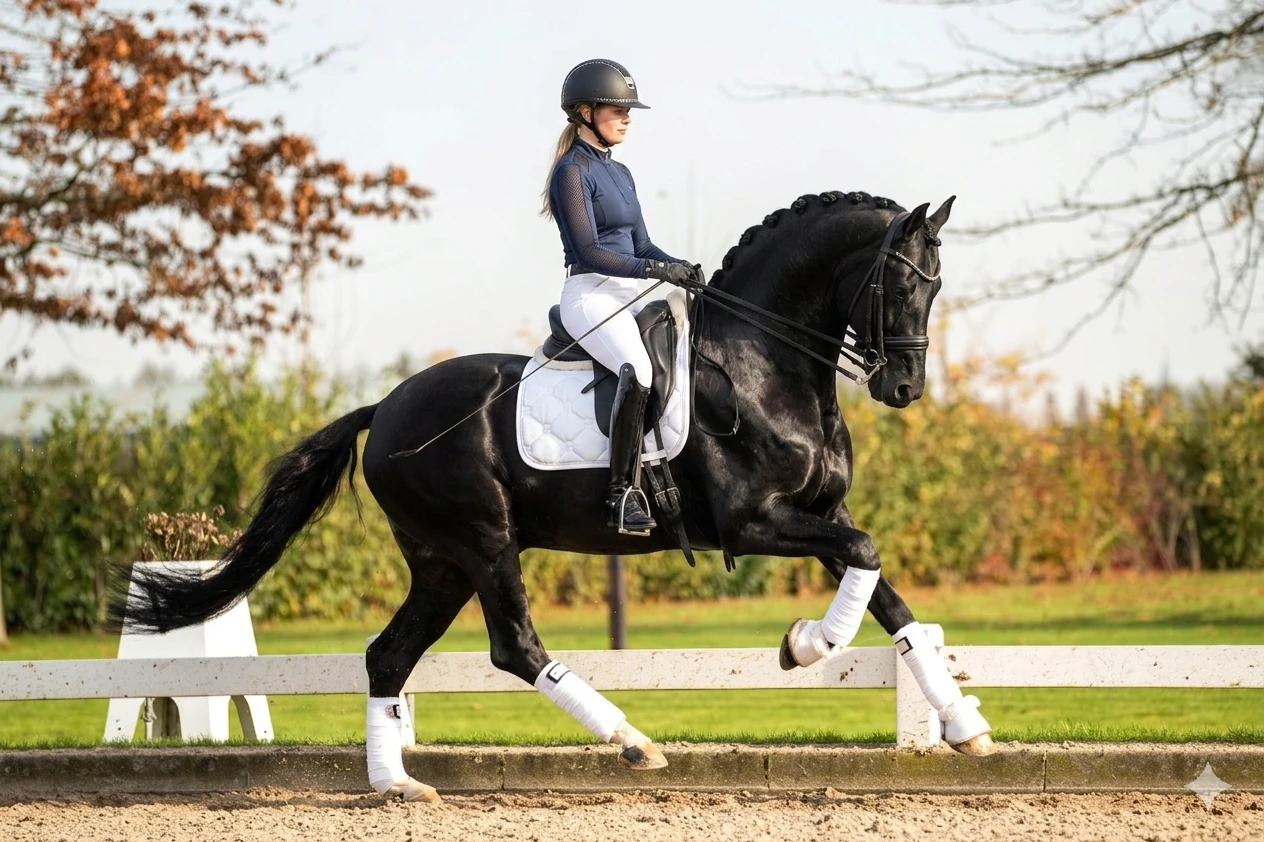
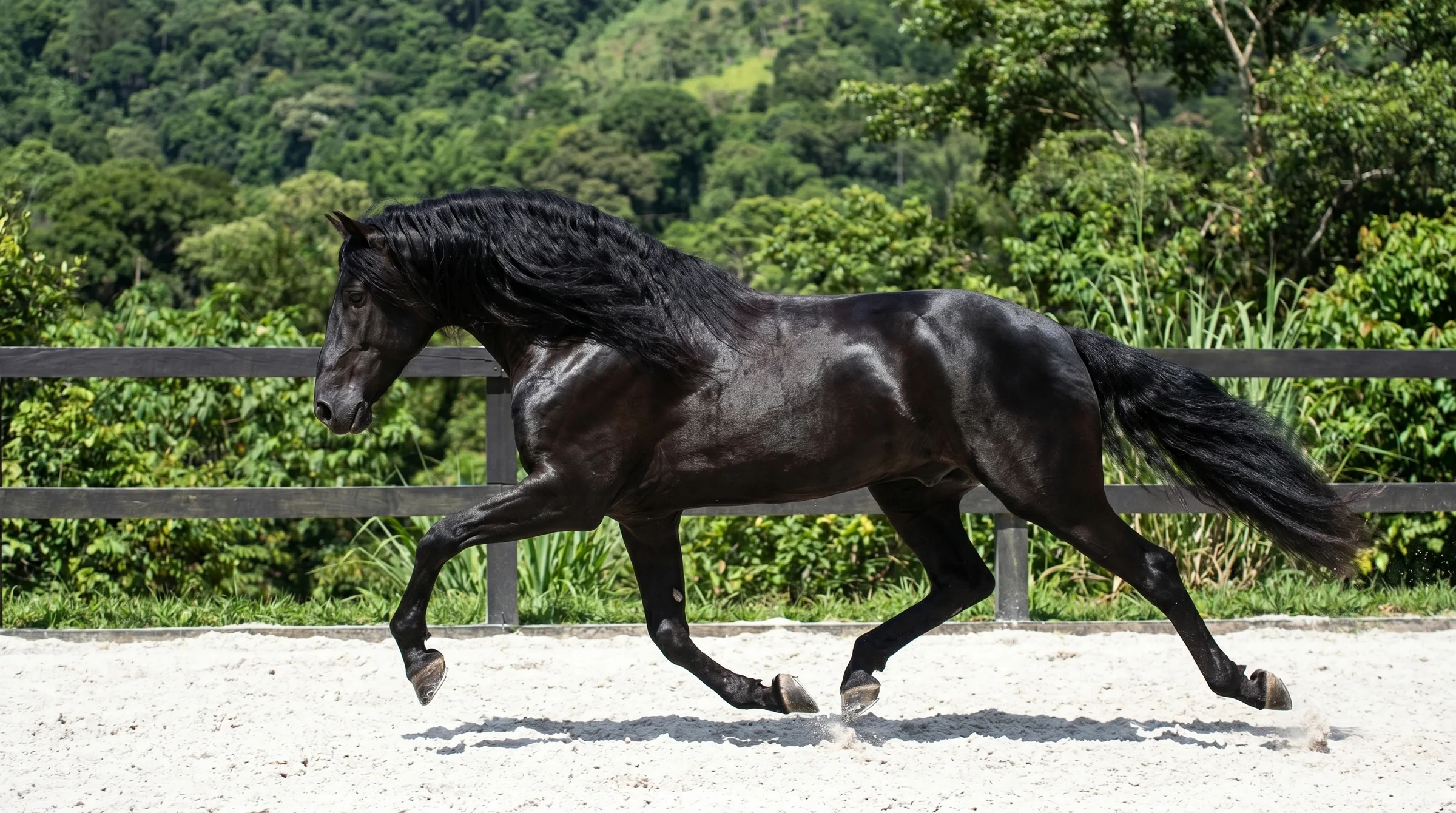
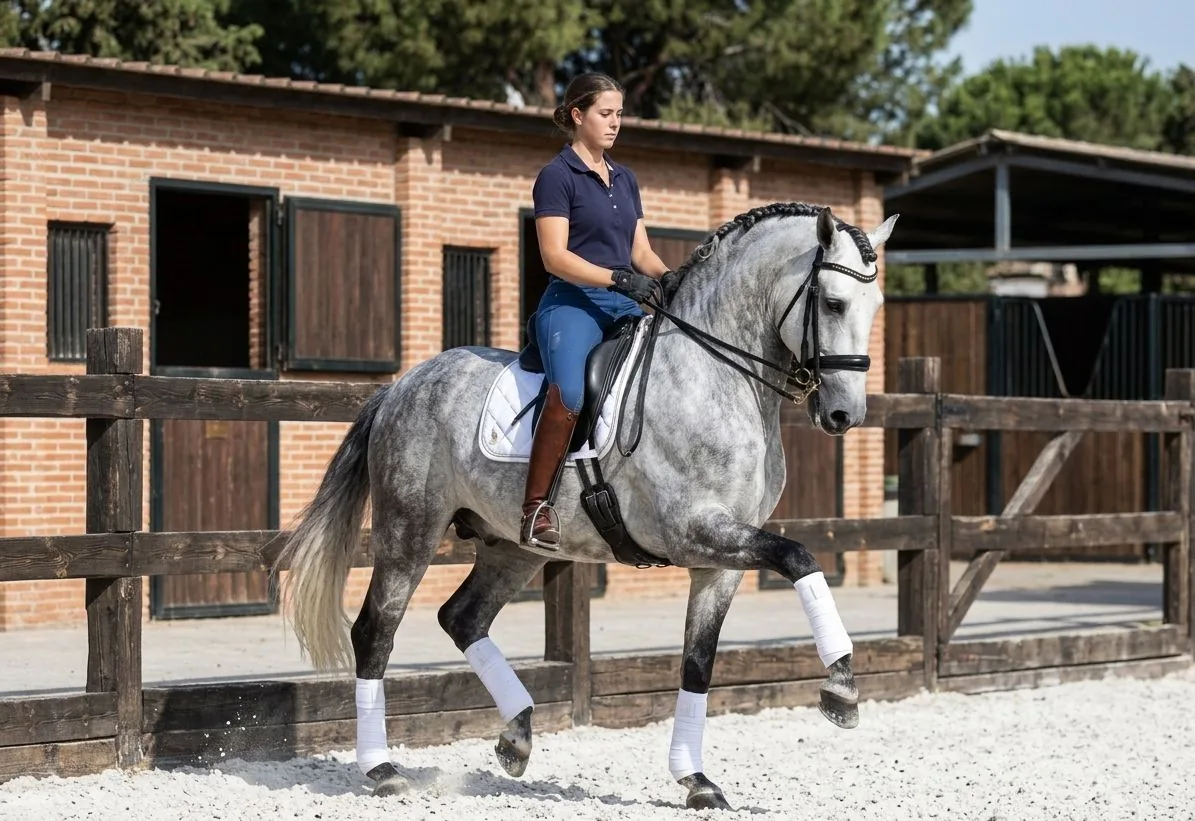
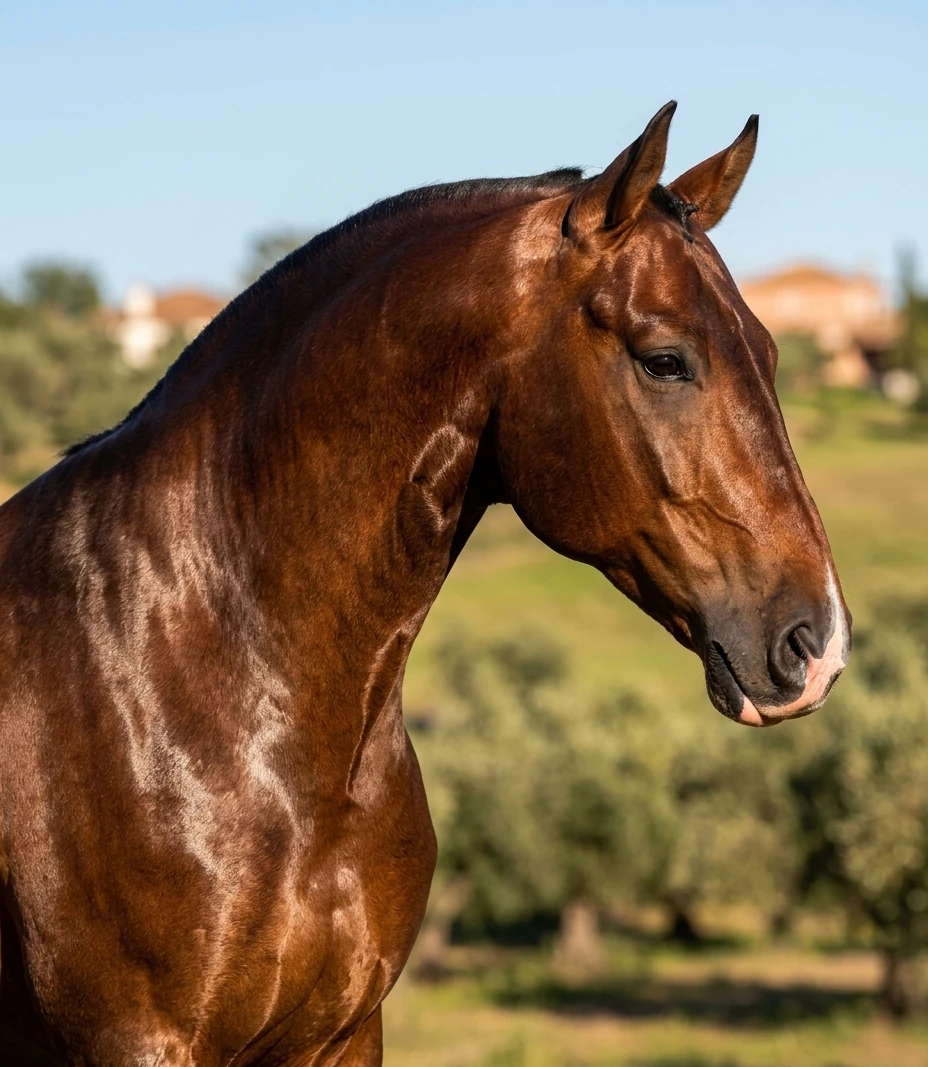
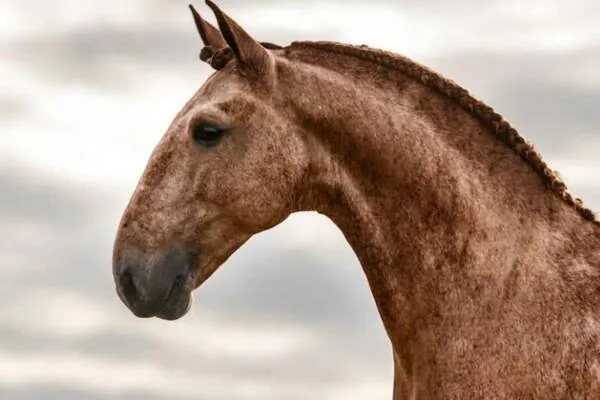
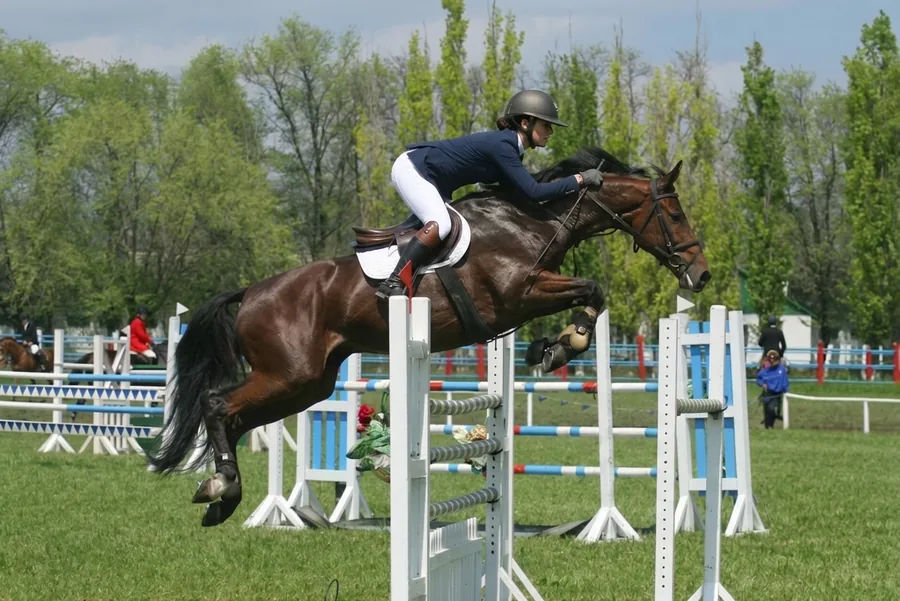
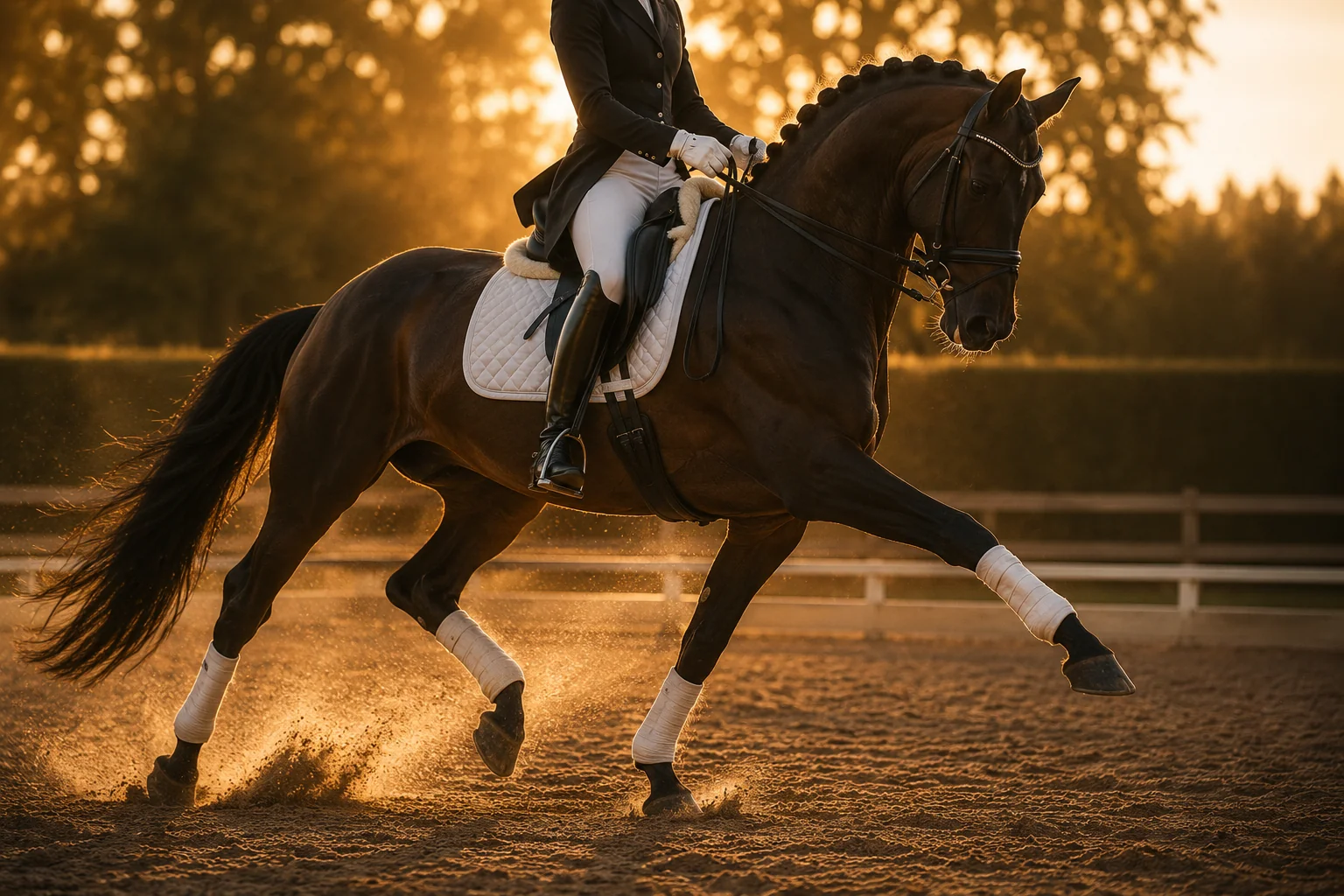
There is the right horse for what you need. Whether for personal breeding or specific bloodlines, as a professional rider with very precise requirements, for leisure, or to take your first steps in the sport: it exists, and we know how to find it.
We have built a network of relationships over more than twenty years in the European equestrian market — breeders, owners, riders, veterinarians — that allows us to reach horses that match your exact criteria.
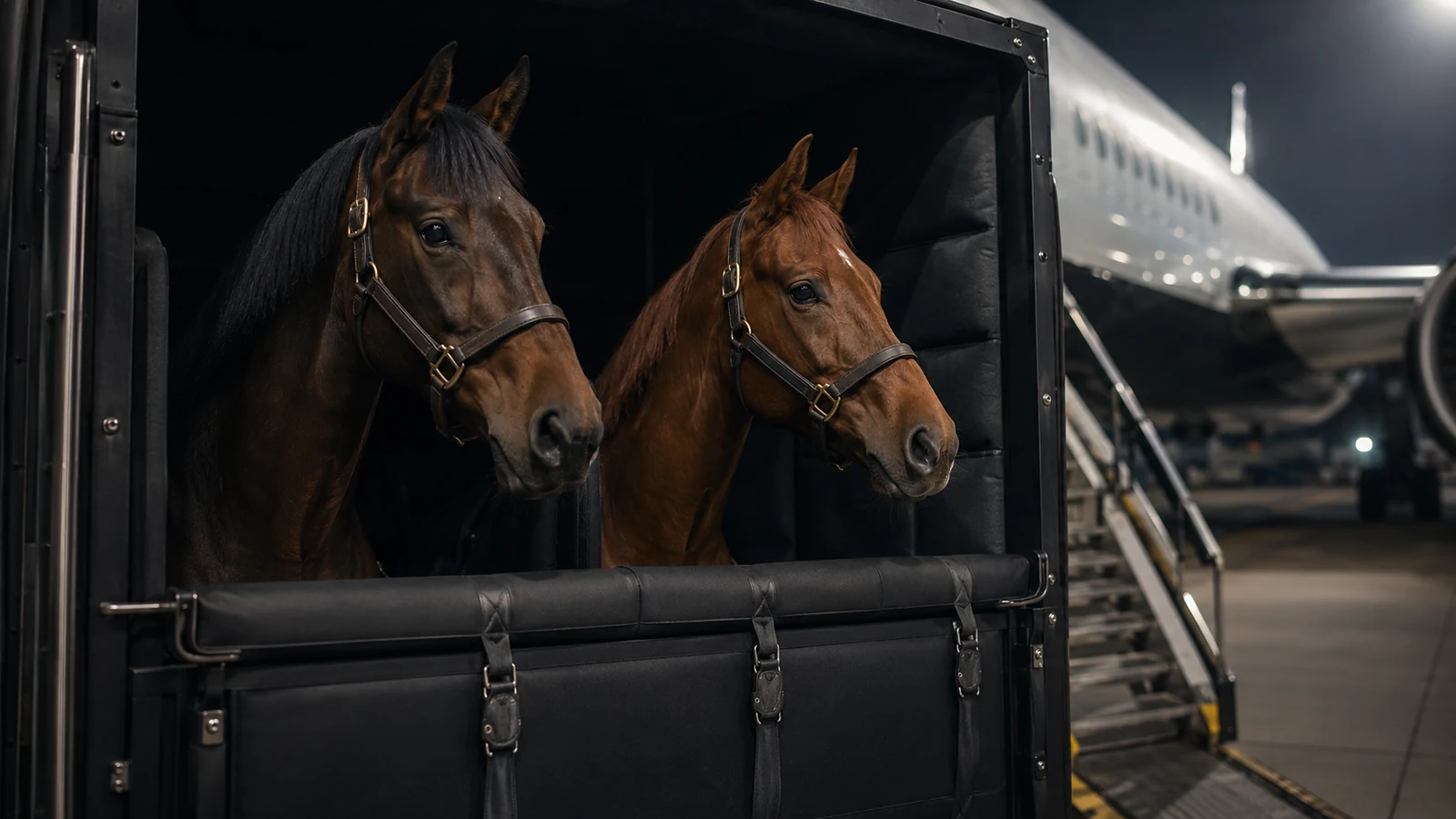
Tell us what you need. We connect your criteria with the right horse and handle everything that follows: technical evaluation, visit, pre-purchase vetting, negotiation, documentation and transport to your door. And if you can't travel to Spain, we go in person to see and assess the horses on your behalf — your eyes and judgement on the ground.
Your only job is to choose. Ours is to make sure the decisión you make is the right one — and that you enjoy the process.
Finding the right horse starts with understanding you: your level, your objectives, the real purpose you have in mind, the budget you want to protect and the risks you are not prepared to take.
What distinguishes Golden Horses is the starting point: before proposing a horse, we define with you what your project truly needs. This way, every option is filtered for its fit with you, not simply because it is available on the market.
The right search begins long before you see the first horse.
We accompany you throughout the process with a method built on more than twenty years of Golden Horses' track record and twenty-five years of equestrian experience from its leadership: work as a rider and trainer, qualification as a Sports Technician in Equestrianism, and advanced training at the Royal Andalusian School of Equestrian Art in Jerez.
From that experience, we analyse each horse and help you move forward with judgement. The search, evaluation, visit, veterinary examination, negotiation, documentation and transport are all part of one journey, coordinated alongside trusted collaborators in Spain, Portugal and Europe.
01
Your project guides the search
Everything starts by understanding what you need: your level, objectives, intended use and the budget you want to protect. From there, we build a tailored search and assess every option for its genuine fit with you.
02
Real technical judgment
Every evaluation rests on experience as a rider and trainer, qualification as a Sports Technician in Equitation, and technification training at the Royal School of Jerez.
03
Selection over volume
Our goal is not to show many horses, but to rule out with judgment until we find candidates that truly fit the client's profile.
04
Trusted collaborators
When the process requires it, we rely on proven veterinarians, transporters, breeders, owners and professional riders across Spain, Portugal and Europe.
05
Turnkey service
We accompany the whole operation from the first enquiry to the horse's arrival: search, evaluation, visit, vet check, negotiation, documentation and coordinated transport.
06
European reach, direct dealings
Our working network extends across Spain, Portugal and Europe, but every decision is always made with personalised judgment, case by case.
Our services
A service for every buyer profile.
Three levels of guidance to buy with judgement: a first strategic orientation, a complete turnkey advisory service or a high-value premium operation.
01/ 03
01
Entry service
Strategic Consultation
350 €
No commission · Refundable if Full Advisory is contracted within 30 days
For the buyer who needs expert guidance before committing. 60–90 minute video call.
Profile analysis, goals and real budget
Definition of the right horse type
Basic evaluation of up to 2 candidates
Risk map and red flags
Written report with conclusions (ES / EN)
7 days WhatsApp support after session
02
★ Signature service
Full Advisory
2.000 €
+ 10% of horse price at closing · Turnkey management
The complete search, evaluation and acquisition process until the horse arrives at your premises.
Active search across Iberian Peninsula and Europe
Technical evaluation before any presentation
In-person assessment of the horses on your behalf if you can't travel
Management of client's personal visit to view and trial the horse
Management of pre-purchase vet check + bilingual report (veterinary cost borne by client)
Negotiation in exclusive defense of the buyer
Purchase contract managed
Management of turnkey transport service (transport cost borne by client)
Ongoing post-sale follow-up and contact
★ Access on request to Golden Horses private portfolio
03
High value · Bespoke
Premium Advisory
3.500 € +
+ 10% of horse price · Personalized proposal
Full management. Absolute discretion and assured results.
Everything included in Full Advisory
In-person representation: we travel to see and assess each horse on your behalf
Priority access to Golden Horses private portfolio
On-site visits to breeders and centres across Spain, Portugal and Europe
Full management of client's personal visit to view and trial the horse
Management of pre-purchase vet check + bilingual report (veterinary cost borne by client)
Advanced biomechanical and sport evaluation coordinated with specialist
Private network of breeders and owners not listed anywhere
Management of turnkey transport service (transport cost borne by client)
Documented photographic arrival report at destination
Ongoing post-sale follow-up and contact · Full confidentiality
Fixed fees are paid at the start of the engagement. 10% commission at closing. Veterinary and transport costs are managed by Golden Horses and borne by the client.
No commitment
First time? Start with a free consultation session.
We don't present horses. We build a purchase decision.
A private six-phase journey, from the first brief to the horse arriving at your yard. Every step keeps the purchase defensible: technically, medically and commercially.
01/ 06
01
Strategic consult
It all starts by listening. Together we define discipline, rider level, goal —sport or breeding—, budget, timing and destination country. No horse is sought until the brief is clear.
02
Technical profile
We translate your goal into measurable criteria: age, height, bloodline, aptitude, training level and non-negotiable limits. We rule out the beautiful-but-wrong before wasting time.
03
Private search
We activate our network of trusted breeders, riders and studs. We reach the quiet market —horses that never hit the portals— across Iberia and Europe.
04
360º evaluation
No horse is recommended on a video: if you can't travel, we go in person to see and assess it on your behalf. We cross-check genetics and coat, sport record, temperament and handling, price against comparables and an independent pre-purchase veterinary exam.
05
Negotiation & safeguards
We defend your position: price, reservation, contract, timing and contingencies if the vetting doesn't confirm what was promised. You buy with backing, not on faith.
06
Delivery & follow-up
We coordinate transport, documentation, customs and health requirements up to arrival. And we stay by your side after the purchase so the adaptation is real, not a formality.
"I had been searching for months for a PRE for classical dressage without finding anything convincing. Golden Horses understood exactly what I needed in the first conversation. The process was transparent from start to finish and the horse arrived in perfect condition."
AL
Alejandra L.
Mexico City, Mexico
★★★★★
"As a professional rider, the technical evaluation they conducted before presenting candidates was flawless. They knew exactly what to look for at the competition level I required. Access to horses not in the public market made all the difference."
MV
Marc V.
Países Bajos
★★★★★
"The turnkey service was what I valued most. From the first video call to the horse arriving at my stud farm in Colombia, I did not have to worry about anything. The international transport management was flawless."
CR
Carlos R.
Bogotá, Colombia
For breeders and owners
This is how we present an exceptional horse.
We don't list your horse on another portal, among hundreds of generic ads with a phone photo and a price tag. We present it as what it is: a real opportunity, for the buyer who knows exactly what they're looking for.
We work with international buyers we already know — people who have been searching for the right horse through our advisory service. When your horse matches what one of them needs, the conversation starts with real context, not a cold message.
We select before we publish. So when we present a horse, the buyer already knows it has passed a serious filter — and that means your horse arrives with the credibility it deserves.
This is how we present a horse
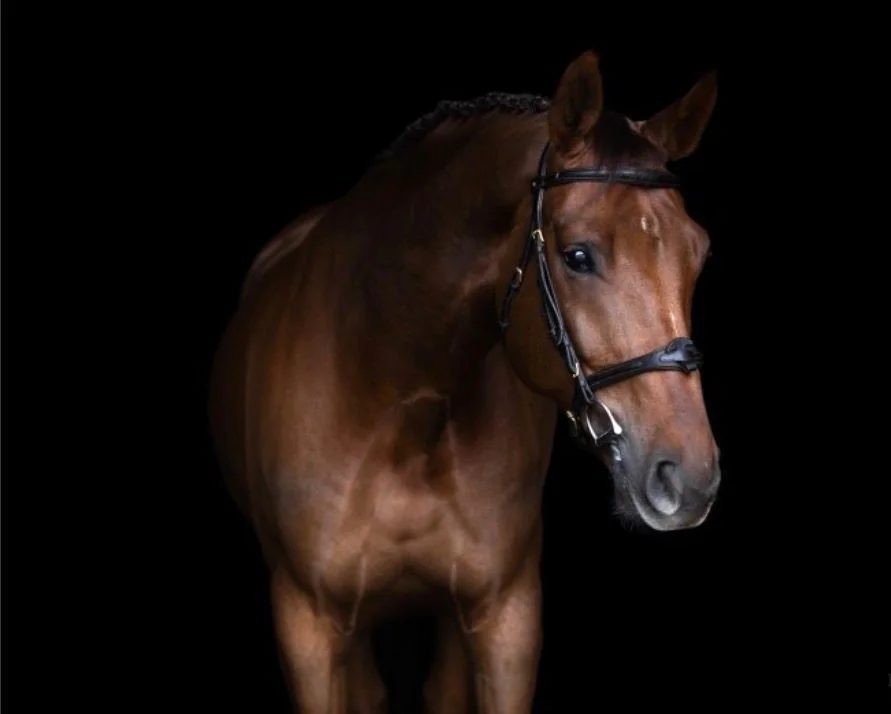
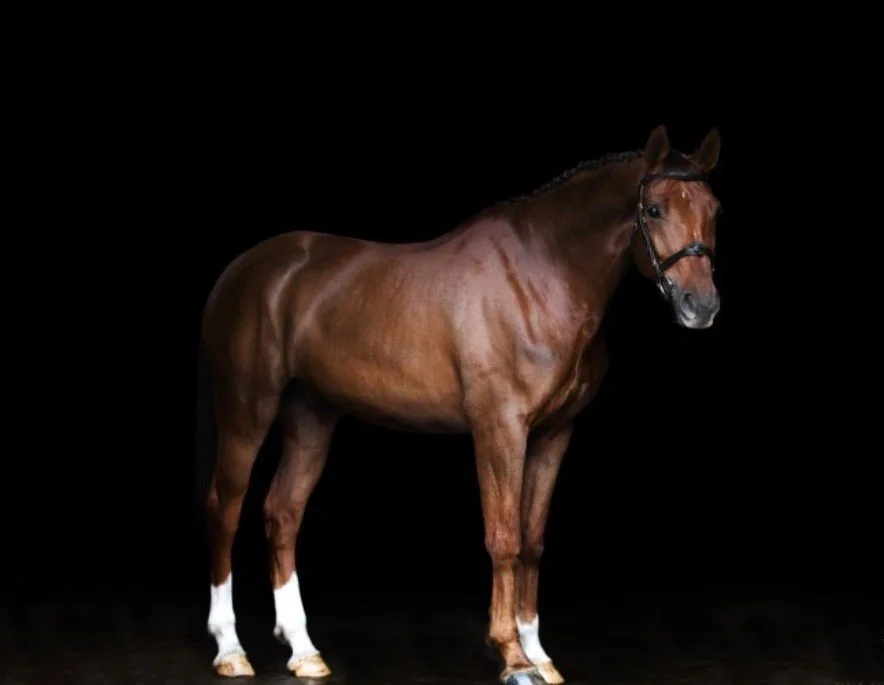
Editorial photography. No filters, no phone snapshots.
This is how your horse would appear to our buyers.
Collaboration formats
Public portfolio
Your horse is presented through Golden Horses channels with a complete profile and access to international buyers in Latin America, Europe and the United States.
Private portfolio
Your horse is offered discreetly only to selected buyers under direct enquiry. No public exposure. Maximum confidentiality.
Full management
We manage the entire sale process. Evaluation, presentation, negotiation and documentation. You receive the right buyer.
Select your budget range and discipline to filter the available horses. All have been evaluated and selected by Golden Horses.
Discipline
Budget
Lujoso AC III
PRE · Pura Raza Española
Age4 years
SexStallion
Height1.66 m
DisciplineDressage
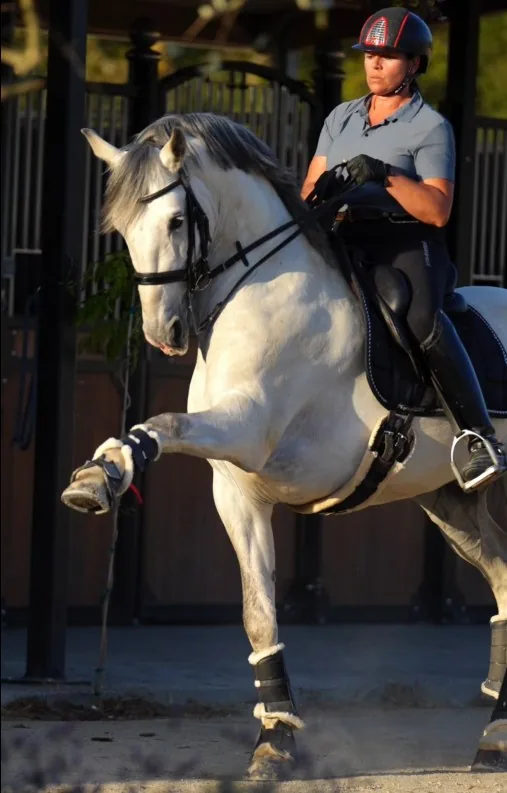
At 4 years old and 1.66 m tall, Lujoso AC III has foundations that invite us to look ahead. This PRE stallion stands out for his excellent qualities for collected-air movements and is developing a level of dressage appropriate to his age. He already works piaffe and passage in-hand: a starting point that opens an especially attractive opportunity to build a competition project with judgement and time.
Veterinary informationPiroplasmosis information and X-rays available for review
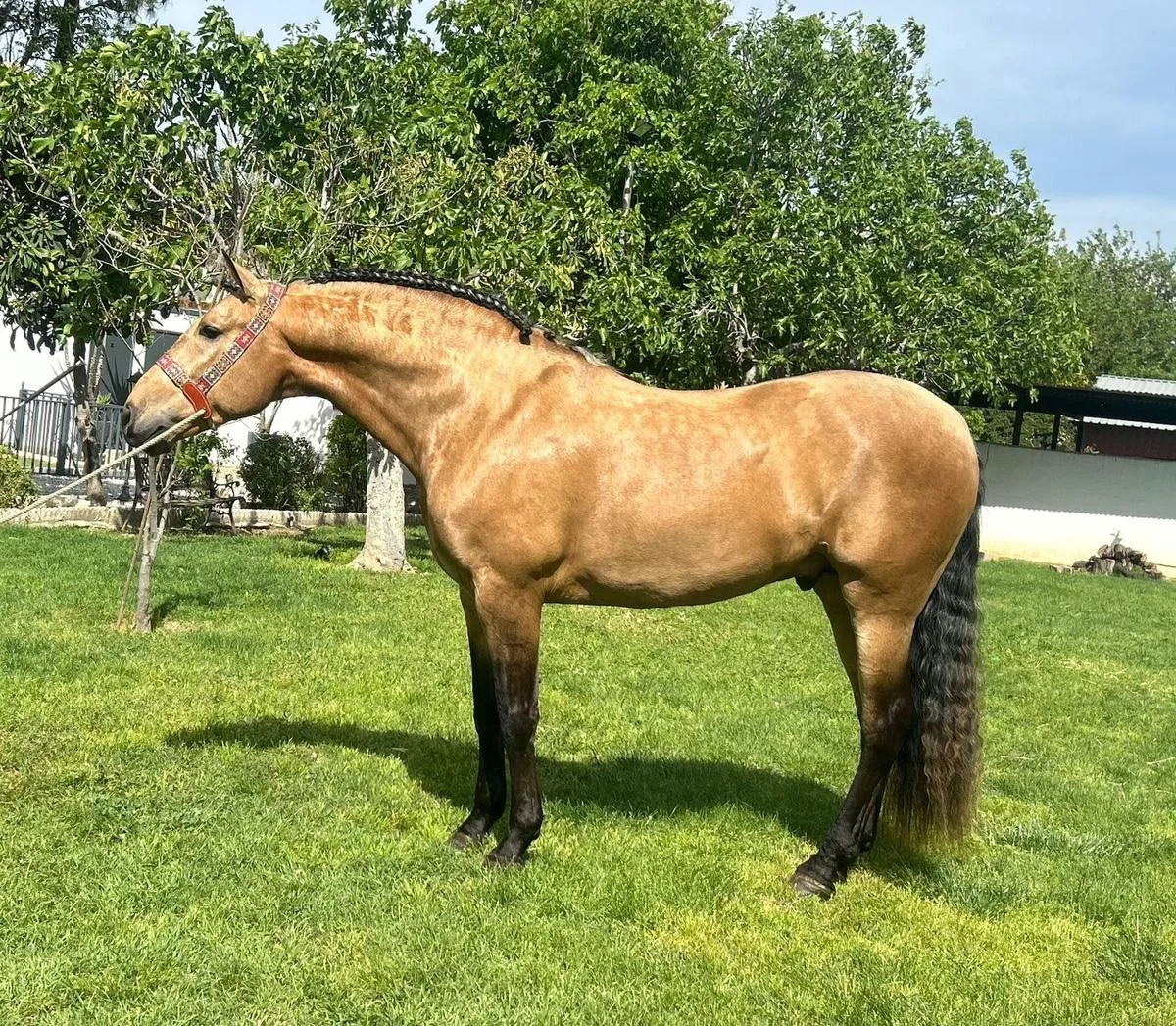
Costurero is a 4-year-old PRE stallion, 1.65 m tall, for dressage. Pleasant to ride, suitable for riders of all levels and with an excellent temperament. Piroplasmosis information and X-rays are available for review.
Veterinary informationPiroplasmosis information and X-rays available for review
Cellini de Ymas is an 11-year-old, 1.80 m CDE for dressage and is currently training Grand Prix. Piroplasmosis information and X-rays are available for review.
9-year-old KWPN mare, chestnut, 1.70 m, competing regularly at international level up to 1.45 m. With an excellent temperament and very easy to ride, she competes in a simple snaffle without any problem. She combines blood, carefulness and exceptional jumping technique, backed by a top-level record: winner of Grands Prix and CSI/CSN classes from 1.35 to 1.40 m, and runner-up at the Spanish Championship. Brave, fast and reliable, she is ready to compete at the highest level. Pyro free, with X-rays available for pre-purchase veterinary inspection.
Competition record 2023 – 2026
🥇 CSN5*** Moura · 1,40 m GP — 2026
🥇 CSN5*** Moura · 1,35 m — 2026
🥈 CSN5*** Moura · 1,40 m GP — 2026
🥇 CSI*** Maeza · 1,35 m — 2025
🥇 CSN3*** · 1,40 m GP — 2025
🥈 Spanish Championship · 1,40 m speed — 2025
🥈 CSI2** Las Mestas · 1,30 m — 2025
🥈 CSI2** Heras · 1,35 m — 2024
🏅 Spanish Championship 6yo — 2023
Contact us for further information and to request vídeos.
6-year-old gelding, chestnut, 1.68 m, by Pegaze out of a Wandor mare. A scopey, extremely careful horse with stunning looks. Already competing at 1.25 m, he is a clear Grand Prix prospect. Nice and easy to ride — an ideal choice for a rider looking for a young horse with a big ceiling and an easy temperament.
Contact us for further information and to request vídeos.
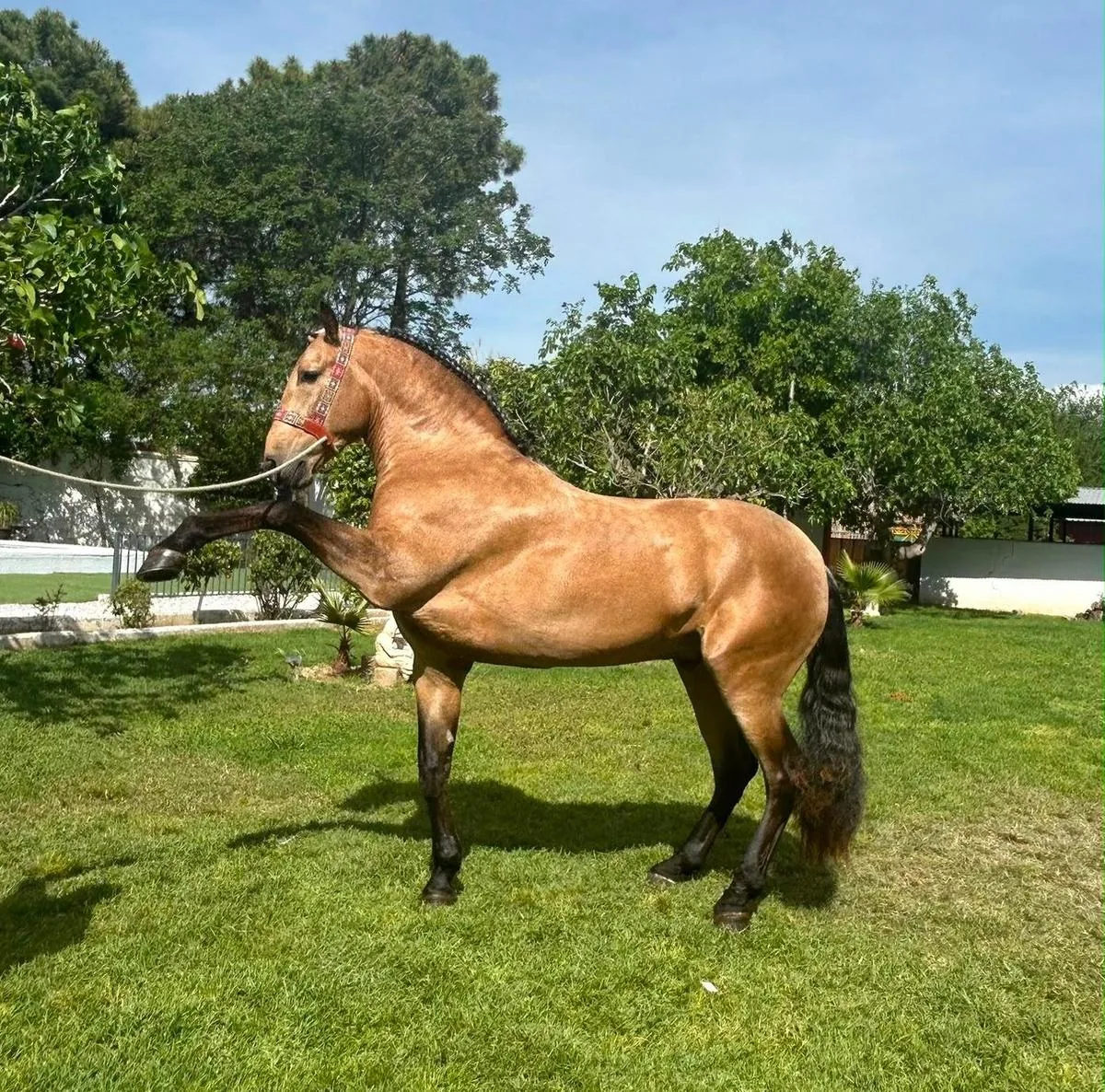
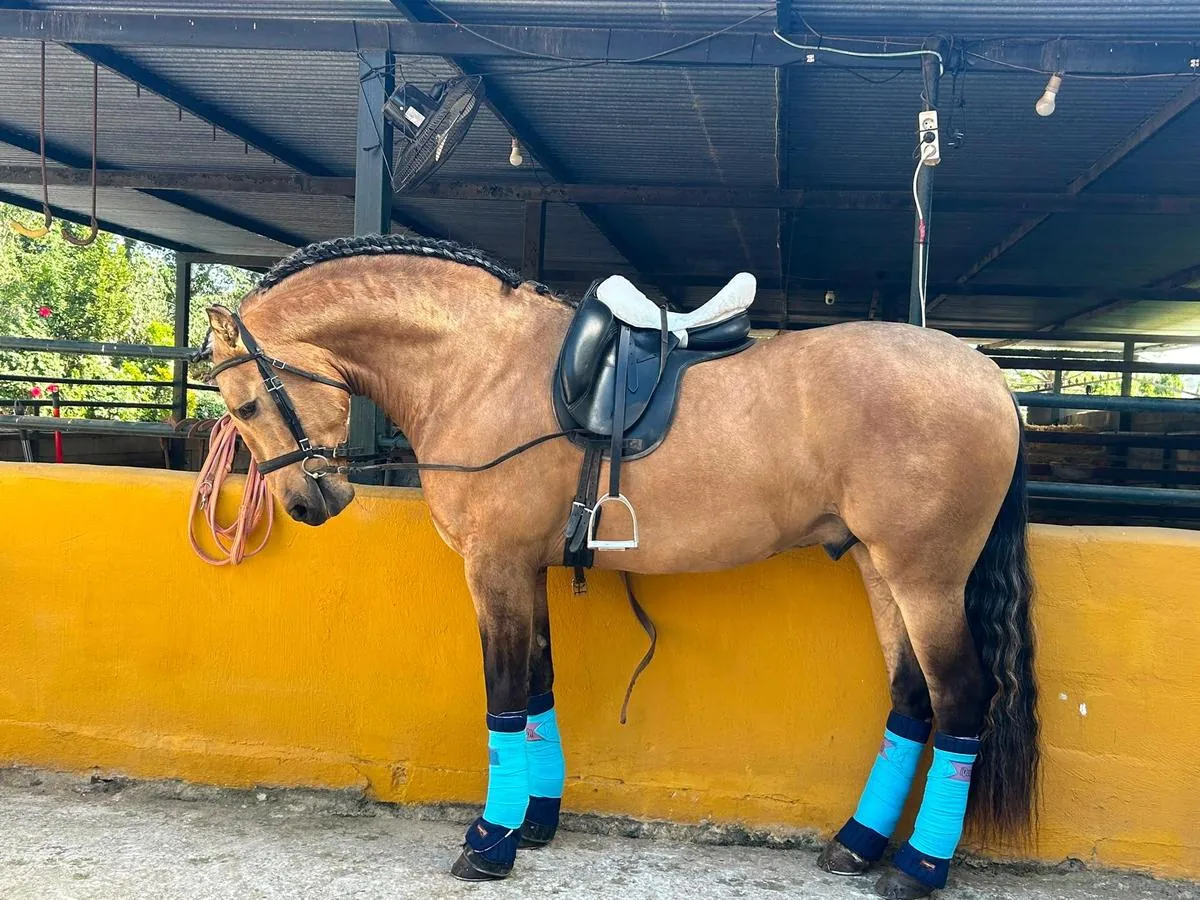
4-year-old PRE stallion, bay coat, 1.74 m tall with an imposing presence. Son of a Cremello stallion, he combines an exceptional temperament with training consistent with his age and enormous potential both under saddle and at stud. As a breeding stallion, he can produce bay, palomino or cremello offspring depending on the mare's coat genetics, making him a highly versatile choice for breeders seeking exclusive coat colours in the PRE. A unique opportunity to acquire a young, tall and striking stallion with a guaranteed future in both sport and reproduction.
Contact us for further information and to request vídeos.
Level7-yr-old test · Passage, Piaffe & flying changes
HealthPyro free · X-rays available
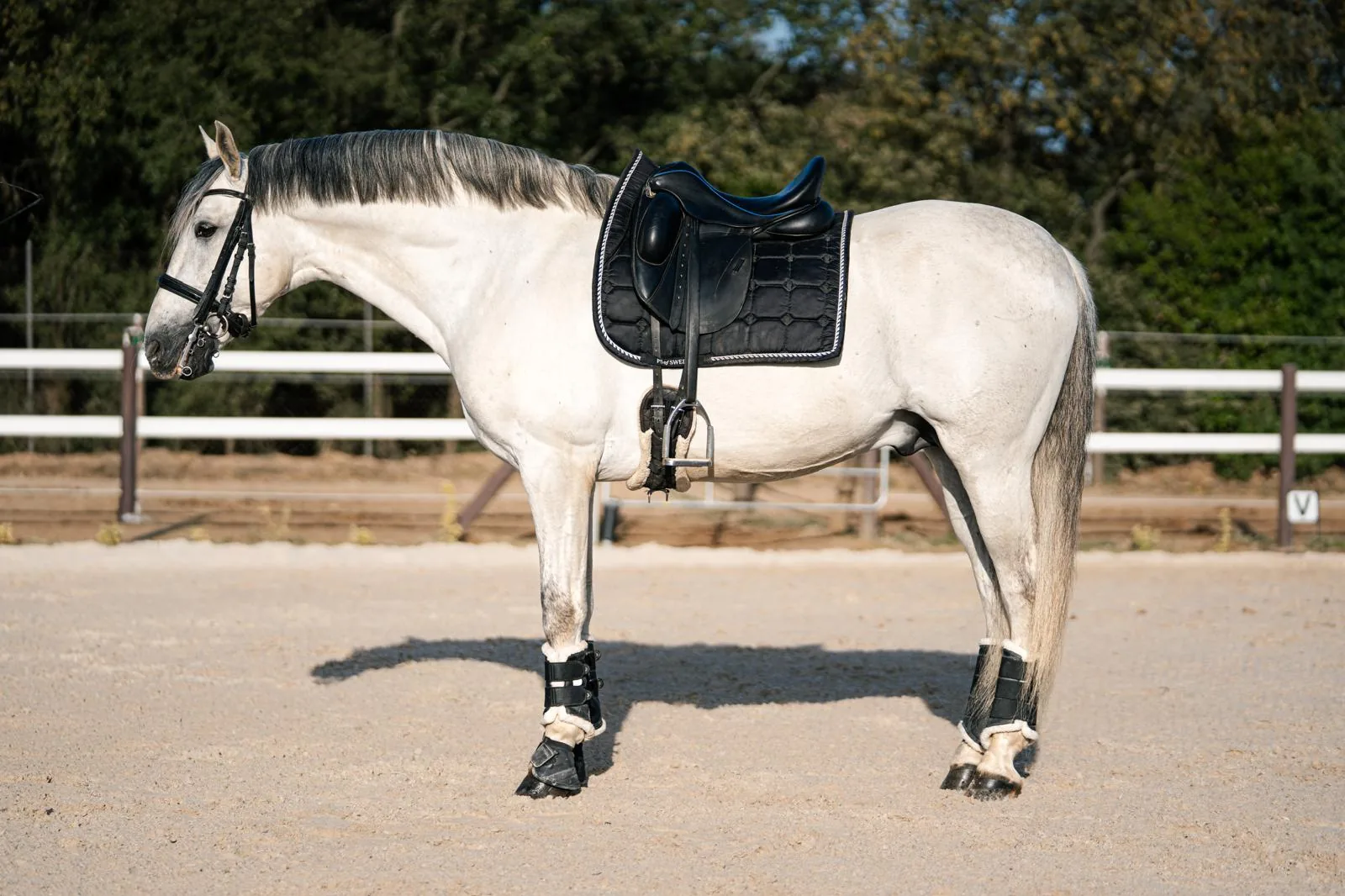
7-year-old PRE stallion, grey coat, 1.64 m. Performs all exercises of the 7-year-old test with quality, with Passage, Piaffe and flying changes already consolidated. What truly sets Orión apart is his temperament: a balanced, noble and manageable horse, equally calm in the arena and out in the field, forgiving of rider mistakes and supportive of their progression. Ideal for the amateur rider who wants to compete with a serious horse without giving up daily confidence and the pleasure of riding. Pyro free, with X-rays available for pre-purchase veterinary check.
Contact us for further information and to request vídeos.
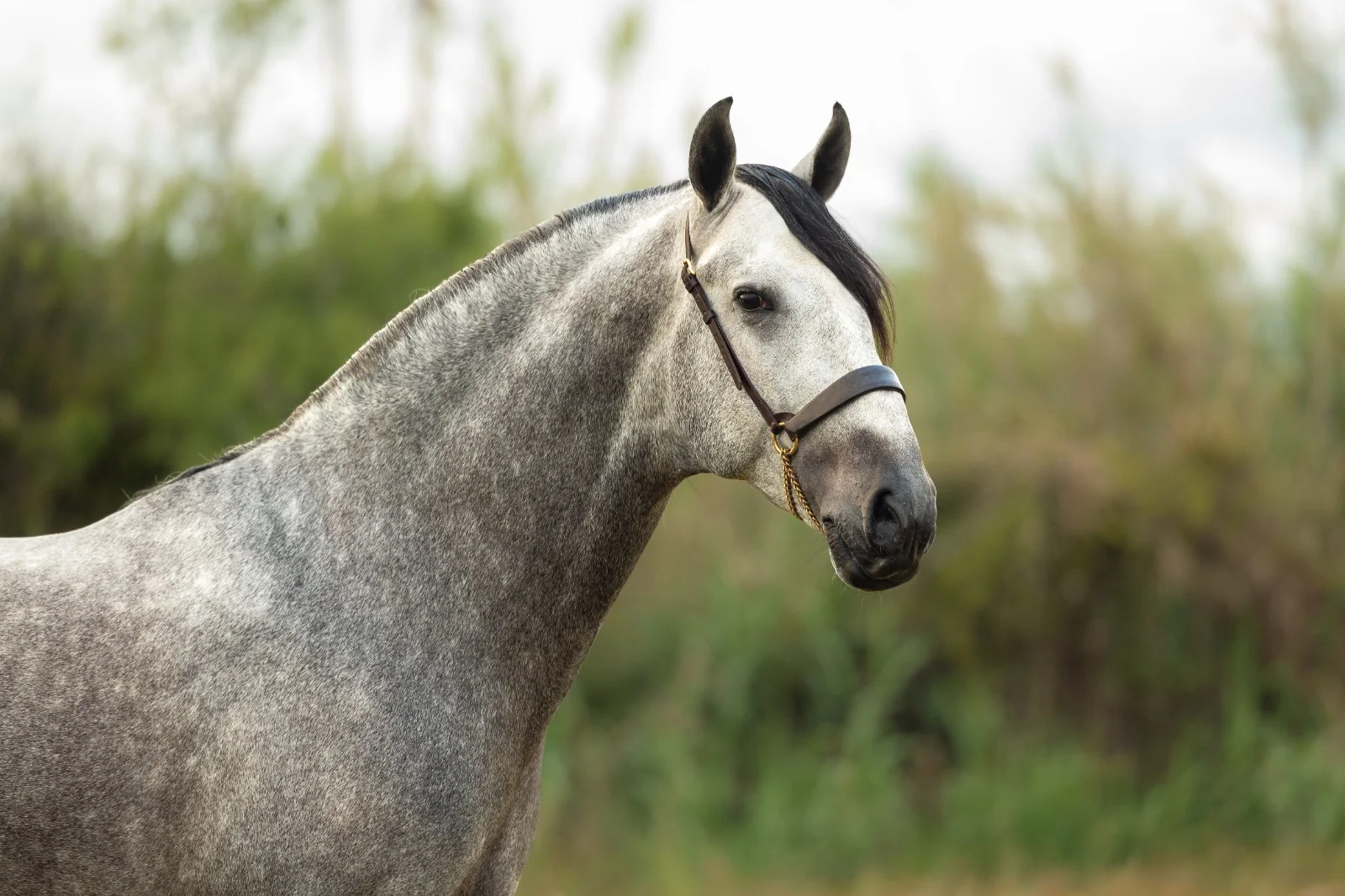
4-year-old PRE stallion, grey coat, 1.66 m (16.1 hh), with an exceptional temperament: balanced, willing and equally suited to male and female riders. His movement already shows the range and naturalness that point to a real future in dressage. Clean X-rays and free of piroplasmosis (test confirmed). Serious pedigree: sired by Noble de Trujillo, with Marín García (Hacendado IV) and M.F. Escalera (Ermitaño III) bloodlines, and breeders' marks including Granda, J.L. Escaler, Guardiola and Romero Benítez. A genuine prospect for anyone looking to invest in a future dressage horse with guarantees from the very start.
Contact us for further information and to request videos.
LevelS-Level · Piaffe, Passage & flying changes in series
DisciplineDressage
HealthPyro free · X-rays available
10-year-old PRE gelding, grey coat, 1.70 m. S-level dressage with fully confirmed exercises: Piaffe, Passage and flying changes in series. A completely trustworthy horse with an excellent temperament — calm, safe and highly manageable both in competition and daily handling. His presence, movement quality and even character make him the ideal partner for the serious rider looking to compete at the highest level with full confidence. Pyro free, with X-rays available for pre-purchase veterinary check.
Contact us for further information and to request vídeos.
Your equestrian business, with the presence it deserves.
Brand strategy, web, content, social media and AI automation for studs, equestrian centres and breeders who want to grow with order, presence and system.
We translate the reality of your equestrian business into a useful digital strategy: identity, web, content, social media and AI automation. The goal is clear — for your brand to look better, communicate better and convert better.
Who it's for
Studs
Equestrian centres
Riding schools
Sector brands and services
Riders and trainers
If you grow without a system, this will sound familiar
You have a good product, reputation and experience — but the communication doesn't match. The website doesn't explain what you do, social media eats your time and enquiries arrive scattered or unfiltered.
We put it in order
We build a brand and communication system that gives a more professional image, explains your offer better, attracts qualified enquiries and saves you time with useful automation — all coherent.
What we deliver
Brand strategy
We define how your business should look, sound and position itself to communicate clearly across every channel.
Web design & development
Clean, elegant, conversion-oriented websites built to explain your business well and generate real contact.
Social media management
We plan and manage your social presence with intent, consistency and visual coherence.
Content & copywriting
Copy that conveys trust, order and real value — no filler, no empty language.
AI automation
Assistants and workflows that answer first enquiries, organise and qualify leads and cut repetitive tasks.
How we work
01
Initial diagnosis
We analyse your business, your current presence, your goals and your bottlenecks.
02
Defining the approach
We turn your reality into a clear proposal: who you speak to, what you offer and what to order or automate.
03
Brand & communication architecture
We design the system of web, social, messaging and processes so everything works coherently.
04
Execution
We create and launch your business's digital side with judgement, aesthetics and function.
05
Follow-up & improvement
We adjust what's needed so the system isn't just beautiful, but genuinely useful.
What sets us apart
Golden Horses Consulting isn't built for generic businesses. It's designed for equestrian businesses that need to convey trust, professionalism and structure — from an established stud to a centre that wants to grow with order.
We don't just make your brand «look good». We make it help you sell, order your day-to-day and save you time through systems and AI automation.
More brand clarity
Better digital presence
More professional messaging
More qualified enquiries
Less time on repetitive tasks
Grow without losing control
Tailored to your business
Ready to put your brand, web and communication in order?
Request a diagnosis and let's see how to grow your equestrian business with a clear strategy and useful automation. From a one-off diagnosis to monthly support — a quote tailored to your goals.
Yes. We work with studs small and large, equestrian centres, breeders and equestrian businesses of every size.
Do you also do AI automation?
Yes. We design practical automations to save time, organise enquiries and support repetitive processes.
Do you only design, or strategy too?
Both. We first define the strategy and then translate it into web, content, social and useful systems.
Can you help if I already have a website and social media?
Yes. We audit what already exists, spot the leaks and reorganise the communication.
Is this an agency or a consultancy?
A consultancy specialised in the equestrian business, with a hands-on side of design, web, communication and automation.
A service independent from our horse buying & selling advisory.
Golden Horses
Equestrian Blog
Knowledge, insight and experience in service of the discerning buyer.
The Service
Finding the Right Horse, With an Expert on Your Side
A 360º equestrian advisory on the buyer's side: we search, evaluate, guarantee and coordinate everything — including international transport — to your stable door.
July 6, 2026 · 10 min read
Buyer's Guide
How to buy a PRE horse in Spain safely (2026 Guide)
Everything you need to know before buying a PRE in Spain: profile, documentation, technical evaluation and realistic budget. The method we apply with our clients.
May 7, 2026 · 12 min read
Equine Genetics
PRE Coat Color Genetics: The Definitive Scientific Guide
From the Pearl gene to homozygous Grey: everything breeders and investors need to know to make science-backed decisións.
May 8, 2026 · 10 min read
Market & Investment
The Global Dressage Market: From Sporting Passion to Elite Investment Asset
Verified macroeconomic data, WBFSH studbook rankings, high-level market asymmetry and the investor protection model. 2024–2025 analysis.
May 9, 2026 · 8 min read
Breed History
The Science of Elegance: History of the Spanish Purebred
From the Pleistocene to the Olympics: five thousand years of verified history, the true ancestors of the PRE, Military Breeding, the Royal School and the Olympic achievements of Soto and Rambla.
May 19, 2026 · 20 min read
Iberian Breeds · PSL
The Awakening of the Centaur: The Lusitano Revolution in Elite Dressage
History, biomechanics, the four founding bloodlines and complete Olympic timeline of the PSL: from Athens 2004 to Versailles 2024.
June 11, 2026 · 15 min read
Sector Analysis · Show Jumping
Show Jumping: Global Economics, Elite Genetics and the Origins of a Revolution
The $300 billion financial engine, the WBFSH ranking of the five elite studbooks and the history of jumping, from the English enclosures to the Premier Jumping League.
June 24, 2026 · 15 min read
Sport Breeds
The Engineered Horse: How the KWPN Conquered World Equestrian Sport
History, breeding-line specialisation, genomic predicates and the WBFSH world leadership of the KWPN, the most decorated sport horse on the planet.
July 13, 2026 · 16 min read
International Export
Exporting a Horse from Spain: Piroplasmosis Testing and Export Documentation
Piroplasmosis testing, USDA/APHIS permits and ASE certificates explained for exporting a horse to the USA, Mexico, Colombia, Chile, Argentina or El Salvador.
July 16, 2026 · 15 min read
Contenido en preparación
Content in preparation
Articles, guides and equestrian market analysis. Subscribe to the newsletter to receive first publications.
How to buy a PRE horse in Spain without risk (2026 Guide)
📅 May 7, 2026⏱ 12 min readCarlos Martin
Everything you need to know before buying a PRE horse in Spain: defining your needs, technical evaluation, ANCCE documentation verification, realistic budget and strategies to avoid mistakes. A practical approach for international buyers.
Imagine you have spent months, perhaps years, dreaming of a Pura Raza Española horse. You have watched vídeos, researched breeders, and pictured the moment the horse arrives at your stable. Spain is, without doubt, the natural home of the PRE. The quality of breeding, the diversity of bloodlines and the tradition make buying here a logical decisión.
But then reality sets in. You start searching and find hundreds of listings, prices you do not understand, paperwork you cannot interpret, and the feeling that — from thousands of kilometres away — anyone could pass off a horse that is not what it seems.
You are not alone. We have spent more than two decades guiding international buyers through this process and have seen almost everything. This article is not a generic list of tips. It is the method we apply with our clients, explained step by step. Our work is to protect the buyer — we do not represent sellers, and we have no horses of our own to place.
01Before searching, truly define what you need
The first mistake — the one that causes all the others — happens before seeing a single horse: failing to define what you are truly looking for. Most buyers start browsing listings and fall in love with a photo or video. That is like choosing a partner based on a social media profile.
Who will ride the horse? A professional rider and an amateur who rides three times a week are very different situations. A talented but demanding horse can become a problem without the right hands.
What do you expect from it? Competing in dressage, enjoying it at home, breeding, starting a High School project or simply having a companion — each option leads to a different horse profile.
Morphology or functionality? The PRE market has two main currents: pure morphology, oriented toward beauty competitions and breeding (SICAB), and the functional, oriented toward arena work. Seeking top competition morphology when functionality is your priority is a frequent and costly detour.
Expressive or calm temperament? A technically correct horse with a character incompatible with yours is a guaranteed mismatch.
What is your realistic total budget? We are not just talking about the horse price, but the full cost: international transport, customs duties, quarantine, insurance and annual maintenance.
02The horse's origin: breeders, portals and the invisible market
Spain has hundreds of stud farms dedicated to PRE breeding. Not all options offer the same guarantees.
Established breeders with a track record — They have years or decades of breeding, are registered as livestock farmers with ANCCE and are generally transparent with documentation. They allow veterinary inspections without objection and have a verifiable history.
New breeders or private sellers — Great horses can be found here too, sometimes at better prices. But the risk is higher if you cannot properly evaluate documentation. Incomplete paperwork, non-matching microchips or dubious lineages are more common in this segment.
Online portals: the showcase, not the diagnosis — A well-edited video shows what it wants to show. A personal visit — or the eyes of a trusted expert on the ground — is the only thing that reveals the full truth.
The invisible market: the private portfolio. The best horses often never get listed. They circulate in private networks of owners and breeders who do not want public exposure. If you only look at what is advertised, you are seeing a part of the market — not necessarily the best part.
03The in-person evaluation: what no video will ever tell you
The in-person visit remains the most reliable tool, provided you know what to look for.
Conformation and biomechanics — Small defects that go unnoticed in a video can become serious long-term problems.
Character in the stable — A horse that looks spectacular on video can be a stressed, evasive or aggressive animal in the stable.
Ridden work and feel — Whenever possible, ride it yourself. If not, have someone you fully trust ride it.
Veterinary history — Ask directly: any injuries? any surgery? A seller who responds vaguely is sending a fairly clear signal.
Microchip verification — Confirm it matches the Equine Identification Document and check the lineage at www.lgancce.com. Do not skip this step.
04Documentation: paper tolerates everything, but the truth does not
Correct documentation certifies racial purity and the legality of the purchase. Incorrect, incomplete or falsified documentation can invalidate the sale and block export. We have seen horses held in customs for weeks due to paperwork irregularities.
Equine Identification Document (DIE / passport) — Confirm data perfectly matches the microchip and graphical description of the animal. No exceptions.
Genealogical certificate — Verify lineage at www.lgancce.com using the UELN code or microchip number.
Health card and vaccination record — Must be up to date. An incomplete record may indicate inconsistent veterinary care.
Pre-purchase veterinary certificate — Includes clinical inspection, conformation evaluation, blood tests (piroplasmosis and other conditions) and, if agreed, X-rays. Conducted by a vet of your choosing.
05The real price: the horse is one part, not the full amount
The sale price of the horse is only one of the costs. Focusing the budget exclusively on that figure is a mistake we have seen repeated again and again.
Functional PRE with guarantees — leisure or dressage introduction€12,000 – €18,000
Classical dressage PRE — quality movement and intermediate training€18,000 – €40,000
High School PRE — collected gaits, changes, or SICAB award-winning stallions/mares€40,000 – €80,000
First-level competition horses — international arena or elite bloodlines€80,000 – €150,000+
To this you must add international transport (€1,500 – €6,000 depending on destination and method), customs duties, quarantine at destination if required, and transport insurance. A budget that integrates all these items from the outset avoids last-minute surprises.
06Negotiation and closing: protect your investment when you are about to decide
Negotiation in the PRE market is common when done with respect and knowledge. The danger lies in negotiating from emotion or urgency.
Base decisións on facts, not impressions — If the veterinary inspection reveals a minor issue, you can negotiate a proportional reduction. If the issue is serious, the prudent course is to walk away.
Written contract, always — It must include horse data, price, payment terms, delivery deadlines, guarantees and withdrawal clauses. A verbal agreement simply does not exist in practical terms.
Staged payments — Avoid paying 100% in advance without guarantees. A sequenced payment system (deposit, partial payment against vet clearance and final payment on delivery) offers greater protection.
07Do you need professional help? When it is worth it
Not everyone needs an advisor. If you have years of experience buying in Europe and know the market, breeders and export procedures, you can probably do without one.
But if you find yourself in any of these situations, professional advice pays for itself:
You cannot travel to Spain to evaluate candidates in person.
You have no prior experience buying horses in Europe.
You are looking for a very specific level of quality and do not want to risk paying a high price for a horse that does not deliver.
You value total impartiality: you do not want a seller disguised as an advisor steering you toward the horse that suits them.
You want access to the private portfolio: horses that are never advertised and only circulate in restricted networks.
—Conclusion
Buying a PRE horse in Spain is a fascinating experience when approached with preparation, judgment and the right guarantees. Defining the profile honestly, verifying documentation rigorously, completing a thorough veterinary inspection, accounting for all costs and keeping a clear head in negotiations are steps no buyer should skip.
Golden Horses Spain · International Equestrian Advisory
We are an equestrian advisory firm specialised in the selection, evaluation and acquisition of PRE, PSL and sport horses in Europe. We don't represent the seller. We work exclusively for the buyer with a transparent approach focused on protecting your investment.
Legal notice: This article is for informational purposes only and does not constitute legal or veterinary advice. Price ranges indicated are approximate and reflect market conditions at the time of publication. For specific cases, always consult with the appropriate professionals.
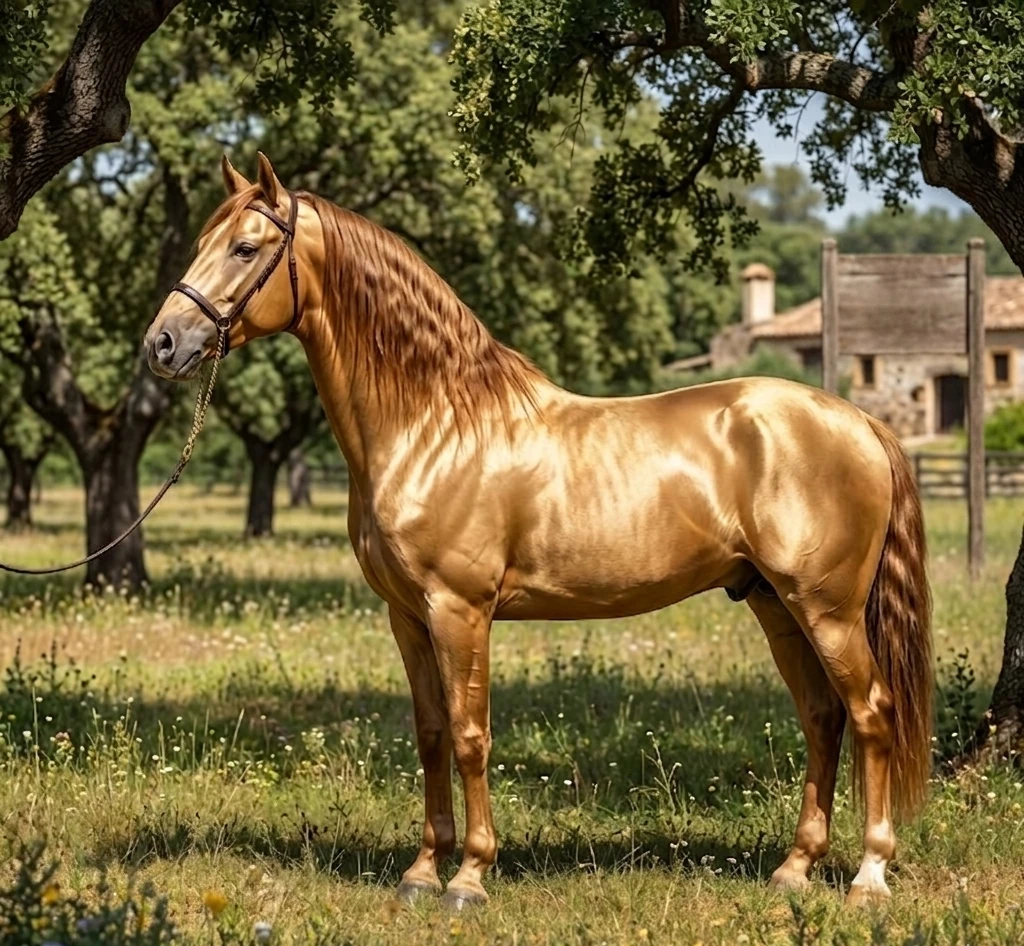
Ejemplar PRE con capa Isabela alazana (ee · Prl/Prl) — dehesa española
Equine Genetics · Golden Horses Spain
PRE Coat Color Genetics: The Definitive Scientific Guide
📅 May 8, 2026⏱ 10 min readCarlos Martin
En el mercado internacional del Pura Raza Española, la excelencia no solo se mide por la alzada o la extensión del trote. La cromotricología —la ciencia que estudia el color de la capa— se ha consolidado como una herramienta de auditoría patrimonial indispensable. Para el ganadero que busca la diferenciación y el inversor que exige certeza, entender el código genético que define la apariencia de un ejemplar es la única vía para eliminar el riesgo y garantizar la rentabilidad a largo plazo.
01 El Pilar Genético: Los Tres Colores Base
Todo color en el PRE nace de la interacción de dos genes: Extension (MC1R) y Agouti (ASIP). Sin estos dos pilares, ninguna dilución o modificación posterior existiría.
Capa Castaña
E_ A_ gg
La más representativa del PRE (~23% del censo ANCCE 2024). El gen Agouti restringe el pigmento negro a los cabos —crines, cola y extremidades—, produciendo el característico contraste entre cuerpo caoba y puntos negros. Es la base necesaria para el Bayo y las capas Perla castaña.
Capa Negra
E_ aa gg
Valorada por su elegancia y menor frecuencia (~2%). La ausencia del gen Agouti permite que el pigmento negro se distribuya uniformemente por todo el cuerpo. Base imprescindible para el Negro Cenizo y las capas Isabela negra.
Capa Alazana
ee
La base del color rojo (~13%). Producida por la ausencia total de pigmento negro al ser homocigoto recesivo en Extension. El Agouti es irrelevante en este genotipo. Es condición indispensable para obtener el Palomino, el Cremello y la Isabela alazana.
02 El Gen Gris (STX17): La Marca Dominante del PRE
El Gris no es un color en sí mismo, sino un modificador postnatal que desencadena una despigmentación progresiva a lo largo de la vida del caballo. Es el gen dominante por excelencia en el PRE, presente en aproximadamente el 57% del censo, una frecuencia inusualmente alta en comparación con cualquier otra raza del mundo.
Su mecanismo molecular implica la duplicación del gen STX17 en el cromosoma 25, que afecta a los melanocitos de la piel. El resultado es un caballo que nace con color y blanquea progresivamente hasta alcanzar el gris perla o blanco puro en la madurez.
Homocigoto (GG)
El caballo siempre será tordo y el 100% de su descendencia será torda, independientemente de la pareja reproductora. Esta característica lo convierte en una herramienta de planificación genética de primer orden para ganaderos que trabajan con líneas de color especial: garantiza visibilidad y cobertura en el mercado de los tordos.
Heterocigoto (Gg)
El caballo es tordo, pero transmite un alelo no tordo (g) en el 50% de los casos. Cruzado con un ejemplar no tordo, produce estadísticamente un 50% de potros tordos y un 50% de potros de color, permitiendo mantener viva la producción de capas especiales.
Alerta Sanitaria — Melanoma
Estudios publicados en PLOS Genetics (Sundström et al., 2012) estiman que entre el 70 y el 80% de los caballos tordos mayores de 15 años desarrollan melanomas dérmicos. Aunque generalmente de evolución lenta, su control veterinario periódico es indispensable en la gestión de ganadería de élite. El análisis genético del estado GG/Gg permite anticipar la probabilidad de descendencia afectada.
03 El Gen Crema (SLC45A2): Diluciones y Nomenclatura ANCCE 2020
El gen Crema (mutación c.457G>A en SLC45A2) es un dominante incompleto: una copia produce dilución visible, pero es la segunda copia la que transforma radicalmente el fenotipo. El 11 de marzo de 2020, la ANCCE actualizó la nomenclatura oficial para alinearse con los laboratorios internacionales.
Diluciones Simples — una copia Crema (Cr/cr)
Estas capas mantienen la piel oscura y los ojos de color castaño. Son las más frecuentes en el mercado de capas especiales del PRE.
Denominación ANCCE 2020
Base
Genotipo
Descripción
Bayo (Buckskin)
Castaña
E_ A_ Cr/cr
Cuerpo dorado-amarillento con cabos negros. Piel oscura, ojos castaños.
Palomino
Alazana
ee Cr/cr
Cuerpo dorado brillante con crines y cola blancas. Piel oscura.
Negro Cenizo (Smoky Black)
Negra
E_ aa Cr/cr
Pigmento negro muy apagado, con reflejos rojizos o bronce al sol. Fácilmente confundible con negro o castaño oscuro. El análisis de ADN es imprescindible para su identificación correcta.
Diluciones Dobles — dos copias Crema (Cr/Cr)
Producen ejemplares con piel rosada y ojos claros (azules o verdosos), rasgos que los identifican visualmente con facilidad y los sitúan en los segmentos de mayor valor del mercado.
Denominación ANCCE 2020
Nombre anterior
Base
Genotipo
Perlina
Perlino
Castaña
E_ A_ Cr/Cr
Cremello
Cremelo
Alazana
ee Cr/Cr
Crema Cenizo
Smoky Cream
Negra
E_ aa Cr/Cr
04 El Gen Perla (Prl / SLC45A2): La Joya Recesiva del PRE
A diferencia del Crema, el gen Perla (mutación c.985G>A, también en el gen SLC45A2 pero en una posición distinta) sigue un patrón de herencia recesivo. Un único alelo Perla no produce dilución visible: el caballo portador (N/Prl) tiene apariencia normal. Sin embargo, sus efectos emergen en dos situaciones específicas de alto valor reproductivo.
Dato Científico Verificado
Un estudio de Avila et al. (2022) publicado en la revista Genes (MDPI) —el análisis de distribución alélica más completo realizado hasta la fecha en razas ibéricas— determinó que la frecuencia del alelo Perla en el PRE es f = 0,11 (11%), y en el PSL f = 0,064 (6,4%). Esto significa que aproximadamente 1 de cada 9 caballos PRE es portador silencioso de Perla, lo que convierte el análisis de ADN en una herramienta de planificación reproductiva esencial.
Isabela — doble Perla (Prl/Prl)
Cuando un caballo hereda dos alelos Perla, se produce uno de los fenotipos más exclusivos y cotizados del mercado ibérico. Los caballos Isabela presentan un brillo metálico único, piel rosada, ojos de color claro y un pelaje con reflejos que varía del champagne al oro pálido. Se clasifican según la base genética subyacente:
Isabela Castaña
E_ A_ Prl/Prl
Tonos dorados cálidos con reflejos metálicos. Cabos ligeramente más oscuros. Piel rosada, ojos claros.
Isabela Alazana
ee Prl/Prl
La variante más luminosa. Pelaje de color crema-champagne con brillo intenso, sin puntos oscuros.
Isabela Negra
E_ aa Prl/Prl
Tonos crema fríos o plateados. La base negra aporta un matiz particular que la distingue de las otras variantes.
Combinaciones Crema-Perla (Cr/Prl)
El heterocigoto compuesto Crema-Perla produce capas visualmente muy similares a las dobles diluciones crema —piel rosada, ojos claros— pero con una genética distinta que permite transmitir ambos genes simultáneamente a la descendencia. Esta característica les otorga un valor reproductivo superior.
05 Tabla Completa: Interacciones Crema × Perla
La siguiente tabla recoge todas las combinaciones posibles entre el estado del gen Crema y del gen Perla, sobre cada una de las tres bases genéticas.
Nombre oficial ANCCE 2020
Base
Genotipo dilución
Piel / Ojos
Alazán
Alazana
cr/cr · N/N
Oscura / Castaños
Palomino
Alazana
Cr/cr · N/N
Oscura / Castaños
Cremello
Alazana
Cr/Cr · N/N
Rosada / Claros
Alazán (portador Perla)
Alazana
cr/cr · N/Prl
Oscura / Castaños portador silencioso
Palomina Perla
Alazana
Cr/cr · N/Prl
Rosada / Claros
Isabela Alazana
Alazana
cr/cr · Prl/Prl
Rosada / Claros
Castaño / Bayo
Castaña
cr/cr · N/N
Oscura / Castaños
Bayo (Buckskin)
Castaña
Cr/cr · N/N
Oscura / Castaños
Perlina
Castaña
Cr/Cr · N/N
Rosada / Claros
Castaño (portador Perla)
Castaña
cr/cr · N/Prl
Oscura / Castaños portador silencioso
Baya Perla
Castaña
Cr/cr · N/Prl
Rosada / Claros
Isabela Castaña
Castaña
cr/cr · Prl/Prl
Rosada / Claros
Negro
Negra
cr/cr · N/N
Oscura / Castaños
Negro Cenizo
Negra
Cr/cr · N/N
Oscura / Castaños
Crema Cenizo
Negra
Cr/Cr · N/N
Rosada / Claros
Negro (portador Perla)
Negra
cr/cr · N/Prl
Oscura / Castaños portador silencioso
Perla Ceniza
Negra
Cr/cr · N/Prl
Rosada / Claros
Isabela Negra
Negra
cr/cr · Prl/Prl
Rosada / Claros
06 El Gen Dun (TBX3): Dilución y Marcas Primitivas
El gen Dun, mediado por el factor de transcripción TBX3, es un dilutor activo —no solo produce marcas decorativas, sino que reduce la intensidad del pigmento en el cuerpo— combinado con la aparición de marcas primitivas características: raya dorsal, cebraduras en las extremidades y posible raya en los hombros.
Existen tres variantes alélicas con efectos fenotípicos distintos, un matiz crítico para interpretar correctamente el análisis de ADN:
D (Dun clásico)
D/nd2 o D/nd1
Produce dilución real del color base (Bayo Dun, Grullo, Alazán Dun) combinada con marcas primitivas evidentes. Extremadamente raro en PRE puro.
nd1 (pseudo-dun)
nd1/nd2 o nd1/nd1
Produce marcas primitivas sin dilución del color base. Frecuencia estimada f = 0,79 en PRE (Avila et al., 2022): explica por qué muchos caballos tordos o castaños del PRE presentan raya dorsal sin ser genéticamente Dun verdadero.
nd2 (wild-type)
nd2/nd2
Alelo estándar sin efecto. No produce ni dilución ni marcas primitivas.
Implicación Práctica
La alta prevalencia del alelo nd1 en el PRE (f ≈ 0,79 según Avila 2022) significa que la raya dorsal visible en un caballo no confirma Dun verdadero. Un análisis genético es imprescindible para distinguir nd1 de D, especialmente relevante en exportación donde la nomenclatura de capa debe ser exacta.
07 Patrones Blancos en el PRE
Ruano (KIT)
El Ruano es un patrón de dilución uniforme que mezcla pelos blancos y pigmentados en el cuerpo, manteniendo cabeza y extremidades de color. Es dominante y estable a lo largo de la vida, sin el blanqueo progresivo del Gris. Infrecuente en PRE puro (<2% del censo).
Splashed White — Descubrimiento en PRE (2023)
Un patrón de blanco caracterizado por manchas simétricas en la cara (frente y maxilares), ojos azules y vientre blanco. En 2023, McFadden et al. publicaron en el Journal of Equine Veterinary Science el descubrimiento de dos nuevos alelos específicos del PRE: SW9 y SW10, identificados por primera vez exclusivamente en esta raza, lo que confirma la singularidad genética del PRE a nivel global.
Tobiano
El patrón de manchas blancas irregulares más conocido en caballos de pintos. Prácticamente inexistente en el PRE puro registrado (ANCCE); su presencia en un ejemplar declarado como PRE puro requeriría verificación genealógica.
08 Genes No Presentes en el PRE Puro
El rigor científico exige señalar también lo que no está documentado en la raza, para evitar afirmaciones sin sustento que comprometan la credibilidad del ganadero o del inversor.
Champagne (SLC36A1)
Ch
Genera piel pecosa característica, ojos ámbar y una dilución con brillo metálico sobre el color base. No ha sido documentado en estudios genómicos del PRE puro (Cook et al., 2008; Avila et al., 2022). Su presencia en un ejemplar registrado como PRE puro requeriría revisión genealógica de posibles cruces históricos.
Silver (PMEL17)
Z
Diluye selectivamente el pigmento negro, afectando cabos y crin pero no el cuerpo alazán. Detectado por primera vez en PSL (Avila 2022). Sin datos publicados de su presencia en PRE puro. Relevante en PSL por el cruce histórico con razas nórdicas y de montaña.
57%Tordos en censo PRE ANCCE 2024
11%Portadores gen Perla Avila et al., 2022
79%Frecuencia alelo nd1 Dun pseudo en PRE
09 Estrategia de Inversión: Por qué el ADN es su Mejor Seguro
El mercado del caballo español factura cerca de 770 millones de euros anuales, con demanda creciente de capas especiales en EE.UU., México y el Golfo Pérsico. Un error en la interpretación genética puede devaluar un activo en decenas de miles de euros.
Garantía de descendencia en capas especiales
Un semental homocigoto para Crema (Cr/Cr) o doble Perla (Prl/Prl) garantiza que el 100% de su descendencia será, como mínimo, portadora del gen dilutor. Esto elimina la incertidumbre del plan de cría y convierte cada cubrición en un activo predecible.
Detección de portadores silenciosos de Perla
Con una frecuencia del 11% en la población PRE, un ejemplar de apariencia normal puede ser portador N/Prl. Cruzado con otra yegua portadora, produce Isabelas —los ejemplares más cotizados del mercado de color—. Sin test de ADN, esta oportunidad queda oculta.
Transparencia en la exportación
La nomenclatura ANCCE 2020 es la referencia legal en los certificados sanitarios y de origen internacionales. Utilizar denominaciones obsoletas ("Perlino" en lugar de "Perlina", "Isabelo" en lugar de "Isabela") genera fricción legal y desconfianza en compradores internacionales.
Gestión veterinaria preventiva
El análisis genético del gen Gris permite anticipar el riesgo de melanoma en la planificación sanitaria. Un caballo GG homocigoto y sus crías tordas deben someterse a revisiones dermatológicas regulares a partir de los 10 años.
Golden Horses Spain
No representamos al vendedor. Auditamos oportunidades.
En un mercado donde los mejores ejemplares nunca llegan a los portales públicos, la información técnica veraz es su mayor activo competitivo.
Avila, F. et al. (2022). Breed Distribution and Allele Frequencies of Base Coat Color, Dilute, and White Patterning Variants in 38 Horse Breeds. Genes, 13(9), 1641. DOI: 10.3390/genes13091641 — PubMed
Durkin, K. et al. (2019). Identification of the mutation causing the Pearl coat color in horses. Animal Genetics, 50(3), 294–297. DOI: 10.1111/age.12773 — PubMed
Holl, H.M. et al. (2019). Coat color association study of equine cream and Pearl dilution variants. Animal Genetics. DOI: 10.1111/age.12797 — PubMed
Imsland, F. et al. (2016). Regulatory mutations in TBX3 disrupt asymmetric hair pigmentation that underlies Dun camouflage color in horses. Nature Genetics, 48, 152–158. DOI: 10.1038/ng.3475 — PubMed
Sundström, E. et al. (2012). Splicing modulates the expression of the grey mutation in horses. PLOS Genetics. DOI: 10.1371/journal.pgen.1003083 — PubMed
McFadden, A. et al. (2023). New splashed white variants SW9 and SW10 identified in the PRE horse breed. Journal of Equine Veterinary Science. DOI: 10.1016/j.jevs.2023.104878 — PubMed
Cook, D. et al. (2008). Missense mutation in the SLC36A1 gene causes the Champagne dilution coat color in horses. PLOS Genetics, 4(9). DOI: 10.1371/journal.pgen.1000195 — PubMed
ANCCE — Libro Genealógico del PRE. Capas Genéticas (nomenclatura 2020). lgancce.com/webcapas
Mercado Ecuestre & Inversión
El Mercado Global de la Doma Clásica: De la Pasión Deportiva al Activo de Inversión de Élite
Un análisis riguroso del ecosistema económico de la Doma Clásica: cifras macroeconómicas verificadas, ranking de studbooks, asimetría de mercado y el modelo de defensa del inversor.
Golden Horses Spain · Análisis 2024–2025 · Basado en datos FEI, WBFSH y PSI
Ejemplar de alto nivel en posición de reunión · Imagen con fines ilustrativos
En el ecosistema ecuestre contemporáneo, la Doma Clásica ha trascendido su naturaleza como disciplina olímpica para consolidarse como un motor económico de escala global. Para el inversor de alto nivel, la adquisición de un caballo de Gran Premio no representa únicamente un compromiso deportivo: es la entrada en un mercado de activos tangibles que moviliza miles de millones de euros anualmente y que exige, por su complejidad, una gestión técnica del riesgo tan rigurosa como cualquier otra clase de activo alternativo.
01 La Radiografía Económica de la Disciplina (2024–2025)
La industria hípica mundial ha demostrado una resiliencia excepcional frente a la volatilidad de los mercados financieros tradicionales. El sector de equipamiento y bienes de consumo ecuestre —una fracción del ecosistema total— se valoró en 12.000 millones de USD en 2024, con una proyección de crecimiento hasta los 18.300 millones de USD para 2034, lo que supone una tasa de crecimiento anual compuesta (CAGR) del 4,3%.
En paralelo, el impacto económico del conjunto de la industria ecuestre en Europa supera los 100.000 millones de euros anuales, sustentando cientos de miles de empleos directos e indirectos en un continente donde el caballo sigue siendo un pilar cultural y productivo de primer orden.
Crecimiento Estructural — FEI 2024
Según los registros de la Federación Ecuestre Internacional (FEI), el número de atletas registrados ha crecido un 59% desde 2009, alcanzando los 42.961 jinetes activos. El registro de caballos de competición internacional ha aumentado un 63% en el mismo periodo, superando los 78.400 ejemplares. Se celebraron más de 900 competiciones internacionales de Doma Clásica en el último año registrado.
$12BSector ecuestre global USD · 2024
42.961Atletas FEI activos +59% desde 2009
+900Competiciones internacionales Doma Clásica · último año
02 El Ranking de la Excelencia: Studbooks y Genética
Para el comprador, el valor de un ejemplar está íntimamente ligado a su studbook o libro genealógico, que actúa como un certificado estadístico de probabilidad de éxito deportivo. El ranking de la WBFSH (World Breeding Federation for Sport Horses) de 2024/2025 confirma el dominio de las razas centroeuropeas, con una presencia creciente y competitiva de las razas ibéricas:
Rango
Studbook
Puntos (2025)
Sementales de referencia
1
KWPN — Países Bajos
12.783
Johnson TN, Totilas (progenie activa)
2
OLDBG — Oldenburgo
12.310
Bordeaux 28, Total Hope OLD
3
HANN — Hannoveriano
11.665
Fidermark, Totilas (progenie activa)
7
LUSIT — PSL, Portugal Ibérico
9.087
Rubi, Zeus do Lis
14
PRE — España Ibérico
3.909
Líneas de Doma Confirmadas
Nota de Lectura — Ranking WBFSH
Los puntos WBFSH se calculan a partir de los resultados de competición de la progenie activa de cada studbook. La referencia a Totilas (KWPN, 2000–2018) refleja el impacto continuado de sus descendientes en competición, no actividad propia del semental. La brecha entre el Top 3 y los studbooks ibéricos explica directamente los diferenciales de precio en subastas de élite.
Esta brecha explica por qué los precios en subastas de élite, como la PSI (Performance Sales International), mantienen promedios de 320.208 euros para caballos de doma, con sementales aprobados alcanzando cifras superiores a los 825.000 euros. La genética no es solo biología: es la variable que determina el precio de salida.
«El studbook es el certificado estadístico de probabilidad de éxito. No es una garantía, pero es el mejor predictor disponible para el inversor.»
03 El Desafío de la Adquisición: La Asimetría del Mercado
A pesar de la transparencia de las cifras macroeconómicas, el mercado de compraventa de caballos de alto nivel sufre una profunda asimetría informativa. Los mejores ejemplares —aquellos con una biomecánica impecable, una salud radiológica verificada y el temperamento adecuado para el Gran Premio— rara vez llegan a los portales públicos. Se mueven en lo que denominamos el «mercado invisible»: redes privadas de críadores, jinetes de élite y gestores de cuadra que operan con total discreción.
En este entorno, el comprador no especializado se enfrenta a tres riesgos críticos de naturaleza estructural:
Conflicto de Interés del Intermediario
Agentes que representan simultáneamente al vendedor y al comprador, o que priorizan su propio inventario sobre las necesidades reales del cliente. La opacidad de las comisiones dobles es una práctica extendida que erosiona el capital del comprador de forma invisible.
Evaluación Técnica Superficial
Una decisión de compra basada en la estética o en vídeos de corta duración que no revelan debilidades biomecánicas, vicios ocultos de comportamiento o patologías radiológicas subclínicas. Un caballo que «luce bien» no es necesariamente un activo viable para el Gran Premio.
Inseguridad Logística y Legal
La complejidad de los contratos internacionales, la gestión del PPE (Pre-Purchase Examination) con veterinarios independientes, el transporte intercontinental y las implicaciones aduaneras son fuentes de riesgo que el comprador sin red de apoyo no puede gestionar eficientemente.
Riesgo de Mercado — El Coste del Error
Una adquisición mal ejecutada en el segmento de caballos de Gran Premio puede suponer pérdidas de entre 50.000 y 300.000 euros en devaluación del activo, costes veterinarios no previstos y gastos de relocalización. La asimetría informativa no es un inconveniente menor: es el principal factor de destrucción de valor en este mercado.
04 Golden Horse Spain: Consultoría Estratégica y Defensa del Inversor
Es en la intersección entre el mercado de élite y la necesidad de seguridad donde Golden Horse Spain despliega su modelo de asesoría. No operamos como un buscador de caballos convencional; funcionamos como una oficina de gestión de activos que prioriza la protección de su capital.
Transparencia Radical — Sin Conflicto de Interés
En Golden Horse Spain no representamos al vendedor. Nuestra lealtad es única y exclusivamente hacia el comprador. Si un ejemplar no cumple los estándares técnicos de biomecánica, genealogía o salud, no será presentado a nuestros clientes. Esta independencia es la piedra angular de nuestro modelo.
Acceso al Mercado Invisible y Cartera Privada
Nuestra red de contactos nos permite acceder a sementales y yeguas de competición que no están listados públicamente: la potencia de un Warmblood centroeuropeo, la capacidad de reunión de un Puro Sangre Lusitano o la nobleza funcional de un Pura Raza Española, con opciones que el mercado general desconoce.
Protocolo de Selección «No Compromises»
Cada caballo evaluado pasa por un filtro de auditoría que incluye: análisis biomecánico avanzado de los tres aires, gestión del PPE con veterinarios independientes (radiografías, ecografías, tests de ADN) y verificación del nivel real de entrenamiento respecto al precio de mercado.
Servicios a Medida — Full Advisory y Nivel Premium
Desde la Asesoría Completa —servicio llave en mano desde la búsqueda activa hasta la entrega en sus instalaciones— hasta el nivel Premium con acceso prioritario a ejemplares de nuestra red privada. Cada operación está diseñada para ser segura, discreta y profesional.
Golden Horses Spain
El caballo adecuado. Sin concesiones.
El éxito en la Doma Clásica comienza mucho antes de entrar en la pista. En un mercado global valorado en miles de millones, la información veraz y la red adecuada son los activos más valiosos que puede adquirir.
Grand View Research / Industry Reports. Equestrian Equipment Market Size & Forecast 2024–2034. CAGR 4,3%. grandviewresearch.com
European Horse Network. The Horse Sector in Europe — Economic Impact Report.europeanhorsenetwork.eu
Breed History
The Science of Elegance: History of the Spanish Purebred
May 2026 · 20 min read · Golden Horses Spain
The Pura Raza Español (PRE) is not simply a horse breed. It is a living archive of more than five thousand years of Mediterranean history: present in the caves of Altamira, in Roman mosaics, in Velázquez's paintings and on the Olympic arena of the 21st century. This article reviews and expands that history with verifiable academic sources.
Infographic · Origin
The Three Ancestral Pillars of the PRE
01The Three Ancestral Pillars
1.1 The Primitive Iberian Horse
The oldest ancestor of the PRE is Equus ferus hispanicus, a wild equid that inhabited the Iberian Peninsula during the Pleistocene. The caves of Altamira (Cantabria) and El Castillo (Puente Viesgo) document its presence from at least 15,000 BC. Research published in the Journal of Archaeological Science (Lira et al., 2010) confirms through mitochondrial DNA analysis that Iberian horse populations already showed distinct genetic characteristics from those of central Europe and Asia more than 10,000 years ago.
Verified historical correction
The PRE does not descend from the Arab horse. Genomic studies (Promerová et al., 2014) demonstrate that Arab gene flow in the PRE is minimal and post-dates the 15th century. The genetic base of the PRE is predominantly Iberian and Berber. The PRE is, genétically, older than Islam.
1.2 The Sorraia
The Sorraia, identified by Portuguese zoologist Ruy d'Andrade in 1937, is considered a possible survivor of the primitive Iberian equid. DNA analysis by Jansen et al. (2002) identified mitochondrial haplogroup D as characteristic of Iberian horses, present with high frequency in both the Sorraia and the modern PRE.
1.3 The Barb Horse
The third pillar is the Barb horse from North Africa. Its influence arrived with the Arab-Berber invasion of 711 AD. Seven hundred and eighty years of coexistence enriched the Iberian genetic heritage without erasing its identity. The dominant African component is Berber, not Eastern Arab — a fundamental distinction that many sources confuse.
* * *
02From Rome to the Renaissance: Forging a Breed
Polybius and Livy describe the Iberian cavalry during the Punic Wars (264–146 BC) as superior to any other equestrian force in the Mediterranean. Hannibal recruited thousands of Iberian horsemen because, in Livy's words, no cavalry soldier in the known world matched their skill. After the Roman conquest, the Iberian horse was massively exported to the heart of the Empire.
During the Middle Ages, the Arab-Berber cavalry of Al-Andalus developed the jineta, a technique of short gallop and rapid turn, which deeply influenced the handling of the Iberian horse. This tradition is the direct origin of the high school of equitation, the basis of classical dressage and contemporary working equitation. In 1492, the Catholic Monarchs issued the Pragmatic on Horses, the first systematic regulation of horse breeding in Spain.
Infographic · Timeline
Five Thousand Years of PRE History
03Philip II and the Golden Age of the Spanish Horse
On 6 December 1567, Philip II signed in El Escorial the Royal Pragmatic founding the Royal Stables of Córdoba — the institutional birth certificate of the modern PRE. The Stables housed more than 1,800 mares and 300 stallions selected under strict criteria: harmonious conformation, noble temperament, cadenced movement and natural elevation.
The 17th century was the century of the Spanish horse. The most prestigious equestrian academies in Europe — Versailles, Naples, Vienna — were founded or reformed with Spanish instructors and Iberian horses. The Lipizzaner, the breed associated with the Spanish Riding School of Vienna, originated as a cross of Spanish horses with Italian mares from the Karst region.
«The Spanish horse is not merely a war or parade animal: it is the measure of the civilisation that breeds it.»— Juan Suárez de Peralta, Tractado de la Caballería de la Gineta y Brida, ca. 1580
04The Institutional Guardian: Spain's Military Horse Breeding Service
No institution has been more decisive in the preservation of the PRE than Spain's Military Horse Breeding Service. Its roots go back to the Catholic Monarchs' pragmatics of 1492, but it was during the 19th century that the institution took its modern form.
In 1847, the Military Stud of Jerez de la Frontera was founded, establishing the first systematic genealogical register of horses in Spain, including the PRE. In 1864, the Military Horse Breeding Service was formally constituted under the Cavalry Corps. In 1893, the Moratalla Stud (Córdoba) was founded, one of the main genetic reservoirs of the PRE during the 20th century.
Today, the Directorate of Military Horse Breeding (DCCFAS), under the Ministry of Defence, jointly manages the PRE Stud Book with ANCCE. This collaboration between a military institution and a breeders' association is unique in the world equestrian landscape and largely explains the robustness of the PRE register internationally.
Verifiable source
Ministry of Defence — DCCFAS, History section: defensa.gob.es/ccfas/HISTORIA/. The official publication Military Horse Breeding. 150 Years of Service documents this trajectory in detail.
05Crisis and Survival: The 18th and 19th Centuries
The 18th century brought a profound crisis: the Thoroughbred fashion from Philip V's Bourbon court, and the devastation of the Wars of Succession and Independence threatened the breed's purity. The Mendizábal Disentailment (1835) dispersed the Carthusian stud of Jerez, but Andalusian private breeders preserved the pure lines. On 23 January 1972, the founding of ANCCE in Jerez marked the beginning of the modern era.
⬥ La Cartuja Stud Farm — Hierro del Bocado
Since 1475, the Carthusian monks had bred horses on the Fuente del Suero estate beside their monastery of Santa María de la Defensión in Jerez. Applying the same monastic patience they brought to illuminating manuscripts, they fixed a unique genetic line in freedom — the so-called Carthusian horse. When Napoleon invaded Spain, clergyman Pedro José Zapata bought sixty mares and three stallions in 1810 — the finest specimens — and hid them in «Breña del Agua» while the monks fled to Cluny. To identify these rescued animals he created the Hierro del Bocado (the bit brand), still used today to mark this bloodline. The 1835 Disentailment definitively expelled the monks, but the bloodline was already safe.
Since 1990 it is managed by the public company EXPASA under the State Patrimony. In March 1998 the Carthusian monks themselves handed EXPASA the original bell-shaped iron, closing a five-century circle. Today more than 200 specimens live freely on the Fuente del Suero estate, designated in 2019 as the National Reference Centre for Zootechnics (CENRE): the world's largest genetic reserve and DNA bank for the Spanish horse. Visits are open to the public in Jerez de la Frontera.
06The Royal Andalusian School: Don Álvaro Domecq and Art Made Institution
In May 1973, then Prince Juan Carlos I awarded the Jerez horseman Don Álvaro Domecq Romero the Golden Horse, the highest honour in the Spanish equestrian world. In recognition of this award, Domecq presented for the first time his spectacle «How the Andalusian horses dance», the founding moment of what is today the Royal Andalusian School of Equestrian Art in Jerez de la Frontera.
Since 1987, King Juan Carlos I has been honorary president of the institution, giving it its Royal title. The school works exclusively with PRE horses and stages more than 150 performances a year for international audiences. Don Álvaro Domecq Romero, the soul of the institution, passed away on 18 November 2025, leaving a legacy that transcends the equestrian world.
Two of the most brilliant names in the history of the PRE in international sport are directly linked to the Royal School: Rafael Soto Andrade and Ignacio Rambla Algarín, both from Jerez and both masters of the institution. The Royal School was the ecosystem that made their Olympic achievements possible: the training, the horses and the support of Don Álvaro Domecq gave them the tools to bring the PRE to the highest world level.
07The PRE at the Olympics: Soto, Rambla and the Olympic Achievements
Rafael Soto and Invasor
Rafael Soto Andrade competed for more than a decade with Invasor, a grey PRE stallion, qualifying for and competing in two consecutive Olympic Games: Sydney 2000 and Athens 2004, reaching the individual dressage final at both events. In Sydney, Soto and Invasor finished fourth individually, just off the podium in a discipline dominated by Central European warmbloods.
🏎
Silver Medal · Athens 2004 · Team Dressage
Spain's first Olympic dressage medal in the modern era
Rafael Soto / Invasor · Ignacio Rambla / Oleaje · Juan Antonio Jiménez / Guizo · Beatriz Ferrer-Salat / Beauvalais
«Invasor was not simply my horse: he was an ambassador of the breed. Every score we achieved was a score for the PRE.»— Rafael Soto Andrade
Ignacio Rambla, Evento and Oleaje
Ignacio Rambla Algarín built with two PRE horses a career that consolidated the breed's place in elite sport. With Evento, his first great international competition PRE, Rambla competed on the FEI circuit with top-level results: his Kür with Evento in Verden is documented as one of the most moving and technically accomplished performances of the era. At the World Equestrian Games in Jerez 2002, Rambla was part of the Spanish team that won the team bronze medal.
It was with Oleaje that Rambla reached the summit: as part of the historic silver medal team at Athens 2004, and again at the London 2012 Olympic Games, cementing himself as the PRE rider with the greatest Olympic presence in history. As a faculty member of the Royal Andalusian School of Equestrian Art, Rambla remains active, passing on the equestrian philosophy that Don Álvaro Domecq established.
Infographic · World Distribution
The PRE in the World: 291,138 Specimens in 60+ Countries
08The PRE Today: A Breed in Global Expansion
As of December 31, 2024, the Stud Book records 290,407 living specimens — 143,728 mares and 146,679 stallions — belonging to 50,188 active breeders in 71 countries. In that year alone 12,615 new specimens were registered and 2,775 new breeders joined, 39% of them international, with particular strength in the USA, Italy and the Netherlands. The PRE accounts for 70% of all registered equids in Spain, with Andalusia concentrating 43% of the national census with around 78,500 specimens.
Blood purity is guaranteed through mandatory DNA verification since 1995: no horse obtains its PRE passport without a genetic analysis confirming parentage. Stud Book management falls jointly to ANCCE and the Directorate of Horse Breeding of the Armed Forces (DCCFAS), continuing the supervisory model born in the 19th century. In the competitive arena, the PRE is fully recognised by the FEI in classical dressage and working equitation. SICAB in Seville, the world's premier PRE show, brings together breeders from five continents each year and is the breed's international showcase. The export market focuses mainly on the USA, Mexico, Italy and France, consolidating the PRE as one of the most valuable cultural and economic assets of the Spanish agricultural sector.
09Myths and Realities of the PRE
Infographic · Scientific Verification
What Science and History Confirm
The PRE descends from the Arab horse brought by the Moors
Reality: The dominant African component in the PRE is Berber, not Arab. The PRE is, genétically, older than Islam. Source: Promerová et al., 2014.
The PRE is not suited for high-level competition
Reality: The silver medal at Athens 2004 with two PRE horses in the team, and three Olympic Games attended by Soto and Rambla, definitively disprove this myth.
The Carthusian and the PRE are two distinct breeds
Reality: The term Carthusian designates a line within the PRE. The Ministry of Agriculture recognises only one breed: the Spanish Purebred. Source: Royal Decree 662/2007.
* * *
10Timeline: Fourteen Essential Milestones
Date
Milestone
c. 15.000 a.C.
Iberian caves — Altamira, El Castillo
218 a.C.
Punic Wars: Iberian cavalry, best in the Mediterranean
711 d.C.
Arab-Berber invasion — Berber contribution to the Iberian genome
1492
Catholic Monarchs' Pragmatic — first systematic regulation
1567
Philip II — Royal Stables of Córdoba. PRE institutional birth certificate
1847
Military Stud of Jerez — first official PRE genealogical register
1893
Moratalla Stud (Córdoba) — key genetic reservoir for the PRE
1972
ANCCE founded in Jerez — modern Stud Book
1973
Don Álvaro Domecq founds the Royal Andalusian School of Equestrian Art
2000
Sydney — Rafael Soto / Invasor, 4th in the Olympic individual final
Lira, J. et al. (2010). Ancient DNA reveals traces of Iberian Neolithic and Bronze Age lineages in modern Iberian horses. Molecular Ecology, 19(20), 4423–4436. DOI: 10.1111/j.1365-294X.2010.04785.x
Jansen, T. et al. (2002). Mitochondrial DNA and the origins of the domestic horse. PNAS, 99(16), 10905–10910.
Promerová, M. et al. (2014). Worldwide frequency distribution of the Gaitkeeper DMRT3 mutation. Animal Genetics, 45(2), 274–282.
Warmuth, V. et al. (2012). Reconstructing the origin and spread of horse domestication. PNAS, 109(21), 8202–8206.
ANCCE (2024). Éxitos deportivos del PRE. ancce.es
Ministerio de Defensa — DCCFAS. Historia de Cría Caballar. defensa.gob.es/ccfas/HISTORIA/
Real Escuela Andaluza del Arte Ecuestre. Historia. realescuela.org
We use analytics cookies (Google Analytics) to understand how the site is used and improve it. Google Analytics is only activated if you accept. You can reject or accept essential cookies only without losing any functionality. Privacy Policy