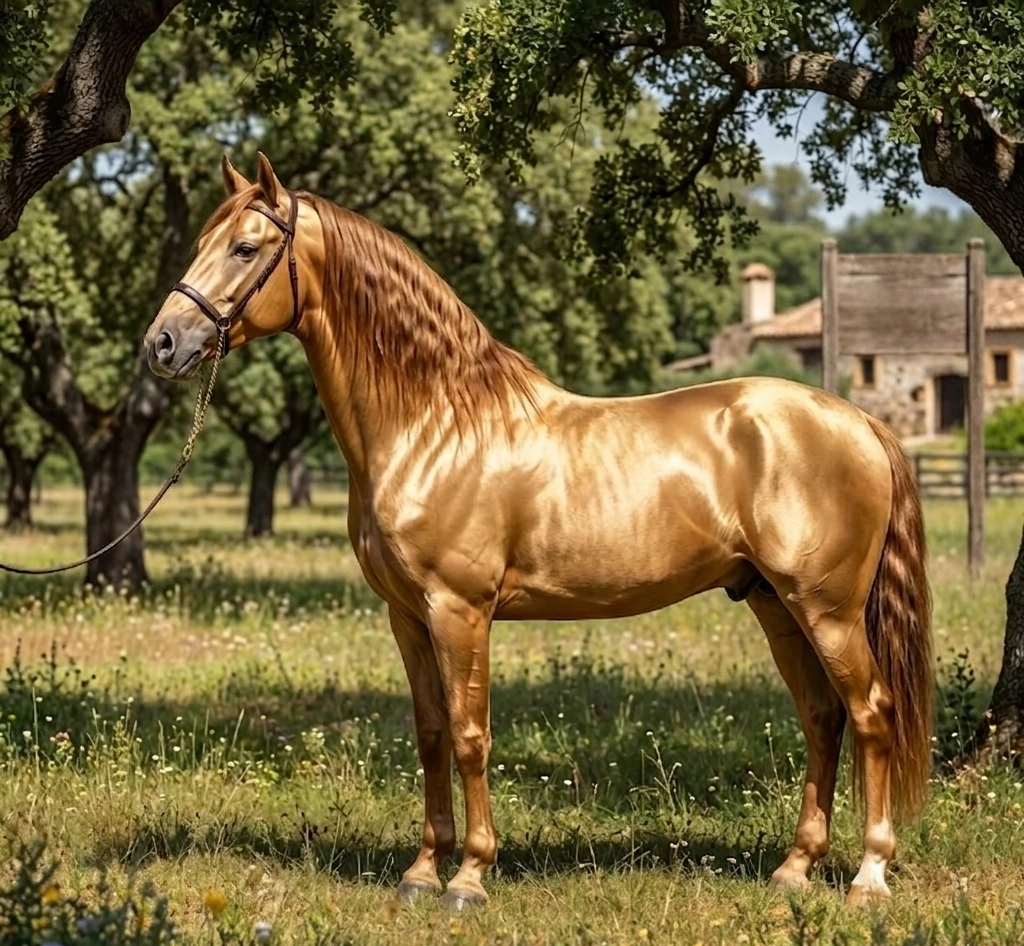
Genética de Capas en el Pura Raza Española: La Guía Científica Definitiva

PRE Coat Color Genetics: The Definitive Scientific Guide

Fellfarb-Genetik beim PRE: Der definitive wissenschaftliche Leitfaden

En el mercado internacional del Pura Raza Española, la excelencia no solo se mide por la alzada o la extensión del trote. La cromotricología —la ciencia que estudia el color de la capa— se ha consolidado como una herramienta de auditoría patrimonial indispensable. Para el ganadero que busca la diferenciación y el inversor que exige certeza, entender el código genético que define la apariencia de un ejemplar es la única vía para eliminar el riesgo y garantizar la rentabilidad a largo plazo.

01 El Pilar Genético: Los Tres Colores Base

Todo color en el PRE nace de la interacción de dos genes: Extension (MC1R) y Agouti (ASIP). Sin estos dos pilares, ninguna dilución o modificación posterior existiría.

  • Capa Castaña
    E_ A_ gg
    La más representativa del PRE (~23% del censo ANCCE 2024). El gen Agouti restringe el pigmento negro a los cabos —crines, cola y extremidades—, produciendo el característico contraste entre cuerpo caoba y puntos negros. Es la base necesaria para el Bayo y las capas Perla castaña.
  • Capa Negra
    E_ aa gg
    Valorada por su elegancia y menor frecuencia (~2%). La ausencia del gen Agouti permite que el pigmento negro se distribuya uniformemente por todo el cuerpo. Base imprescindible para el Negro Cenizo y las capas Isabela negra.
  • Capa Alazana
    ee
    La base del color rojo (~13%). Producida por la ausencia total de pigmento negro al ser homocigoto recesivo en Extension. El Agouti es irrelevante en este genotipo. Es condición indispensable para obtener el Palomino, el Cremello y la Isabela alazana.

02 El Gen Gris (STX17): La Marca Dominante del PRE

El Gris no es un color en sí mismo, sino un modificador postnatal que desencadena una despigmentación progresiva a lo largo de la vida del caballo. Es el gen dominante por excelencia en el PRE, presente en aproximadamente el 57% del censo, una frecuencia inusualmente alta en comparación con cualquier otra raza del mundo.

Su mecanismo molecular implica la duplicación del gen STX17 en el cromosoma 25, que afecta a los melanocitos de la piel. El resultado es un caballo que nace con color y blanquea progresivamente hasta alcanzar el gris perla o blanco puro en la madurez.

Homocigoto (GG)

El caballo siempre será tordo y el 100% de su descendencia será torda, independientemente de la pareja reproductora. Esta característica lo convierte en una herramienta de planificación genética de primer orden para ganaderos que trabajan con líneas de color especial: garantiza visibilidad y cobertura en el mercado de los tordos.

Heterocigoto (Gg)

El caballo es tordo, pero transmite un alelo no tordo (g) en el 50% de los casos. Cruzado con un ejemplar no tordo, produce estadísticamente un 50% de potros tordos y un 50% de potros de color, permitiendo mantener viva la producción de capas especiales.

Alerta Sanitaria — Melanoma

Estudios publicados en PLOS Genetics (Sundström et al., 2012) estiman que entre el 70 y el 80% de los caballos tordos mayores de 15 años desarrollan melanomas dérmicos. Aunque generalmente de evolución lenta, su control veterinario periódico es indispensable en la gestión de ganadería de élite. El análisis genético del estado GG/Gg permite anticipar la probabilidad de descendencia afectada.

03 El Gen Crema (SLC45A2): Diluciones y Nomenclatura ANCCE 2020

El gen Crema (mutación c.457G>A en SLC45A2) es un dominante incompleto: una copia produce dilución visible, pero es la segunda copia la que transforma radicalmente el fenotipo. El 11 de marzo de 2020, la ANCCE actualizó la nomenclatura oficial para alinearse con los laboratorios internacionales.

Diluciones Simples — una copia Crema (Cr/cr)

Estas capas mantienen la piel oscura y los ojos de color castaño. Son las más frecuentes en el mercado de capas especiales del PRE.

Denominación ANCCE 2020 Base Genotipo Descripción
Bayo (Buckskin) Castaña E_ A_ Cr/cr Cuerpo dorado-amarillento con cabos negros. Piel oscura, ojos castaños.
Palomino Alazana ee Cr/cr Cuerpo dorado brillante con crines y cola blancas. Piel oscura.
Negro Cenizo (Smoky Black) Negra E_ aa Cr/cr Pigmento negro muy apagado, con reflejos rojizos o bronce al sol. Fácilmente confundible con negro o castaño oscuro. El análisis de ADN es imprescindible para su identificación correcta.

Diluciones Dobles — dos copias Crema (Cr/Cr)

Producen ejemplares con piel rosada y ojos claros (azules o verdosos), rasgos que los identifican visualmente con facilidad y los sitúan en los segmentos de mayor valor del mercado.

Denominación ANCCE 2020 Nombre anterior Base Genotipo
Perlina Perlino Castaña E_ A_ Cr/Cr
Cremello Cremelo Alazana ee Cr/Cr
Crema Cenizo Smoky Cream Negra E_ aa Cr/Cr

04 El Gen Perla (Prl / SLC45A2): La Joya Recesiva del PRE

A diferencia del Crema, el gen Perla (mutación c.985G>A, también en el gen SLC45A2 pero en una posición distinta) sigue un patrón de herencia recesivo. Un único alelo Perla no produce dilución visible: el caballo portador (N/Prl) tiene apariencia normal. Sin embargo, sus efectos emergen en dos situaciones específicas de alto valor reproductivo.

Dato Científico Verificado

Un estudio de Avila et al. (2022) publicado en la revista Genes (MDPI) —el análisis de distribución alélica más completo realizado hasta la fecha en razas ibéricas— determinó que la frecuencia del alelo Perla en el PRE es f = 0,11 (11%), y en el PSL f = 0,064 (6,4%). Esto significa que aproximadamente 1 de cada 9 caballos PRE es portador silencioso de Perla, lo que convierte el análisis de ADN en una herramienta de planificación reproductiva esencial.

Isabela — doble Perla (Prl/Prl)

Cuando un caballo hereda dos alelos Perla, se produce uno de los fenotipos más exclusivos y cotizados del mercado ibérico. Los caballos Isabela presentan un brillo metálico único, piel rosada, ojos de color claro y un pelaje con reflejos que varía del champagne al oro pálido. Se clasifican según la base genética subyacente:

  • Isabela Castaña
    E_ A_ Prl/Prl
    Tonos dorados cálidos con reflejos metálicos. Cabos ligeramente más oscuros. Piel rosada, ojos claros.
  • Isabela Alazana
    ee Prl/Prl
    La variante más luminosa. Pelaje de color crema-champagne con brillo intenso, sin puntos oscuros.
  • Isabela Negra
    E_ aa Prl/Prl
    Tonos crema fríos o plateados. La base negra aporta un matiz particular que la distingue de las otras variantes.

Combinaciones Crema-Perla (Cr/Prl)

El heterocigoto compuesto Crema-Perla produce capas visualmente muy similares a las dobles diluciones crema —piel rosada, ojos claros— pero con una genética distinta que permite transmitir ambos genes simultáneamente a la descendencia. Esta característica les otorga un valor reproductivo superior.

05 Tabla Completa: Interacciones Crema × Perla

La siguiente tabla recoge todas las combinaciones posibles entre el estado del gen Crema y del gen Perla, sobre cada una de las tres bases genéticas.

Nombre oficial ANCCE 2020 Base Genotipo dilución Piel / Ojos
AlazánAlazanacr/cr · N/NOscura / Castaños
PalominoAlazanaCr/cr · N/NOscura / Castaños
CremelloAlazanaCr/Cr · N/NRosada / Claros
Alazán (portador Perla)Alazanacr/cr · N/PrlOscura / Castaños portador silencioso
Palomina PerlaAlazanaCr/cr · N/PrlRosada / Claros
Isabela AlazanaAlazanacr/cr · Prl/PrlRosada / Claros
Castaño / BayoCastañacr/cr · N/NOscura / Castaños
Bayo (Buckskin)CastañaCr/cr · N/NOscura / Castaños
PerlinaCastañaCr/Cr · N/NRosada / Claros
Castaño (portador Perla)Castañacr/cr · N/PrlOscura / Castaños portador silencioso
Baya PerlaCastañaCr/cr · N/PrlRosada / Claros
Isabela CastañaCastañacr/cr · Prl/PrlRosada / Claros
NegroNegracr/cr · N/NOscura / Castaños
Negro CenizoNegraCr/cr · N/NOscura / Castaños
Crema CenizoNegraCr/Cr · N/NRosada / Claros
Negro (portador Perla)Negracr/cr · N/PrlOscura / Castaños portador silencioso
Perla CenizaNegraCr/cr · N/PrlRosada / Claros
Isabela NegraNegracr/cr · Prl/PrlRosada / Claros

06 El Gen Dun (TBX3): Dilución y Marcas Primitivas

El gen Dun, mediado por el factor de transcripción TBX3, es un dilutor activo —no solo produce marcas decorativas, sino que reduce la intensidad del pigmento en el cuerpo— combinado con la aparición de marcas primitivas características: raya dorsal, cebraduras en las extremidades y posible raya en los hombros.

Existen tres variantes alélicas con efectos fenotípicos distintos, un matiz crítico para interpretar correctamente el análisis de ADN:

  • D (Dun clásico)
    D/nd2 o D/nd1
    Produce dilución real del color base (Bayo Dun, Grullo, Alazán Dun) combinada con marcas primitivas evidentes. Extremadamente raro en PRE puro.
  • nd1 (pseudo-dun)
    nd1/nd2 o nd1/nd1
    Produce marcas primitivas sin dilución del color base. Frecuencia estimada f = 0,79 en PRE (Avila et al., 2022): explica por qué muchos caballos tordos o castaños del PRE presentan raya dorsal sin ser genéticamente Dun verdadero.
  • nd2 (wild-type)
    nd2/nd2
    Alelo estándar sin efecto. No produce ni dilución ni marcas primitivas.
Implicación Práctica

La alta prevalencia del alelo nd1 en el PRE (f ≈ 0,79 según Avila 2022) significa que la raya dorsal visible en un caballo no confirma Dun verdadero. Un análisis genético es imprescindible para distinguir nd1 de D, especialmente relevante en exportación donde la nomenclatura de capa debe ser exacta.

07 Patrones Blancos en el PRE

Ruano (KIT)

El Ruano es un patrón de dilución uniforme que mezcla pelos blancos y pigmentados en el cuerpo, manteniendo cabeza y extremidades de color. Es dominante y estable a lo largo de la vida, sin el blanqueo progresivo del Gris. Infrecuente en PRE puro (<2% del censo).

Splashed White — Descubrimiento en PRE (2023)

Un patrón de blanco caracterizado por manchas simétricas en la cara (frente y maxilares), ojos azules y vientre blanco. En 2023, McFadden et al. publicaron en el Journal of Equine Veterinary Science el descubrimiento de dos nuevos alelos específicos del PRE: SW9 y SW10, identificados por primera vez exclusivamente en esta raza, lo que confirma la singularidad genética del PRE a nivel global.

Tobiano

El patrón de manchas blancas irregulares más conocido en caballos de pintos. Prácticamente inexistente en el PRE puro registrado (ANCCE); su presencia en un ejemplar declarado como PRE puro requeriría verificación genealógica.

08 Genes No Presentes en el PRE Puro

El rigor científico exige señalar también lo que no está documentado en la raza, para evitar afirmaciones sin sustento que comprometan la credibilidad del ganadero o del inversor.

  • Champagne (SLC36A1)
    Ch
    Genera piel pecosa característica, ojos ámbar y una dilución con brillo metálico sobre el color base. No ha sido documentado en estudios genómicos del PRE puro (Cook et al., 2008; Avila et al., 2022). Su presencia en un ejemplar registrado como PRE puro requeriría revisión genealógica de posibles cruces históricos.
  • Silver (PMEL17)
    Z
    Diluye selectivamente el pigmento negro, afectando cabos y crin pero no el cuerpo alazán. Detectado por primera vez en PSL (Avila 2022). Sin datos publicados de su presencia en PRE puro. Relevante en PSL por el cruce histórico con razas nórdicas y de montaña.
57% Tordos en censo PRE
ANCCE 2024
11% Portadores gen Perla
Avila et al., 2022
79% Frecuencia alelo nd1
Dun pseudo en PRE

09 Estrategia de Inversión: Por qué el ADN es su Mejor Seguro

El mercado del caballo español factura cerca de 770 millones de euros anuales, con demanda creciente de capas especiales en EE.UU., México y el Golfo Pérsico. Un error en la interpretación genética puede devaluar un activo en decenas de miles de euros.

  • Garantía de descendencia en capas especiales Un semental homocigoto para Crema (Cr/Cr) o doble Perla (Prl/Prl) garantiza que el 100% de su descendencia será, como mínimo, portadora del gen dilutor. Esto elimina la incertidumbre del plan de cría y convierte cada cubrición en un activo predecible.
  • Detección de portadores silenciosos de Perla Con una frecuencia del 11% en la población PRE, un ejemplar de apariencia normal puede ser portador N/Prl. Cruzado con otra yegua portadora, produce Isabelas —los ejemplares más cotizados del mercado de color—. Sin test de ADN, esta oportunidad queda oculta.
  • Transparencia en la exportación La nomenclatura ANCCE 2020 es la referencia legal en los certificados sanitarios y de origen internacionales. Utilizar denominaciones obsoletas ("Perlino" en lugar de "Perlina", "Isabelo" en lugar de "Isabela") genera fricción legal y desconfianza en compradores internacionales.
  • Gestión veterinaria preventiva El análisis genético del gen Gris permite anticipar el riesgo de melanoma en la planificación sanitaria. Un caballo GG homocigoto y sus crías tordas deben someterse a revisiones dermatológicas regulares a partir de los 10 años.
Golden Horses Spain

No vendemos caballos. Auditamos oportunidades.

En un mercado donde los mejores ejemplares nunca llegan a los portales públicos, la información técnica veraz es su mayor activo competitivo.

Agenda tu primera sesión de asesoría gratuita · WhatsApp Solicitar Consultoría

Referencias Científicas

  1. Avila, F. et al. (2022). Breed Distribution and Allele Frequencies of Base Coat Color, Dilute, and White Patterning Variants in 38 Horse Breeds. Genes, 13(9), 1641. DOI: 10.3390/genes13091641PubMed
  2. Durkin, K. et al. (2019). Identification of the mutation causing the Pearl coat color in horses. Animal Genetics, 50(3), 294–297. DOI: 10.1111/age.12773PubMed
  3. Holl, H.M. et al. (2019). Coat color association study of equine cream and Pearl dilution variants. Animal Genetics. DOI: 10.1111/age.12797PubMed
  4. Imsland, F. et al. (2016). Regulatory mutations in TBX3 disrupt asymmetric hair pigmentation that underlies Dun camouflage color in horses. Nature Genetics, 48, 152–158. DOI: 10.1038/ng.3475PubMed
  5. Sundström, E. et al. (2012). Splicing modulates the expression of the grey mutation in horses. PLOS Genetics. DOI: 10.1371/journal.pgen.1003­083PubMed
  6. McFadden, A. et al. (2023). New splashed white variants SW9 and SW10 identified in the PRE horse breed. Journal of Equine Veterinary Science. DOI: 10.1016/j.jevs.2023.104878PubMed
  7. Cook, D. et al. (2008). Missense mutation in the SLC36A1 gene causes the Champagne dilution coat color in horses. PLOS Genetics, 4(9). DOI: 10.1371/journal.pgen.1000195PubMed
  8. ANCCE — Libro Genealógico del PRE. Capas Genéticas (nomenclatura 2020). lgancce.com/webcapas

In the international market for the Pura Raza Española, excellence is not measured by height or trot extension alone. Chromotrichology — the science that studies coat colour — has become an indispensable asset-auditing tool. For the breeder seeking differentiation and the investor demanding certainty, understanding the genetic code behind a horse's appearance is the only way to eliminate risk and guarantee long-term profitability.

01 The Genetic Foundation: The Three Base Colours

Every colour in the PRE arises from the interaction of two genes: Extension (MC1R) and Agouti (ASIP). Without these two pillars, no later dilution or modification would exist.

  • Bay
    E_ A_ gg
    The most representative base coat in the PRE (~23% of the 2024 ANCCE census). The Agouti gene restricts black pigment to the points — mane, tail and lower legs — producing the characteristic contrast between a mahogany body and black points. It is the necessary base for Buckskin and the chestnut-based Pearl colours.
  • Black
    E_ aa gg
    Prized for its elegance and lower frequency (~2%). The absence of the Agouti gene lets black pigment spread evenly across the whole body. An essential base for Smoky Black and black-based Pearl colours.
  • Chestnut
    ee
    The base of the red colour range (~13%). Produced by the total absence of black pigment as a homozygous recessive at Extension. Agouti is irrelevant in this genotype. An indispensable condition for Palomino, Cremello and chestnut-based Pearl (Isabela).

02 The Grey Gene (STX17): The PRE's Dominant Trait

Grey is not a colour in itself but a postnatal modifier that triggers progressive depigmentation over the horse's lifetime. It is the dominant gene par excellence in the PRE, present in around 57% of the census — an unusually high frequency compared with any other breed in the world.

Its molecular mechanism involves duplication of the STX17 gene on chromosome 25, which affects skin melanocytes. The result is a horse born with colour that progressively lightens until it reaches flea-bitten grey or pure white at maturity.

Homozygous (GG)

The horse will always be grey and 100% of its offspring will be grey, regardless of the breeding partner. This trait makes it a first-rate genetic-planning tool for breeders working with special colour lines: it guarantees visibility and coverage in the grey market.

Heterozygous (Gg)

The horse is grey but passes on a non-grey allele (g) in 50% of cases. Crossed with a non-grey horse, it statistically produces 50% grey foals and 50% coloured foals, keeping the production of special colours alive.

Health Warning — Melanoma

Studies published in PLOS Genetics (Sundström et al., 2012) estimate that between 70 and 80% of grey horses over 15 years old develop dermal melanomas. Although they generally progress slowly, regular veterinary monitoring is essential in elite-breeding management. Genetic analysis of GG/Gg status makes it possible to anticipate the probability of affected offspring.

03 The Cream Gene (SLC45A2): Dilutions and the 2020 ANCCE Nomenclature

The Cream gene (mutation c.457G>A in SLC45A2) is an incomplete dominant: one copy produces visible dilution, but it's the second copy that radically transforms the phenotype. On 11 March 2020, ANCCE updated its official nomenclature to align with international laboratories.

Single Dilutions — one Cream copy (Cr/cr)

These coats keep dark skin and brown eyes. They are the most common in the PRE's special-colour market.

2020 ANCCE Name Base Genotype Description
Buckskin Bay E_ A_ Cr/cr Golden-yellow body with black points. Dark skin, brown eyes.
Palomino Chestnut ee Cr/cr Bright golden body with white mane and tail. Dark skin.
Smoky Black Black E_ aa Cr/cr Very muted black pigment, with reddish or bronze highlights in sunlight. Easily confused with black or dark bay. DNA analysis is essential for correct identification.

Double Dilutions — two Cream copies (Cr/Cr)

These produce horses with pink skin and pale eyes (blue or greenish), traits that make them easy to identify visually and place them in the market's highest-value segments.

2020 ANCCE Name Former Name Base Genotype
Perlina Perlino Bay E_ A_ Cr/Cr
Cremello Cremelo Chestnut ee Cr/Cr
Crema Cenizo Smoky Cream Black E_ aa Cr/Cr

04 The Pearl Gene (Prl / SLC45A2): The PRE's Recessive Jewel

Unlike Cream, the Pearl gene (mutation c.985G>A, also in the SLC45A2 gene but at a different position) follows a recessive inheritance pattern. A single Pearl allele produces no visible dilution: the carrier horse (N/Prl) looks normal. Its effects, however, emerge in two specific situations of high breeding value.

Verified Scientific Fact

A study by Avila et al. (2022) published in the journal Genes (MDPI) — the most complete allele-distribution analysis carried out to date in Iberian breeds — determined that the Pearl allele frequency in the PRE is f = 0.11 (11%), and in the PSL f = 0.064 (6.4%). This means roughly 1 in every 9 PRE horses is a silent Pearl carrier, which makes DNA analysis an essential breeding-planning tool.

Isabela — double Pearl (Prl/Prl)

When a horse inherits two Pearl alleles, one of the most exclusive and highly sought phenotypes in the Iberian market results. Isabela horses show a unique metallic sheen, pink skin, pale eyes and a coat with highlights ranging from champagne to pale gold. They are classified by underlying genetic base:

  • Bay Isabela
    E_ A_ Prl/Prl
    Warm golden tones with metallic highlights. Slightly darker points. Pink skin, pale eyes.
  • Chestnut Isabela
    ee Prl/Prl
    The brightest variant. Cream-champagne coat with intense sheen, no dark points.
  • Black Isabela
    E_ aa Prl/Prl
    Cool cream or silvery tones. The black base lends a particular nuance that sets it apart from the other variants.

Cream-Pearl Combinations (Cr/Prl)

The compound heterozygote Cream-Pearl produces coats visually very similar to double Cream dilutions — pink skin, pale eyes — but with a different genetic makeup that allows both genes to be passed on to offspring simultaneously. This trait gives it superior breeding value.

05 Full Table: Cream × Pearl Interactions

The table below sets out every possible combination between the Cream-gene status and the Pearl-gene status, across each of the three genetic bases.

Official 2020 ANCCE Name Base Dilution Genotype Skin / Eyes
ChestnutChestnutcr/cr · N/NDark / Brown
PalominoChestnutCr/cr · N/NDark / Brown
CremelloChestnutCr/Cr · N/NPink / Pale
Chestnut (Pearl carrier)Chestnutcr/cr · N/PrlDark / Brown silent carrier
Palomino PearlChestnutCr/cr · N/PrlPink / Pale
Chestnut IsabelaChestnutcr/cr · Prl/PrlPink / Pale
Bay / Buckskin baseBaycr/cr · N/NDark / Brown
BuckskinBayCr/cr · N/NDark / Brown
PerlinaBayCr/Cr · N/NPink / Pale
Bay (Pearl carrier)Baycr/cr · N/PrlDark / Brown silent carrier
Buckskin PearlBayCr/cr · N/PrlPink / Pale
Bay IsabelaBaycr/cr · Prl/PrlPink / Pale
BlackBlackcr/cr · N/NDark / Brown
Smoky BlackBlackCr/cr · N/NDark / Brown
Crema CenizoBlackCr/Cr · N/NPink / Pale
Black (Pearl carrier)Blackcr/cr · N/PrlDark / Brown silent carrier
Smoky PearlBlackCr/cr · N/PrlPink / Pale
Black IsabelaBlackcr/cr · Prl/PrlPink / Pale

06 The Dun Gene (TBX3): Dilution and Primitive Markings

The Dun gene, mediated by the TBX3 transcription factor, is an active diluter — it doesn't just add decorative markings, it reduces pigment intensity across the body — combined with the appearance of characteristic primitive markings: a dorsal stripe, leg barring and a possible shoulder stripe.

There are three allelic variants with distinct phenotypic effects — a critical nuance for correctly interpreting DNA analysis:

  • D (Classic Dun)
    D/nd2 or D/nd1
    Produces true dilution of the base colour (Dun Buckskin, Grullo, Red Dun) combined with obvious primitive markings. Extremely rare in purebred PRE.
  • nd1 (Pseudo-Dun)
    nd1/nd2 or nd1/nd1
    Produces primitive markings without dilution of the base colour. Estimated frequency f = 0.79 in the PRE (Avila et al., 2022): explains why many grey or bay PRE horses show a dorsal stripe without being genetically true Dun.
  • nd2 (Wild-type)
    nd2/nd2
    Standard allele with no effect. Produces neither dilution nor primitive markings.
Practical Implication

The high prevalence of the nd1 allele in the PRE (f ≈ 0.79 per Avila 2022) means a visible dorsal stripe on a horse does not confirm true Dun. Genetic analysis is essential to distinguish nd1 from D — especially relevant for export, where coat-colour nomenclature must be exact.

07 White Patterns in the PRE

Roan (KIT)

Roan is a uniform dilution pattern that mixes white and pigmented hairs across the body while keeping the head and legs coloured. It is dominant and stable throughout life, without the progressive lightening seen in Grey. Uncommon in purebred PRE (<2% of the census).

Splashed White — Discovered in the PRE (2023)

A white pattern marked by symmetrical facial patches (forehead and jaw), blue eyes and a white belly. In 2023, McFadden et al. published in the Journal of Equine Veterinary Science the discovery of two new PRE-specific alleles: SW9 and SW10, identified for the first time exclusively in this breed — confirming the PRE's genetic uniqueness on a global scale.

Tobiano

The best-known irregular white-spotting pattern in pinto horses. Practically non-existent in registered purebred PRE (ANCCE); its presence in a horse declared as purebred PRE would require pedigree verification.

08 Genes Not Present in the Purebred PRE

Scientific rigour also requires pointing out what is not documented in the breed, to avoid unsupported claims that could compromise a breeder's or investor's credibility.

  • Champagne (SLC36A1)
    Ch
    Produces characteristic freckled skin, amber eyes and a metallic-sheen dilution over the base colour. Not documented in genomic studies of the purebred PRE (Cook et al., 2008; Avila et al., 2022). Its presence in a horse registered as purebred PRE would require pedigree review for possible historical crossbreeding.
  • Silver (PMEL17)
    Z
    Selectively dilutes black pigment, affecting points and mane but not a chestnut body. First detected in the PSL (Avila 2022). No published data on its presence in the purebred PRE. Relevant in the PSL because of historical crossbreeding with Nordic and mountain breeds.
57% Grey horses in the PRE census
ANCCE 2024
11% Pearl-gene carriers
Avila et al., 2022
79% nd1 allele frequency
Pseudo-Dun in the PRE

09 Investment Strategy: Why DNA Is Your Best Insurance

The Spanish horse market turns over close to 770 million euros a year, with growing demand for special colours in the US, Mexico and the Persian Gulf. An error in genetic interpretation can devalue an asset by tens of thousands of euros.

  • Guaranteed offspring in special colours A stallion homozygous for Cream (Cr/Cr) or double Pearl (Prl/Prl) guarantees that 100% of his offspring will be, at minimum, carriers of the dilution gene. This removes uncertainty from the breeding plan and turns every covering into a predictable asset.
  • Detecting silent Pearl carriers With an 11% frequency in the PRE population, a normal-looking horse may be an N/Prl carrier. Crossed with another carrier mare, it produces Isabelas — the most sought-after horses in the colour market. Without a DNA test, this opportunity stays hidden.
  • Transparency in export The 2020 ANCCE nomenclature is the legal reference on international health and origin certificates. Using outdated names ("Perlino" instead of "Perlina", "Isabelo" instead of "Isabela") creates legal friction and distrust among international buyers.
  • Preventive veterinary management Genetic analysis of the Grey gene makes it possible to anticipate melanoma risk in health planning. A homozygous GG horse and its grey offspring should undergo regular dermatological check-ups from age 10 onward.
Golden Horses Spain

We don't sell horses. We audit opportunities.

In a market where the best horses never reach public listings, accurate technical information is your greatest competitive asset.

Book your free advisory session · WhatsApp Request Advisory

Scientific References

  1. Avila, F. et al. (2022). Breed Distribution and Allele Frequencies of Base Coat Color, Dilute, and White Patterning Variants in 38 Horse Breeds. Genes, 13(9), 1641. DOI: 10.3390/genes13091641PubMed
  2. Durkin, K. et al. (2019). Identification of the mutation causing the Pearl coat color in horses. Animal Genetics, 50(3), 294–297. DOI: 10.1111/age.12773PubMed
  3. Holl, H.M. et al. (2019). Coat color association study of equine cream and Pearl dilution variants. Animal Genetics. DOI: 10.1111/age.12797PubMed
  4. Imsland, F. et al. (2016). Regulatory mutations in TBX3 disrupt asymmetric hair pigmentation that underlies Dun camouflage color in horses. Nature Genetics, 48, 152–158. DOI: 10.1038/ng.3475PubMed
  5. Sundström, E. et al. (2012). Splicing modulates the expression of the grey mutation in horses. PLOS Genetics. DOI: 10.1371/journal.pgen.1003­083PubMed
  6. McFadden, A. et al. (2023). New splashed white variants SW9 and SW10 identified in the PRE horse breed. Journal of Equine Veterinary Science. DOI: 10.1016/j.jevs.2023.104878PubMed
  7. Cook, D. et al. (2008). Missense mutation in the SLC36A1 gene causes the Champagne dilution coat color in horses. PLOS Genetics, 4(9). DOI: 10.1371/journal.pgen.1000195PubMed
  8. ANCCE — Libro Genealógico del PRE. Capas Genéticas (nomenclatura 2020). lgancce.com/webcapas

Im internationalen Markt für den Pura Raza Española wird Exzellenz nicht nur nach Stockmaß oder Trottextension gemessen. Die Chromotrichologie — die Wissenschaft, die die Fellfarbe untersucht — hat sich als unverzichtbares Werkzeug der Bestandsauditierung etabliert. Für den Züchter, der Differenzierung sucht, und den Investor, der Sicherheit fordert, ist das Verständnis des genetischen Codes, der das Erscheinungsbild eines Exemplars bestimmt, der einzige Weg, Risiken zu eliminieren und langfristige Rentabilität zu garantieren.

01 Die genetische Grundlage: Die drei Grundfarben

Jede Farbe beim PRE entsteht aus der Wechselwirkung zweier Gene: Extension (MC1R) und Agouti (ASIP). Ohne diese beiden Pfeiler würde keine spätere Verdünnung oder Modifikation existieren.

  • Braune Grundfarbe
    E_ A_ gg
    Die repräsentativste beim PRE (~23% der ANCCE-Zählung 2024). Das Agouti-Gen beschränkt das schwarze Pigment auf die Abzeichen — Mähne, Schweif und Gliedmaßen — und erzeugt den charakteristischen Kontrast zwischen mahagonibraunem Körper und schwarzen Punkten. Grundlage für den Falben und die Kastanienperlfarben.
  • Schwarze Grundfarbe
    E_ aa gg
    Wegen ihrer Eleganz und geringeren Häufigkeit geschätzt (~2%). Das Fehlen des Agouti-Gens ermöglicht es dem schwarzen Pigment, sich gleichmäßig über den gesamten Körper zu verteilen. Unverzichtbare Grundlage für den Rauchgrau und die schwarzen Isabela-Farben.
  • Fuchsgrundfarbe
    ee
    Die Grundlage der Rotfarbe (~13%). Durch das völlige Fehlen von schwarzem Pigment als homozygoter Rezessiver bei Extension erzeugt. Das Agouti ist in diesem Genotyp irrelevant. Unabdingbare Voraussetzung für den Palomino, den Cremello und den Fuchsisabela.

02 Das Schimmelgen (STX17): Das dominante Merkmal des PRE

Das Schimmel ist keine eigenständige Farbe, sondern ein postnataler Modifikator, der eine progressive Entpigmentierung im Laufe des Lebens auslöst. Es ist das schlechthin dominante Gen beim PRE, bei etwa 57% der Zählung vorhanden — eine ungewöhnlich hohe Häufigkeit im Vergleich zu jeder anderen Rasse der Welt.

Sein molekularer Mechanismus beinhaltet die Duplikation des Gens STX17 auf Chromosom 25, das die Melanozyten der Haut betrifft. Das Ergebnis ist ein Pferd, das farbig geboren wird und sich progressiv aufhellt, bis es in der Reife Perlaschimmel oder reines Weiß erreicht.

Homozygot (GG)

Das Pferd wird immer schimmelfarben sein und 100% seiner Nachkommen werden Schimmel sein, unabhängig vom Zuchtpartner. Diese Eigenschaft macht es zu einem erstklassigen Werkzeug der Genetikplanung für Züchter, die mit speziellen Farblinien arbeiten: Es garantiert Sichtbarkeit und Abdeckung auf dem Schimmelmarkt.

Heterozygot (Gg)

Das Pferd ist schimmelfarben, überträgt aber in 50% der Fälle ein Nicht-Schimmel-Allel (g). Mit einem Nicht-Schimmel-Exemplar gekreuzt, produziert es statistisch 50% Schimmelfohlen und 50% farbige Fohlen und hält so die Produktion spezieller Farben aufrecht.

Gesundheitswarnung — Melanom

Studien in PLOS Genetics (Sundström et al., 2012) schätzen, dass zwischen 70 und 80% der Schimmel über 15 Jahre Hautmelanome entwickeln. Obwohl sie sich im Allgemeinen langsam entwickeln, ist ihre regelmäßige tierärztliche Kontrolle in der Elitezucht unverzichtbar. Die genetische Analyse des GG/Gg-Status ermöglicht, die Wahrscheinlichkeit betroffener Nachkommen vorauszusagen.

03 Das Cremegen (SLC45A2): Verdünnungen und ANCCE-Nomenklatur 2020

Das Cremegen (Mutation c.457G>A in SLC45A2) ist ein unvollständig Dominantes: eine Kopie erzeugt sichtbare Verdünnung, aber erst die zweite Kopie verändert den Phänotyp radikal. Am 11. März 2020 aktualisierte die ANCCE die offizielle Nomenklatur, um sie mit internationalen Labors zu harmonisieren.

Einfache Verdünnungen — eine Cremekopie (Cr/cr)

Diese Farben behalten dunkle Haut und braune Augen. Sie sind die häufigsten im Markt der Sonderfarben des PRE.

ANCCE-Bezeichnung 2020GrundlageGenotypBeschreibung
Falbe (Buckskin)BraunE_ A_ Cr/crGoldgelber Körper mit schwarzen Abzeichen. Dunkle Haut, braune Augen.
PalominoFuchsee Cr/crHellgoldener Körper mit weißer Mähne und Schweif. Dunkle Haut.
Rauchschwarz (Smoky Black)SchwarzE_ aa Cr/crSehr gedämpftes schwarzes Pigment mit rötlichen oder bronzenen Reflexen in der Sonne. Leicht mit Schwarz oder Dunkelbraun zu verwechseln. DNA-Analyse unverzichtbar für korrekte Identifikation.

Doppelte Verdünnungen — zwei Cremekopien (Cr/Cr)

Sie erzeugen Exemplare mit rosafarbener Haut und hellen Augen (blau oder grünlich), Merkmale, die sie visuell leicht erkennbar machen und sie in den Segmenten mit dem höchsten Marktwert positionieren.

ANCCE-Bezeichnung 2020Frühere BezeichnungGrundlageGenotyp
PerlinaPerlinoBraunE_ A_ Cr/Cr
CremelloCremeloFuchsee Cr/Cr
Crema CenizoSmoky CreamSchwarzE_ aa Cr/Cr

04 Das Perlgen (Prl / SLC45A2): Das rezessive Juwel des PRE

Im Gegensatz zum Cremegen folgt das Perlgen (Mutation c.985G>A, ebenfalls im Gen SLC45A2 aber an einer anderen Position) einem rezessiven Vererbungsmuster. Ein einzelnes Perla-Allel erzeugt keine sichtbare Verdünnung: der Träger (N/Prl) sieht normal aus. Seine Effekte treten jedoch in zwei spezifischen Situationen von hohem reproduktivem Wert auf.

Wissenschaftlich Verifizierter Fakt

Eine Studie von Avila et al. (2022) in der Zeitschrift Genes (MDPI) — die vollständigste Analyse der Allelverteilung bei iberischen Rassen bislang — bestimmte, dass die Häufigkeit des Perla-Allels beim PRE f = 0,11 (11%) beträgt und beim PSL f = 0,064 (6,4%). Das bedeutet, dass etwa 1 von 9 PRE-Pferden ein stiller Träger von Perla ist — die DNA-Analyse ist daher ein unverzichtbares Werkzeug der Reproduktionsplanung.

Isabela — doppeltes Perla (Prl/Prl)

Wenn ein Pferd zwei Perla-Allele erbt, entsteht einer der exklusivsten und wertvollsten Phänotypen des iberischen Marktes. Isabela-Pferde zeigen einen einzigartigen metallischen Glanz, rosafarbene Haut, helle Augen und ein Fell mit Reflexen, die von Champagner bis blassem Gold variieren. Sie werden nach der genetischen Grundlage klassifiziert:

  • Kastanienisabela
    E_ A_ Prl/Prl
    Warme goldene Töne mit metallischen Reflexen. Etwas dunklere Abzeichen. Rosafarbene Haut, helle Augen.
  • Fuchsisabela
    ee Prl/Prl
    Die leuchtendste Variante. Creme-Champagner-farbenes Fell mit intensivem Glanz, ohne dunkle Abzeichen.
  • Schwarzisabela
    E_ aa Prl/Prl
    Kühle cremeige oder silbrige Töne. Die schwarze Grundlage verleiht eine besondere Nuance, die sie von den anderen Varianten unterscheidet.

Creme-Perla-Kombinationen (Cr/Prl)

Der zusammengesetzte Heterozygot Creme-Perla erzeugt Farben, die den doppelten Cremeverdünnungen visuell sehr ähnlich sind — rosafarbene Haut, helle Augen —, aber mit einer anderen Genetik, die es ermöglicht, beide Gene gleichzeitig an die Nachkommen zu übertragen. Diese Eigenschaft verleiht ihnen einen überlegenen Reproduktionswert.

05 Vollständige Tabelle: Creme × Perla Wechselwirkungen

Die folgende Tabelle zeigt alle möglichen Kombinationen zwischen dem Creme-Gen-Status und dem Perla-Gen-Status für jede der drei genetischen Grundlagen.

Offizieller ANCCE-Name 2020GrundlageVerdünnungsgenotypHaut / Augen
FuchsFuchscr/cr · N/NDunkel / Braun
PalominoFuchsCr/cr · N/NDunkel / Braun
CremelloFuchsCr/Cr · N/NRosa / Hell
Fuchs (Perla-Träger)Fuchscr/cr · N/PrlDunkel / Braun stiller Träger
Palomino PerlaFuchsCr/cr · N/PrlRosa / Hell
FuchsisabelaFuchscr/cr · Prl/PrlRosa / Hell
Braun / FalbeBrauncr/cr · N/NDunkel / Braun
Falbe (Buckskin)BraunCr/cr · N/NDunkel / Braun
PerlinaBraunCr/Cr · N/NRosa / Hell
Braun (Perla-Träger)Brauncr/cr · N/PrlDunkel / Braun stiller Träger
Falben-PerlaBraunCr/cr · N/PrlRosa / Hell
KastanienisabelaBrauncr/cr · Prl/PrlRosa / Hell
SchwarzSchwarzcr/cr · N/NDunkel / Braun
RauchschwarzSchwarzCr/cr · N/NDunkel / Braun
Crema CenizoSchwarzCr/Cr · N/NRosa / Hell
Schwarz (Perla-Träger)Schwarzcr/cr · N/PrlDunkel / Braun stiller Träger
Perla CenizaSchwarzCr/cr · N/PrlRosa / Hell
SchwarzisabelaSchwarzcr/cr · Prl/PrlRosa / Hell

06 Das Dun-Gen (TBX3): Verdünnung und Urzeichnungen

Das Dun-Gen, vermittelt durch den Transkriptionsfaktor TBX3, ist ein aktiver Verdünner — er reduziert nicht nur die Pigmentintensität im Körper, sondern erzeugt auch charakteristische Urzeichnungen: Aalstrich, Zebrierung an den Gliedmaßen und möglicher Schulterstreifen.

Es gibt drei Allelvarianten mit unterschiedlichen phänotypischen Effekten — ein kritischer Nuancen für die korrekte Interpretation der DNA-Analyse:

  • D (klassisches Dun)
    D/nd2 oder D/nd1
    Erzeugt echte Verdünnung der Grundfarbe (Dun-Falbe, Grullo, Dun-Fuchs) kombiniert mit auffälligen Urzeichnungen. Beim reinen PRE extrem selten.
  • nd1 (Pseudo-Dun)
    nd1/nd2 oder nd1/nd1
    Erzeugt Urzeichnungen ohne Verdünnung der Grundfarbe. Geschätzte Häufigkeit f = 0,79 beim PRE (Avila et al., 2022): erklärt, warum viele Schimmel- oder Braunpferde des PRE einen Aalstrich aufweisen, ohne genetisch echtes Dun zu sein.
  • nd2 (Wildtyp)
    nd2/nd2
    Standard-Allel ohne Effekt. Erzeugt weder Verdünnung noch Urzeichnungen.
Praktische Konsequenz

Die hohe Prävalenz des nd1-Allels beim PRE (f ≈ 0,79 gemäß Avila 2022) bedeutet, dass ein sichtbarer Aalstrich bei einem Pferd kein echtes Dun bestätigt. Eine genetische Analyse ist unverzichtbar, um nd1 von D zu unterscheiden — besonders relevant beim Export, wo die Fellfarb-Nomenklatur exakt sein muss.

07 Weiße Muster beim PRE

Roan (KIT)

Der Roan ist ein gleichmäßiges Verdünnungsmuster, das weiße und pigmentierte Haare im Körper mischt und Kopf und Gliedmaßen farbig lässt. Es ist dominant und stabil im Laufe des Lebens, ohne die progressive Aufhellung des Schimmels. Beim reinen PRE selten (<2% der Zählung).

Splashed White — Entdeckung beim PRE (2023)

Ein weißes Muster, das durch symmetrische Flecken im Gesicht (Stirn und Kiefer), blaue Augen und weißen Bauch gekennzeichnet ist. Im Jahr 2023 veröffentlichten McFadden et al. im Journal of Equine Veterinary Science die Entdeckung zweier neuer PRE-spezifischer Allele: SW9 und SW10, die erstmals ausschließlich in dieser Rasse identifiziert wurden — ein Beweis für die weltweite genetische Einzigartigkeit des PRE.

Tobiano

Das bekannteste Weißfleckenmuster bei Schecken. Beim registrierten reinen PRE (ANCCE) praktisch nicht existent; seine Anwesenheit bei einem als reiner PRE deklarierten Exemplar würde eine genealogische Überprüfung erfordern.

08 Nicht vorhandene Gene beim reinen PRE

Wissenschaftliche Strenge erfordert auch anzumerken, was in der Rasse nicht dokumentiert ist, um unbegründete Behauptungen zu vermeiden, die die Glaubwürdigkeit des Züchters oder Investors gefährden.

  • Champagne (SLC36A1)
    Ch
    Erzeugt charakteristische gesprenkelte Haut, Bernsteinaugen und eine Verdünnung mit metallischem Glanz. In genomischen Studien des reinen PRE nicht dokumentiert (Cook et al., 2008; Avila et al., 2022). Seine Anwesenheit bei einem als reiner PRE registrierten Exemplar würde eine genealogische Überprüfung erfordern.
  • Silver (PMEL17)
    Z
    Verdünnt selektiv das schwarze Pigment und betrifft Abzeichen und Mähne, nicht aber den Fuchskörper. Erstmals beim PSL nachgewiesen (Avila 2022). Keine veröffentlichten Daten über seine Anwesenheit beim reinen PRE. Relevant beim PSL aufgrund historischer Kreuzungen mit nordischen Rassen.
57%Schimmel bei PRE-Zählung
ANCCE 2024
11%Träger des Perlgens
Avila et al., 2022
79%Häufigkeit des nd1-Allels
Pseudo-Dun beim PRE

09 Anlagestrategie: Warum DNA Ihre beste Versicherung ist

Der spanische Pferdemarkt setzt rund 770 Millionen Euro jährlich um, mit wachsender Nachfrage nach Sonderfarben in den USA, Mexiko und am Persischen Golf. Ein Fehler bei der genetischen Interpretation kann einen Vermögenswert um Zehntausende von Euro entwerten.

  • Garantie der Nachkommenschaft in Sonderfarben Ein für Creme (Cr/Cr) oder doppeltes Perla (Prl/Prl) homozygoter Hengst garantiert, dass 100% seiner Nachkommen mindestens Träger des Verdünnungsgens sein werden. Dies eliminiert die Unsicherheit im Zuchtplan und macht jede Belegung zu einem vorhersehbaren Vermögenswert.
  • Erkennung stiller Perla-Träger Mit einer Häufigkeit von 11% in der PRE-Population kann ein äußerlich normales Exemplar ein N/Prl-Träger sein. Mit einer anderen Trägerstute gekreuzt, produziert es Isabelas — die wertvollsten Exemplare im Farbmarkt. Ohne DNA-Test bleibt diese Gelegenheit verborgen.
  • Transparenz beim Export Die ANCCE-Nomenklatur 2020 ist der gesetzliche Standard in internationalen Gesundheits- und Herkunftszertifikaten. Veraltete Bezeichnungen ('Perlino' statt 'Perlina', 'Isabelo' statt 'Isabela') erzeugen rechtliche Schwierigkeiten und Misstrauen bei internationalen Käufern.
  • Präventives Veterinärmanagement Die genetische Analyse des Schimmelgens ermöglicht es, das Melanomrisiko in der Gesundheitsplanung vorwegzunehmen. Ein homozygoter GG-Hengst und seine Schimmelnachkommen sollten ab dem 10. Lebensjahr regelmäßigen dermatologischen Untersuchungen unterzogen werden.
Golden Horses Spain

Wir verkaufen keine Pferde. Wir prüfen Möglichkeiten.

In einem Markt, in dem die besten Exemplare nie auf öffentliche Portale gelangen, sind verlässliche technische Informationen Ihr größter Wettbewerbsvorteil.

Vereinbare deine kostenlose Erstberatung · WhatsApp Beratung anfragen

Wissenschaftliche Referenzen

  1. Avila, F. et al. (2022). Breed Distribution and Allele Frequencies of Base Coat Color, Dilute, and White Patterning Variants in 38 Horse Breeds. Genes, 13(9), 1641. DOI: 10.3390/genes13091641PubMed
  2. Durkin, K. et al. (2019). Identification of the mutation causing the Pearl coat color in horses. Animal Genetics, 50(3), 294–297. DOI: 10.1111/age.12773PubMed
  3. Holl, H.M. et al. (2019). Coat color association study of equine cream and Pearl dilution variants. Animal Genetics. DOI: 10.1111/age.12797PubMed
  4. Imsland, F. et al. (2016). Regulatory mutations in TBX3 disrupt asymmetric hair pigmentation that underlies Dun camouflage color in horses. Nature Genetics, 48, 152–158. DOI: 10.1038/ng.3475PubMed
  5. Sundström, E. et al. (2012). Splicing modulates the expression of the grey mutation in horses. PLOS Genetics. DOI: 10.1371/journal.pgen.1003083PubMed
  6. McFadden, A. et al. (2023). New splashed white variants SW9 and SW10 identified in the PRE horse breed. Journal of Equine Veterinary Science. DOI: 10.1016/j.jevs.2023.104878PubMed
  7. Cook, D. et al. (2008). Missense mutation in the SLC36A1 gene causes the Champagne dilution coat color in horses. PLOS Genetics, 4(9). DOI: 10.1371/journal.pgen.1000195PubMed
  8. ANCCE — Libro Genealógico del PRE. Capas Genéticas (nomenclatura 2020). lgancce.com/webcapas

Weiterlesen

Die Wissenschaft der Eleganz: Geschichte des Pura Raza Español
Ein PRE-Pferd in Spanien sicher kaufen (Leitfaden 2026)