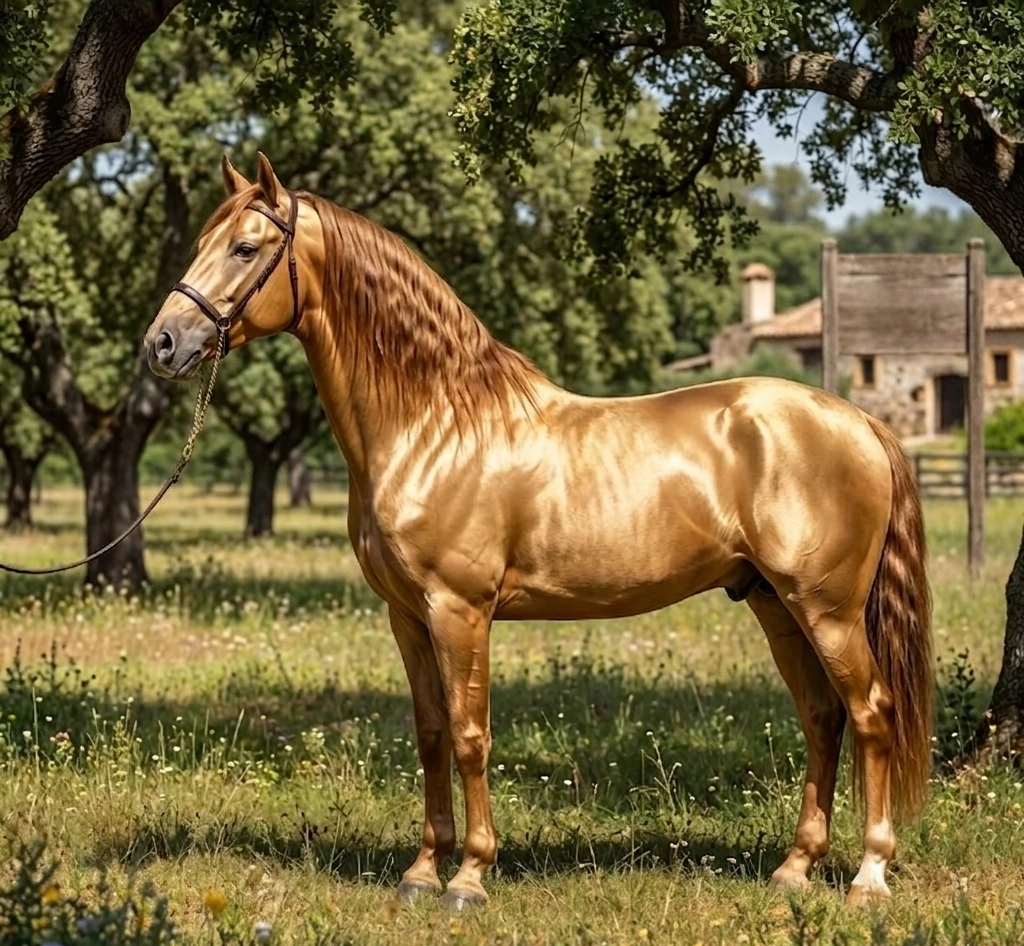
PRE specimen with golden Isabela chestnut coat (ee · Prl/Prl) — Spanish dehesa
Equine Genetics · Golden Horses Spain
PRE Coat Color Genetics: The Definitive Scientific Guide
In the international market for the Pura Raza Española, excellence is not measured by height or trot extension alone. Chromotrichology — the science that studies coat colour — has become an indispensable asset-auditing tool. For the breeder seeking differentiation and the investor demanding certainty, understanding the genetic code behind a horse's appearance is the only way to eliminate risk and guarantee long-term profitability.
01 The Genetic Foundation: The Three Base Colours
Every colour in the PRE arises from the interaction of two genes: Extension (MC1R) and Agouti (ASIP). Without these two pillars, no later dilution or modification would exist.
-
BayE_ A_ ggThe most representative base coat in the PRE (~23% of the 2024 ANCCE census). The Agouti gene restricts black pigment to the points — mane, tail and lower legs — producing the characteristic contrast between a mahogany body and black points. It is the necessary base for Buckskin and the chestnut-based Pearl colours.
-
BlackE_ aa ggPrized for its elegance and lower frequency (~2%). The absence of the Agouti gene lets black pigment spread evenly across the whole body. An essential base for Smoky Black and black-based Pearl colours.
-
ChestnuteeThe base of the red colour range (~13%). Produced by the total absence of black pigment as a homozygous recessive at Extension. Agouti is irrelevant in this genotype. An indispensable condition for Palomino, Cremello and chestnut-based Pearl (Isabela).
02 The Grey Gene (STX17): The PRE's Dominant Trait
Grey is not a colour in itself but a postnatal modifier that triggers progressive depigmentation over the horse's lifetime. It is the dominant gene par excellence in the PRE, present in around 57% of the census — an unusually high frequency compared with any other breed in the world.
Its molecular mechanism involves duplication of the STX17 gene on chromosome 25, which affects skin melanocytes. The result is a horse born with colour that progressively lightens until it reaches flea-bitten grey or pure white at maturity.
Homozygous (GG)
The horse will always be grey and 100% of its offspring will be grey, regardless of the breeding partner. This trait makes it a first-rate genetic-planning tool for breeders working with special colour lines: it guarantees visibility and coverage in the grey market.
Heterozygous (Gg)
The horse is grey but passes on a non-grey allele (g) in 50% of cases. Crossed with a non-grey horse, it statistically produces 50% grey foals and 50% coloured foals, keeping the production of special colours alive.
Studies published in PLOS Genetics (Sundström et al., 2012) estimate that between 70 and 80% of grey horses over 15 years old develop dermal melanomas. Although they generally progress slowly, regular veterinary monitoring is essential in elite-breeding management. Genetic analysis of GG/Gg status makes it possible to anticipate the probability of affected offspring.
03 The Cream Gene (SLC45A2): Dilutions and the 2020 ANCCE Nomenclature
The Cream gene (mutation c.457G>A in SLC45A2) is an incomplete dominant: one copy produces visible dilution, but it's the second copy that radically transforms the phenotype. On 11 March 2020, ANCCE updated its official nomenclature to align with international laboratories.
Single Dilutions — one Cream copy (Cr/cr)
These coats keep dark skin and brown eyes. They are the most common in the PRE's special-colour market.
| 2020 ANCCE Name | Base | Genotype | Description |
|---|---|---|---|
| Buckskin | Bay | E_ A_ Cr/cr | Golden-yellow body with black points. Dark skin, brown eyes. |
| Palomino | Chestnut | ee Cr/cr | Bright golden body with white mane and tail. Dark skin. |
| Smoky Black | Black | E_ aa Cr/cr | Very muted black pigment, with reddish or bronze highlights in sunlight. Easily confused with black or dark bay. DNA analysis is essential for correct identification. |
Double Dilutions — two Cream copies (Cr/Cr)
These produce horses with pink skin and pale eyes (blue or greenish), traits that make them easy to identify visually and place them in the market's highest-value segments.
| 2020 ANCCE Name | Former Name | Base | Genotype |
|---|---|---|---|
| Perlina | Perlino | Bay | E_ A_ Cr/Cr |
| Cremello | Cremelo | Chestnut | ee Cr/Cr |
| Crema Cenizo | Smoky Cream | Black | E_ aa Cr/Cr |
04 The Pearl Gene (Prl / SLC45A2): The PRE's Recessive Jewel
Unlike Cream, the Pearl gene (mutation c.985G>A, also in the SLC45A2 gene but at a different position) follows a recessive inheritance pattern. A single Pearl allele produces no visible dilution: the carrier horse (N/Prl) looks normal. Its effects, however, emerge in two specific situations of high breeding value.
A study by Avila et al. (2022) published in the journal Genes (MDPI) — the most complete allele-distribution analysis carried out to date in Iberian breeds — determined that the Pearl allele frequency in the PRE is f = 0.11 (11%), and in the PSL f = 0.064 (6.4%). This means roughly 1 in every 9 PRE horses is a silent Pearl carrier, which makes DNA analysis an essential breeding-planning tool.
Isabela — double Pearl (Prl/Prl)
When a horse inherits two Pearl alleles, one of the most exclusive and highly sought phenotypes in the Iberian market results. Isabela horses show a unique metallic sheen, pink skin, pale eyes and a coat with highlights ranging from champagne to pale gold. They are classified by underlying genetic base:
-
Bay IsabelaE_ A_ Prl/PrlWarm golden tones with metallic highlights. Slightly darker points. Pink skin, pale eyes.
-
Chestnut Isabelaee Prl/PrlThe brightest variant. Cream-champagne coat with intense sheen, no dark points.
-
Black IsabelaE_ aa Prl/PrlCool cream or silvery tones. The black base lends a particular nuance that sets it apart from the other variants.
Cream-Pearl Combinations (Cr/Prl)
The compound heterozygote Cream-Pearl produces coats visually very similar to double Cream dilutions — pink skin, pale eyes — but with a different genetic makeup that allows both genes to be passed on to offspring simultaneously. This trait gives it superior breeding value.
05 Full Table: Cream × Pearl Interactions
The table below sets out every possible combination between the Cream-gene status and the Pearl-gene status, across each of the three genetic bases.
| Official 2020 ANCCE Name | Base | Dilution Genotype | Skin / Eyes |
|---|---|---|---|
| Chestnut | Chestnut | cr/cr · N/N | Dark / Brown |
| Palomino | Chestnut | Cr/cr · N/N | Dark / Brown |
| Cremello | Chestnut | Cr/Cr · N/N | Pink / Pale |
| Chestnut (Pearl carrier) | Chestnut | cr/cr · N/Prl | Dark / Brown silent carrier |
| Palomino Pearl | Chestnut | Cr/cr · N/Prl | Pink / Pale |
| Chestnut Isabela | Chestnut | cr/cr · Prl/Prl | Pink / Pale |
| Bay / Buckskin base | Bay | cr/cr · N/N | Dark / Brown |
| Buckskin | Bay | Cr/cr · N/N | Dark / Brown |
| Perlina | Bay | Cr/Cr · N/N | Pink / Pale |
| Bay (Pearl carrier) | Bay | cr/cr · N/Prl | Dark / Brown silent carrier |
| Buckskin Pearl | Bay | Cr/cr · N/Prl | Pink / Pale |
| Bay Isabela | Bay | cr/cr · Prl/Prl | Pink / Pale |
| Black | Black | cr/cr · N/N | Dark / Brown |
| Smoky Black | Black | Cr/cr · N/N | Dark / Brown |
| Crema Cenizo | Black | Cr/Cr · N/N | Pink / Pale |
| Black (Pearl carrier) | Black | cr/cr · N/Prl | Dark / Brown silent carrier |
| Smoky Pearl | Black | Cr/cr · N/Prl | Pink / Pale |
| Black Isabela | Black | cr/cr · Prl/Prl | Pink / Pale |
06 The Dun Gene (TBX3): Dilution and Primitive Markings
The Dun gene, mediated by the TBX3 transcription factor, is an active diluter — it doesn't just add decorative markings, it reduces pigment intensity across the body — combined with the appearance of characteristic primitive markings: a dorsal stripe, leg barring and a possible shoulder stripe.
There are three allelic variants with distinct phenotypic effects — a critical nuance for correctly interpreting DNA analysis:
-
D (Classic Dun)D/nd2 or D/nd1Produces true dilution of the base colour (Dun Buckskin, Grullo, Red Dun) combined with obvious primitive markings. Extremely rare in purebred PRE.
-
nd1 (Pseudo-Dun)nd1/nd2 or nd1/nd1Produces primitive markings without dilution of the base colour. Estimated frequency f = 0.79 in the PRE (Avila et al., 2022): explains why many grey or bay PRE horses show a dorsal stripe without being genetically true Dun.
-
nd2 (Wild-type)nd2/nd2Standard allele with no effect. Produces neither dilution nor primitive markings.
The high prevalence of the nd1 allele in the PRE (f ≈ 0.79 per Avila 2022) means a visible dorsal stripe on a horse does not confirm true Dun. Genetic analysis is essential to distinguish nd1 from D — especially relevant for export, where coat-colour nomenclature must be exact.
07 White Patterns in the PRE
Roan (KIT)
Roan is a uniform dilution pattern that mixes white and pigmented hairs across the body while keeping the head and legs coloured. It is dominant and stable throughout life, without the progressive lightening seen in Grey. Uncommon in purebred PRE (<2% of the census).
Splashed White — Discovered in the PRE (2023)
A white pattern marked by symmetrical facial patches (forehead and jaw), blue eyes and a white belly. In 2023, McFadden et al. published in the Journal of Equine Veterinary Science the discovery of two new PRE-specific alleles: SW9 and SW10, identified for the first time exclusively in this breed — confirming the PRE's genetic uniqueness on a global scale.
Tobiano
The best-known irregular white-spotting pattern in pinto horses. Practically non-existent in registered purebred PRE (ANCCE); its presence in a horse declared as purebred PRE would require pedigree verification.
08 Genes Not Present in the Purebred PRE
Scientific rigour also requires pointing out what is not documented in the breed, to avoid unsupported claims that could compromise a breeder's or investor's credibility.
-
Champagne (SLC36A1)ChProduces characteristic freckled skin, amber eyes and a metallic-sheen dilution over the base colour. Not documented in genomic studies of the purebred PRE (Cook et al., 2008; Avila et al., 2022). Its presence in a horse registered as purebred PRE would require pedigree review for possible historical crossbreeding.
-
Silver (PMEL17)ZSelectively dilutes black pigment, affecting points and mane but not a chestnut body. First detected in the PSL (Avila 2022). No published data on its presence in the purebred PRE. Relevant in the PSL because of historical crossbreeding with Nordic and mountain breeds.
ANCCE 2024
Avila et al., 2022
Pseudo-Dun in the PRE
09 Investment Strategy: Why DNA Is Your Best Insurance
The Spanish horse market turns over close to 770 million euros a year, with growing demand for special colours in the US, Mexico and the Persian Gulf. An error in genetic interpretation can devalue an asset by tens of thousands of euros.
- Guaranteed offspring in special colours A stallion homozygous for Cream (Cr/Cr) or double Pearl (Prl/Prl) guarantees that 100% of his offspring will be, at minimum, carriers of the dilution gene. This removes uncertainty from the breeding plan and turns every covering into a predictable asset.
- Detecting silent Pearl carriers With an 11% frequency in the PRE population, a normal-looking horse may be an N/Prl carrier. Crossed with another carrier mare, it produces Isabelas — the most sought-after horses in the colour market. Without a DNA test, this opportunity stays hidden.
- Transparency in export The 2020 ANCCE nomenclature is the legal reference on international health and origin certificates. Using outdated names ("Perlino" instead of "Perlina", "Isabelo" instead of "Isabela") creates legal friction and distrust among international buyers.
- Preventive veterinary management Genetic analysis of the Grey gene makes it possible to anticipate melanoma risk in health planning. A homozygous GG horse and its grey offspring should undergo regular dermatological check-ups from age 10 onward.
We don't sell horses. We audit opportunities.
In a market where the best horses never reach public listings, accurate technical information is your greatest competitive asset.
Book your free advisory session · WhatsApp Request AdvisoryScientific References
- Avila, F. et al. (2022). Breed Distribution and Allele Frequencies of Base Coat Color, Dilute, and White Patterning Variants in 38 Horse Breeds. Genes, 13(9), 1641. DOI: 10.3390/genes13091641 — PubMed
- Durkin, K. et al. (2019). Identification of the mutation causing the Pearl coat color in horses. Animal Genetics, 50(3), 294–297. DOI: 10.1111/age.12773 — PubMed
- Holl, H.M. et al. (2019). Coat color association study of equine cream and Pearl dilution variants. Animal Genetics. DOI: 10.1111/age.12797 — PubMed
- Imsland, F. et al. (2016). Regulatory mutations in TBX3 disrupt asymmetric hair pigmentation that underlies Dun camouflage color in horses. Nature Genetics, 48, 152–158. DOI: 10.1038/ng.3475 — PubMed
- Sundström, E. et al. (2012). Splicing modulates the expression of the grey mutation in horses. PLOS Genetics. DOI: 10.1371/journal.pgen.1003083 — PubMed
- McFadden, A. et al. (2023). New splashed white variants SW9 and SW10 identified in the PRE horse breed. Journal of Equine Veterinary Science. DOI: 10.1016/j.jevs.2023.104878 — PubMed
- Cook, D. et al. (2008). Missense mutation in the SLC36A1 gene causes the Champagne dilution coat color in horses. PLOS Genetics, 4(9). DOI: 10.1371/journal.pgen.1000195 — PubMed
- ANCCE — Libro Genealógico del PRE. Capas Genéticas (nomenclatura 2020). lgancce.com/webcapas