The Engineered Horse:
How the Netherlands Designed
the Perfect Equine Athlete
History, breeding-line specialisation, genomic predicates and the WBFSH world leadership of the KWPN — the most decorated sport horse on the planet.
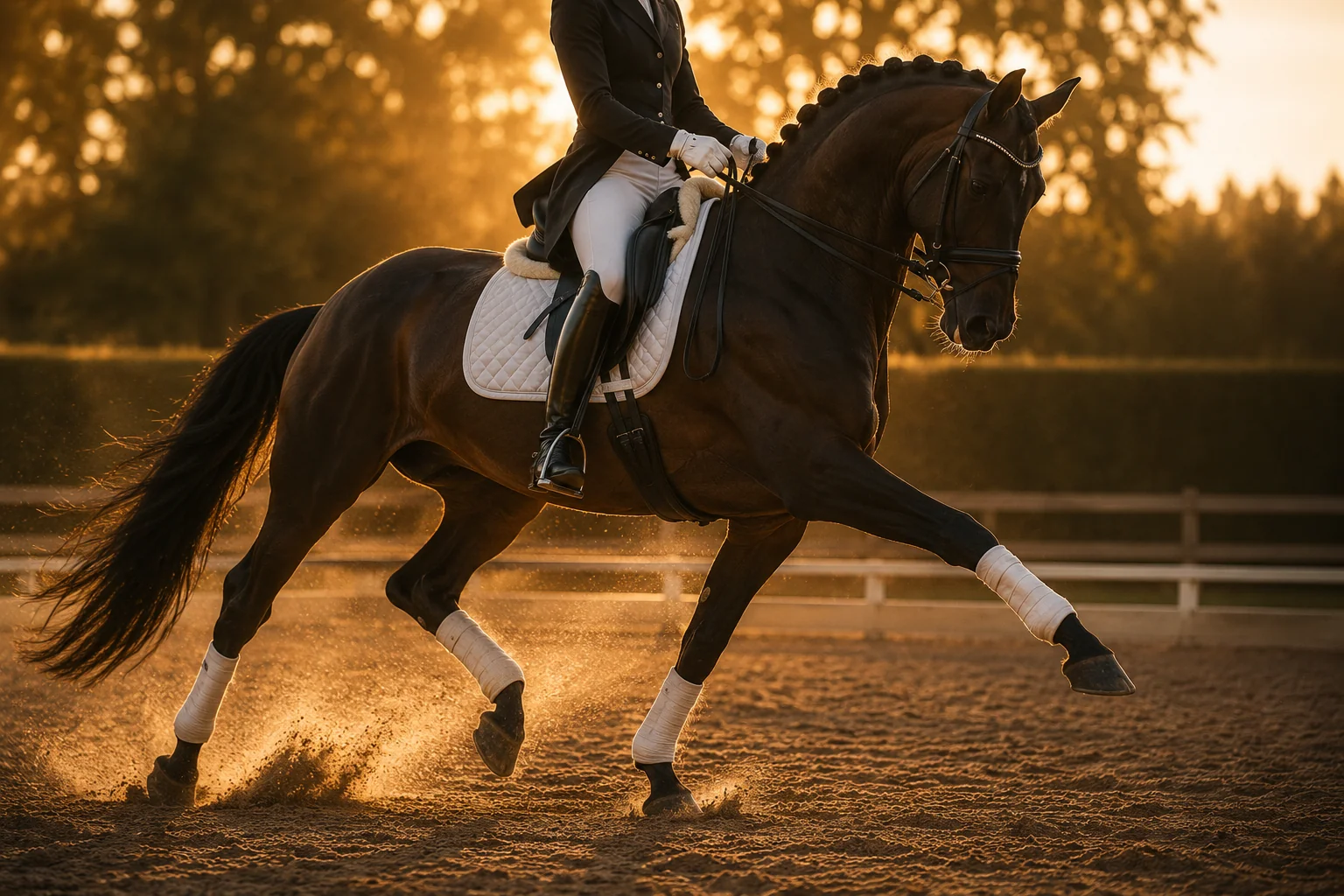
Some breeds are inherited from the past; others are engineered for the future. The KWPN — Koninklijk Warmbloed Paardenstamboek Nederland — belongs to the second category: born from the plough and farm labour, and reinvented within a single century into the precision machine that now dominates Olympic-level dressage and show jumping. This is no genetic accident. It is the result of one of the most rigorous selection policies in all of world zootechnics.
of the first studbook
WBFSH 2025 (12,783 pts)
as world nº1 (2017-25)
breed's historic record
01 From the Plough to the Olympus: the historical evolution
Regulated warmblood breeding in the Netherlands officially began in 1887, when King William II recognised the country's first studbook organisation. For over half a century, Dutch breeding remained fragmented into regional registries oriented toward agriculture: the robust Groninger from the north, bred on heavy clay soils for draught power, and the lighter, more elegant Gelderlander, bred on sandy soils for smart carriage driving.
Post-WWII farm mechanisation made these animals obsolete in their traditional roles. Rather than allow their extinction, Dutch breeders boldly redirected their programmes toward equestrian sport, introducing Thoroughbred blood and Holsteiner and Hanoverian sires — such as Normann, Amor and Eclatant — to bring stamina, speed and lightness to the existing agricultural base.
This strategy culminated between 1969 and 1970 with the merger of regional registries into the national WPN association. In 1988, marking the centenary of registered breeding, Queen Beatrix granted the honorary title "Royal" (Koninklijk), giving definitive birth to the KWPN name.
King William II recognises the first Dutch studbook, laying the legal foundations for equine registration in the country.
The breeding of the refined carriage and light-draught horse is formally organised.
The registry of the strong, heavy horse ideal for clay terrain is consolidated.
Regional registries are unified under a single national studbook, adopting the rampant lion as the breed's emblem.
🦁 Rampant lion emblemQueen Beatrix grants the "Royal" title on the centenary of registered breeding. The KWPN name is definitively born.
👑 Centenary of registered breedingThe studbook divides breeding into discipline-specific directions, drastically accelerating genetic progress.
02 Radical Specialisation: a horse for every discipline
Unlike other European registries that for decades maintained the ideal of an all-purpose athlete, the KWPN implemented a radical division in 2006: the biomechanical and cognitive requirements of Grand Prix dressage and top-level jumping are fundamentally divergent, and the studbook decided to stop chasing a mediocre compromise between the two.
Elasticity and lightness across the three basic gaits, with high cooperation and extreme sensitivity to the rider.
Quick reflexes, hind-leg opening and intelligence, with a bold temperament and competitive drive.
Proud carriage, very high knee action and energetic temperament combined with driving docility.
Rectangular build and an honest, friendly, balanced, easy-to-handle character.
03 Morphology and Biomechanics of an Engineered Athlete
The modern KWPN is the result of careful zootechnical engineering aimed at maximising movement efficiency and physical stamina. Standing 165 to 170 cm and weighing 450 to 550 kg, it has an athletic, rectangular silhouette, a high-set neck enabling natural uphill balance, and a muscular croup optimised for propulsion and collection.
High-set, long, muscular and arched; a prominent wither and a short back that transfers energy optimally.
Uphill · BalanceRounded, slightly sloping croup; straight, solid limbs with clean joints.
Propulsion · DurabilityMedium size, straight profile, large lively eyes reflecting intelligence, attentiveness and docility.
Intelligence · TrainabilityTrot with a prolonged suspension phase; elastic, uphill canter with great collection capacity.
Suspension · Collection04 The Predicate System: selection by data, not by eye
The KWPN's success rests on a transparent evaluation system that does not depend on subjective criteria, but on empirical data covering health, conformation and performance. Every horse can accumulate predicates that objectively document its genetic value — public information any serious buyer should demand before deciding.
≥70 points in conformation and ≥75 in movement/jump, with a minimum height of 160 cm, verified via morphological or IBOP testing.
A Ster mare with above-average conformation and sporting aptitude confirmed by IBOP/EPTM testing or competitive results.
Meets Keur requirements plus a passed PROK radiological exam or a D-OC genetic test ≥96 (or ≥99).
Mares: minimum 3 offspring rated Ster/Keur/Elite or an approved stallion. Stallions: breeding index above 140.
Since 2016, the D-OC predicate has used DNA (a hair sample) to estimate the probability of transmitting osteochondrosis, with reliability three times higher than traditional clinical X-rays. The studbook also requires genetic testing of all active stallions for Warmblood Fragile Foal Syndrome (WFFS), publishing carrier status openly so breeders can plan safe matings.
05 Legendary Dynasties: stallions who redefined the sport
No ranking alone explains the KWPN's dominance. That leadership was built, generation after generation, on the legacy of stallions who redefined the limits of modern equestrian sport.
The only stallion to win the double jumping gold (individual and team) at a single Olympic Games, Atlanta 1996, after 23 clear rounds at CSI5* level.
🥇 Double Olympic goldNamed the breed's "Stallion of the Century". A brilliant international jumping career with Albert Voorn; his influence lives on through more than 40 approved sons, including Heartbreaker.
👑 Stallion of the Century"Toto" was the first dressage horse to break 90% in Grand Prix Freestyle, with a triple gold at the 2010 World Equestrian Games. He later sold for an estimated figure exceeding €10 million.
🏆 Breed sale recordIndividual show jumping gold medal at the Tokyo 2020 Olympics, named KWPN Horse of the Year 2021.
🥇 Individual Olympic goldWith 2,469 points, Glamourdale leads the pack of horses securing KWPN's 2025 WBFSH world nº1 dressage ranking, alongside Jagerbomb, Fame, Flambeau and Gotilas du Feuillard (a son of Totilas).
📊 WBFSH 2025 ranking leader06 Choosing a KWPN with Judgement: what the buyer must look for
The KWPN represents both the widest supply and the fiercest competition in the sport horse market. Its own success — thousands of horses registered every year, dozens of active bloodlines — is also its greatest trap for the unadvised buyer: telling apart a Ster-rated horse from one with genuine Grand Prix potential requires reading well beyond the paperwork.
A predicate documents the genetic starting point; it does not replace individual evaluation of movement, temperament, up-to-date X-rays and real fit with the rider's goal. In a market as saturated with supply as the Dutch one, that expert judgement makes all the difference between a good purchase and a horse that looks correct on paper but never takes off in the ring.
KWPN-NA registers an average of 550 foals a year in North America alone, with over 1,300 active members. Globally, this means a constant flow of supply — but also that most predicated horses never reach top-level competition. Access to horses already proven in the ring, or to bloodlines with documented offspring, rarely passes through the open market.
The KWPN's continued supremacy proves that 21st-century zootechnical success does not depend on romantic tradition, but on genomic science and relentless quality control. For the international buyer, that same rigour — applied to selecting the individual horse — is the only way to turn studbook prestige into a horse that truly performs for its rider.
Looking for a KWPN with genuine sporting potential?
At Golden Horses Spain we work exclusively for the buyer, with a direct network across the Iberian and European Warmblood market. We filter by predicate, veterinary history and genuine aptitude — not paperwork alone — and coordinate evaluation, negotiation and turnkey export to your door.
Sources: KWPN.org (official studbook) · KWPN-NA · WBFSH Studbook Rankings 2025 · Eurodressage · VDL Stud · Horse Magazine. Statistical data reflects the most recent verified information available at time of publication.