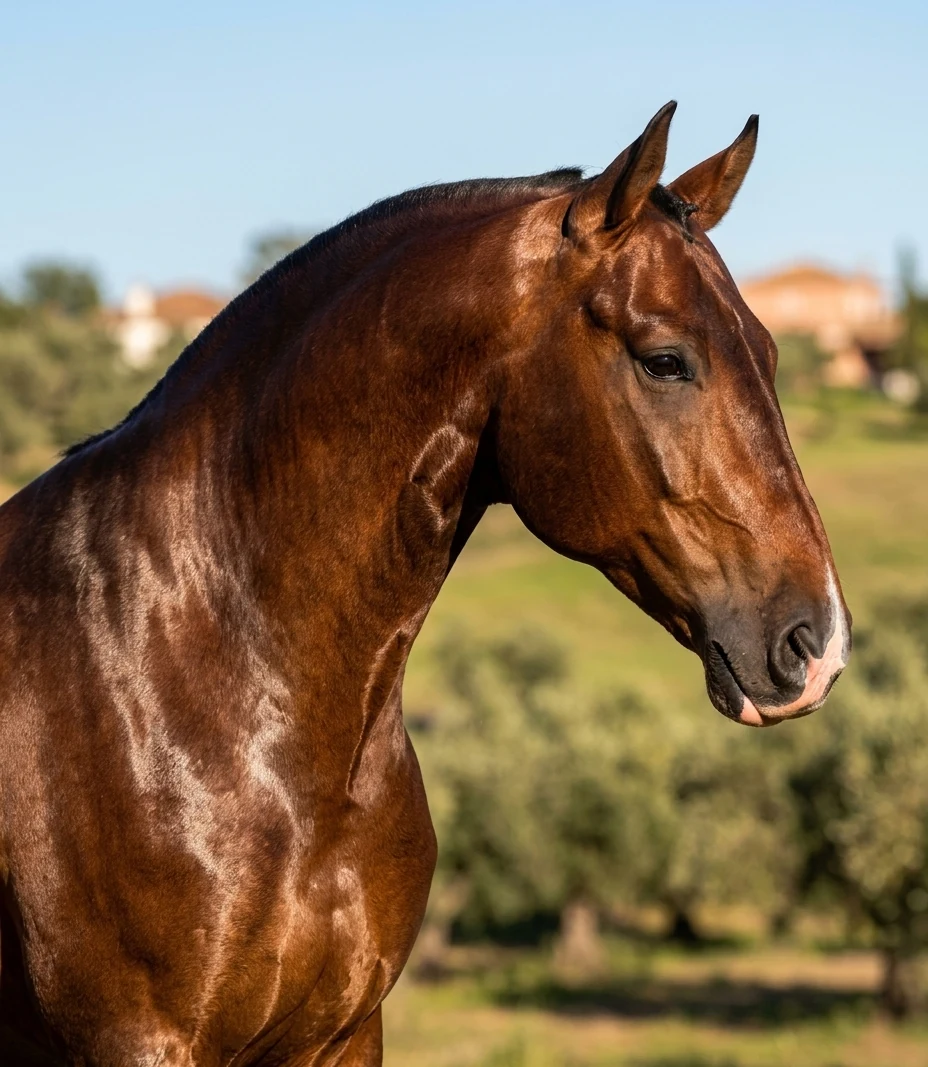
In today's equestrian ecosystem, Classical Dressage has outgrown its identity as an Olympic discipline to become a global economic engine. For the high-level investor, acquiring a Grand Prix horse is not merely a sporting commitment: it is entry into a tangible-asset market that moves billions of euros every year and demands, given its complexity, technical risk management as rigorous as any other alternative asset class.
01 An Economic X-Ray of the Discipline (2024–2025)
The global equestrian industry has shown exceptional resilience against the volatility of traditional financial markets. The equestrian equipment and consumer-goods sector — a fraction of the total ecosystem — was valued at USD 12 billion in 2024, with growth projected to USD 18.3 billion by 2034, a compound annual growth rate (CAGR) of 4.3%.
In parallel, the economic impact of the equestrian industry as a whole in Europe exceeds 100 billion euros a year, sustaining hundreds of thousands of direct and indirect jobs on a continent where the horse remains a cultural and productive cornerstone.
According to records from the Fédération Équestre Internationale (FEI), the number of registered athletes has grown 59% since 2009, reaching 42,961 active riders. Registration of international competition horses has increased 63% over the same period, surpassing 78,400 horses. More than 900 international Dressage competitions were held in the last recorded year.
USD · 2024
+59% since 2009
Classical Dressage · last year
02 The Excellence Ranking: Studbooks and Genetics
For the buyer, a horse's value is closely tied to its studbook, which acts as a statistical certificate of sporting-success probability. The WBFSH (World Breeding Federation for Sport Horses) 2024/2025 ranking confirms the dominance of Central European breeds, with a growing and competitive presence from the Iberian breeds:
| Rank | Studbook | Points (2025) | Reference Sires |
|---|---|---|---|
| 1 | KWPN — Netherlands | 12,783 | Johnson TN, Totilas (active progeny) |
| 2 | OLDBG — Oldenburg | 12,310 | Bordeaux 28, Total Hope OLD |
| 3 | HANN — Hanoverian | 11,665 | Fidermark, Totilas (active progeny) |
| 7 | LUSIT — PSL, Portugal Iberian | 9,087 | Rubi, Zeus do Lis |
| 14 | PRE — Spain Iberian | 3,909 | Confirmed Dressage Lines |
WBFSH points are calculated from the competition results of each studbook's active progeny. The reference to Totilas (KWPN, 2000–2018) reflects the continuing impact of his descendants in competition, not activity by the stallion himself. The gap between the Top 3 and the Iberian studbooks directly explains the price differentials seen at elite auctions.
This gap explains why prices at elite auctions such as PSI (Performance Sales International) hold averages of 320,208 euros for dressage horses, with approved stallions reaching figures above 825,000 euros. Genetics is not just biology: it is the variable that sets the asking price.
03 The Acquisition Challenge: Market Asymmetry
Despite the transparency of macroeconomic figures, the market for buying and selling top-level horses suffers from deep information asymmetry. The best horses — those with impeccable biomechanics, verified radiological health and the right temperament for the Grand Prix — rarely reach public listings. They move through what we call the "invisible market": private networks of breeders, elite riders and stable managers operating with complete discretion.
In this environment, the non-specialist buyer faces three critical structural risks:
- Intermediary Conflict of Interest Agents who represent both seller and buyer at once, or who prioritise their own inventory over the client's real needs. Opacity around double commissions is a widespread practice that erodes the buyer's capital invisibly.
- Superficial Technical Evaluation A purchase decision based on looks or short videos that don't reveal biomechanical weaknesses, hidden behavioural vices or subclinical radiological pathologies. A horse that "looks good" is not necessarily a viable Grand Prix asset.
- Logistical and Legal Uncertainty The complexity of international contracts, managing the PPE (Pre-Purchase Examination) with independent vets, intercontinental transport and customs implications are sources of risk that a buyer without a support network cannot manage efficiently.
A poorly executed acquisition in the Grand Prix horse segment can mean losses of between 50,000 and 300,000 euros through asset devaluation, unforeseen veterinary costs and relocation expenses. Information asymmetry is not a minor inconvenience: it is the leading factor of value destruction in this market.
04 Golden Horses Spain: Strategic Advisory and Investor Protection
It is at the intersection of the elite market and the need for security that Golden Horses Spain deploys its advisory model. We do not operate as a conventional horse finder; we function as an asset-management office that prioritises protecting your capital.
- Radical Transparency — No Conflict of Interest At Golden Horses Spain we have no horses of our own to sell. Our loyalty lies solely and exclusively with the buyer. If a horse doesn't meet the technical standards for biomechanics, pedigree or health, it will not be presented to our clients. This independence is the cornerstone of our model.
- Access to the Invisible Market and Private Portfolio Our network of contacts gives us access to competition stallions and mares that are not publicly listed: the power of a Central European Warmblood, the collection ability of a Puro Sangue Lusitano, or the functional nobility of a Pura Raza Española, with options the general market never sees.
- The "No Compromises" Selection Protocol Every horse evaluated goes through an audit filter that includes: advanced biomechanical analysis of the three gaits, PPE management with independent vets (X-rays, ultrasounds, DNA tests), and verification of the real training level against the asking price.
- Tailored Services — Full Advisory and Premium Tier From Full Advisory — a turnkey service from active search through to delivery at your facility — to the Premium tier with priority access to horses from our private network. Every operation is designed to be safe, discreet and professional.
The right horse. No compromises.
Success in Classical Dressage begins long before entering the arena. In a global market worth billions, accurate information and the right network are the most valuable assets you can acquire.
Book your free advisory session · WhatsApp REQUEST ADVISORYSources and References
- Fédération Équestre Internationale (FEI). Athlete & Horse Registration Statistics 2024. fei.org
- World Breeding Federation for Sport Horses (WBFSH). Studbook Ranking Dressage 2024/2025. wbfsh.org
- PSI — Performance Sales International. Auction Results & Price Reports 2024. psi-auktion.de
- Grand View Research / Industry Reports. Equestrian Equipment Market Size & Forecast 2024–2034. CAGR 4.3%. grandviewresearch.com
- European Horse Network. The Horse Sector in Europe — Economic Impact Report. europeanhorsenetwork.eu