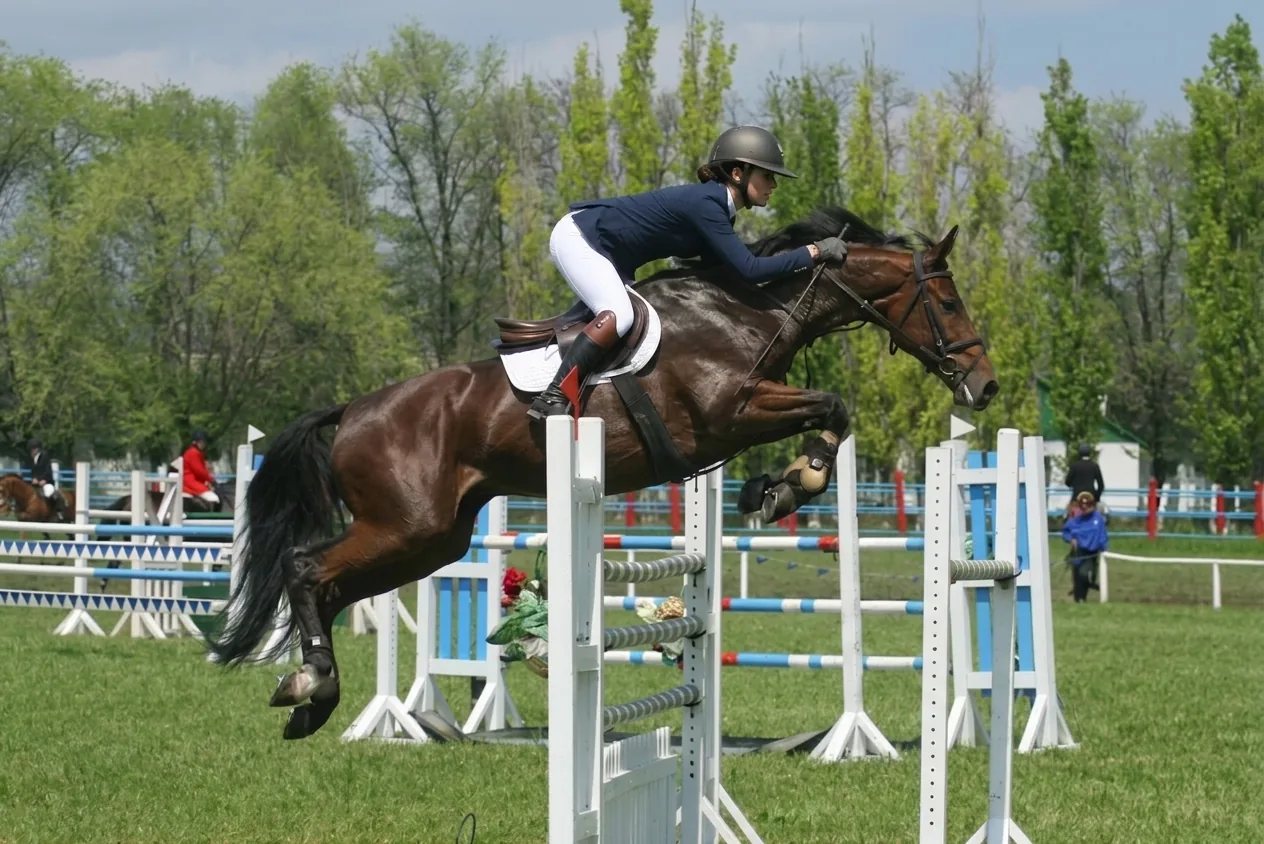
The financial engine, the science of selection and the history of the world's most dynamic Olympic discipline.
Show jumping is not only the world's most followed Olympic equestrian discipline; it is also the most dynamic commercial and financial engine of the entire global horse industry. From the clandestine pounding matches of 18th-century Ireland to the multimillion-euro circuits of the Longines Global Champions Tour, the history of show jumping is that of a discipline that has transformed how horse and human negotiate, 1.60 metres above the ground, the limits of the possible.
The international equestrian industry generates an estimated annual economic impact of 300 billion dollars and sustains between 1.6 and 2 million full-time jobs worldwide. Within this ecosystem, show jumping holds the central position: it is the discipline with the most FEI-registered competitors, the one that distributes the largest prize purses, and the one that attracts the highest volume of private investment in sport-horse breeding.
The financial growth of elite competition is telling. In 2005, the world's best riders competed in 45 international events for a total of 6.6 million euros in prize money. Today, the elite Global Champions Tour circuit stages 17 events a year with a purse exceeding 35 million euros — a single GCL Super Cup day in Prague distributed over 11.4 million in one weekend.
This capital directly raises the value of elite horses. Palloubet d'Halong, a Selle Français, became the most expensive jumping horse in history when acquired for an estimated 15 million dollars. And the Premier Jumping League — scheduled for 2027 under Frank McCourt's patronage, with 14 venues and a 16-team format — confirms an unmistakable trend: show jumping is attracting the investment of major fortunes with the same logic that football and tennis did in previous decades.
| Region / Country | Annual economic impact | Equine population | Employment |
|---|---|---|---|
| Global | $300.000 M USD | 60 M | 1,6 – 2 M |
| Europe | $133.000 M USD | 6,0 M | 400.000 |
| USA | $122.000 M USD | 8,2 M | 1,7 M |
| Spain | €7.392 M EUR (0,59% PIB) | 722.158 | 149.863 |
| UAE | $2.400 M USD | — | Expanding |
| China | $1.580 M USD | — | State investment |
The historical comparison of record prices illustrates the segment's maturity: while Fusaichi Pegasus (racing) reached 70 million dollars and Moorland's Totilas (dressage) sold for up to 21 million, jumping has already reached 15 million with Palloubet d'Halong. The convergence of all three markets towards similar valuations is an unmistakable sign of financial maturity.
Show jumping has the most licences within the International Equestrian Federation (FEI), which gathers 136 national federations. The global census totals 506,116 horses and 203,468 active competitors, with very stable renewal flows that show the maturity of the ecosystem.
Two structural shifts stand out. The first is the feminisation of the grassroots: historically tied to military circles, modern equestrian sport now shows an overwhelming female majority. German Federation (FN) data for 2025 confirm that only 11% of competition licences belong to male riders, down from 20% two decades ago.
The second is the optimisation of organised sport. In Germany, national jumping shows fell from 3,500 to 3,138 a year, yet ring participations stabilised at 1,078,453: less is staged, but better attended and more efficient.
"Equestrian activity contributes 1.2 billion pounds a year in social value to the United Kingdom, impacting physical health, mental wellbeing and community development." British Equestrian · The Power of Horses, 2024
In modern jumping, closed-line breeds have been almost entirely replaced by warmblood populations bred under performance-oriented open-book schemes. Success is no longer measured by purity of blood, but by functional ability demonstrated over fences above 1.45 metres.
Statistical analysis reveals precise patterns. The KWPN is the most represented breed in elite world competition (19.26% of the population). By sex, geldings are the largest group (43.98%), yet approved stallions achieve a higher performance score — 117.84 points versus 105.76 for geldings and 104.66 for mares — reflecting the strict selection they undergo.
The average proportion of Thoroughbred blood in the pedigrees of the best jumping horses stands at 41.61%. Horses with an intermediate percentage (30.1%–70.0%) achieve significantly superior results. The Thoroughbred contributes agility, reaction speed, stamina and courage: qualities no cold-blood programme has managed to replicate.
Another decisive factor is the peak performance age. A jumping horse reaches physical and mental maturity between 10 and 13 years (an average of 124.71 points in international rankings), clearly outperforming young horses in development (76.66) and veterans over 14 (109.29). This curve explains the economic logic of young-horse programmes.
The World Breeding Federation for Sport Horses (WBFSH) publishes, together with the FEI, the official ranking of studbooks, calculated from the points of each association's six best horses in valid events. The 2025 ranking confirms Western Europe's dominance.
| Rk. | Studbook / Breed | Pts. WBFSH | Leading sire |
|---|---|---|---|
| 1° | Selle Français (SF) | 9.046 | Cornet Obolensky |
| 2° | Holsteiner (HOLST) | 7.960 | Kannan |
| 3° | Royal Dutch Sport Horse (KWPN) | 7.889 | Chacco-Blue |
| 4° | Belgian Warmblood (BWP) | 7.550 | Diamant de Semilly |
| 5° | Oldenburger Int. (OS) | 7.345 | Mylord Carthago HN |
Behind these five studbooks lies a small group of stallions of decisive influence. Cornet Obolensky tops the 2025 WBFSH sire ranking with 30,705 points, followed by Kannan (30,364) and Chacco-Blue (25,931). These sires transmit not only power and scope but also willingness and temperamental stability — the variables that most define performance under pressure.
Competitive jumping is a modern phenomenon — not before the second half of the 18th century — and its origin is neither epic nor aristocratic: it is the direct product of a parliamentary decision on land use. The British Enclosure Acts forced landowners to fence properties with hedges, ditches and walls. To keep pace with fox hunting, horses had to learn to clear those barriers. So the first hunters were born.
In Ireland, this need gave rise to the 18th-century pounding matches: cross-country endurance duels. Parliament banned them in 1739, but they continued clandestinely. From them came the first documented race (County Cork, 1752): 4.5 miles from church to church. The name of that format — steeplechase, a race towards the church steeple — remains in use today.
The technique in use until the late 19th century was biomechanically harmful: riders forced the horse's head up with tight reins and, on take-off, threw their torso back, loading their weight onto the horse's loins. The result: blocking of the jump's natural arc (bascule), chronic back pain and a high refusal rate. It was not riding; it was a fight against the horse's biomechanics.
The transformation came with Captain Federico Caprilli (1868–1907), an Italian officer at the Pinerolo School. He photographed horses jumping at liberty and confirmed that the horse stretches its neck forward to balance. His Natural Riding System — the "forward seat" — calls for short stirrups, a forward-inclined torso and hands that yield towards the mouth in flight. In 1902 he set a world high-jump record of 2.08 m on Sfacciato.
"The first rule of riding is to simplify and, if possible, eliminate the rider's intervention, so the horse can maintain its natural balance." Federico Caprilli · Pinerolo, c. 1901
In an ecosystem where elite genetics, maturity age and sire lineage determine performance over 1.60 metres, finding the right horse ceases to be a matter of luck and becomes a technical decision. That is where Golden Horses Spain comes in: we offer you market knowledge, access to horses that never reach the public portals, and a rigorous assessment — morphological, biomechanical and veterinary — so that you acquire, with full transparency and no conflict of interest, the jumping horse you need to compete at any level you set yourself. From identifying the horse to its arrival at your premises, we handle everything.
At Golden Horses Spain we work exclusively for the buyer. We access jumping horses that are not on the open market — selected with expertise, evaluated with rigour and acquired with full transparency. From identifying the horse to delivery at destination, we handle every detail of the turnkey process, whatever level you compete at and wherever you are in the world.
Sources: Equerry Co. · WOAH/FEI Data 2024 · Yeguada Cartuja / MAGRAMA 2023 · British Equestrian (The Power of Horses, 2024) · ResearchGate 2021 (Thoroughbred influence) · WBFSH World Ranking — Jumping Studbooks & Sires 2025 · SporthorseData · Practical Horseman (Caprilli) · FEI Annual Report 2024. Data reflects the most recent verified information available at time of publication.