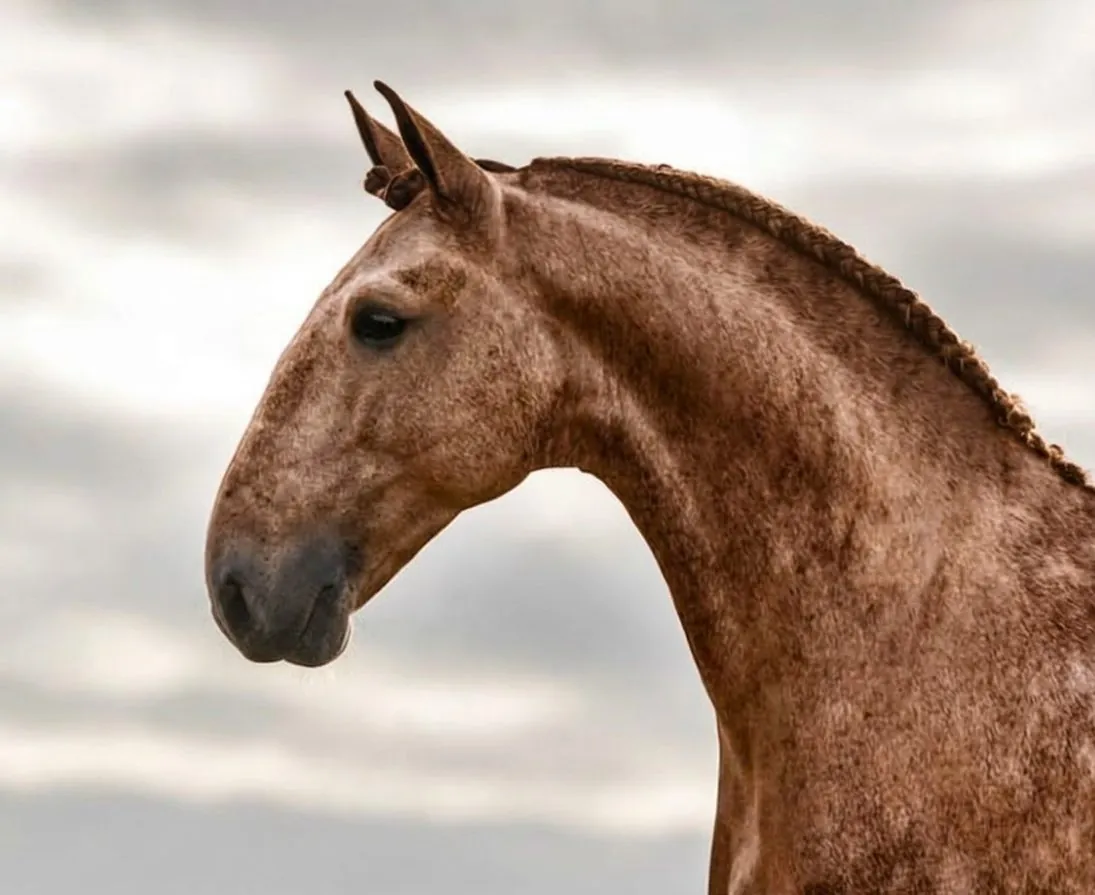
A comprehensive analysis of PSL history, biomechanics, bloodlines and Olympic timeline.
There are legacies forged in the whisper of the wind. In ancient Lusitania, Roman conquerors were so dazzled by the speed and lightness of native horses that they called them "the children of Aeolus", feeding the myth that mares were fertilised by the West Wind. From that absolute communion between warrior rider and horse was born the legend of the centaur. Today, that myth is sculpted daily on the arena of the world's most demanding Olympic arenas.
Although it shares historical roots with the PRE (Pura Raza Española), the Lusitano began its own path in 1967 with the founding of its official studbook under the APSL — the Associação Portuguesa de Criadores do Cavalo Puro Sangue Lusitano. This separation was not merely administrative: it consolidated bloodlines and a unique temperament that today headline Olympic podiums.
The result is an extraordinarily brave, reactive horse with immense concentration and impulse control that makes the difference on international tracks. Today, 50% of breeding stock is outside Portugal, with active breeders in over 25 countries — from Brazil's major studs to emerging operations in the USA, Germany and Mexico.
For decades, the international Grand Prix circuit was dominated by powerful Central European Warmbloods. It was assumed that Iberian horses, with their more baroque lines, lacked the physical scope needed to compete. However, from the 1990s onwards, Lusitano breeding underwent an unprecedented strategic shift.
Through rigorous ridden public stallion approvals and demanding functional selection, modern breeders produced horses with more elastic backs, greater stride scope, and forward-projecting canter — without losing their crown jewel: innate aptitude for collection.
Science has confirmed what great riders already knew: in maximum collection exercises such as piaffe, the Lusitano tilts its hindquarters and flexes its lower joints in a physiologically superior manner. It is the ultimate expression of classical lightness.
Strongly arched, muscular, with medium-high attachment. Enables light contact and natural elevation without forced effort.
Contact · ElevationSloped, elliptical and extraordinarily powerful. Ideal for engaging the hindquarters and tilting the pelvis — the foundation of deep collection.
Collection · Piaffe · PassageDense bones, long cannon bones and dry tendons. A combination that provides superior agility and bone density for exceptional sporting longevity.
Agility · LongevityBrave, reactive, with immense concentration capacity. Exceptional impulse control: responds to the most subtle aids with millimetre precision.
Intelligence · SensitivityTo understand the engine of a Grand Prix Lusitano, we must look at its four founding bloodlines, united today under a strict Improvement Plan that classifies the best sires as Merit Breeders (★★★★★) or Recommended (★★★★) based on sporting performance and offspring.
Tall, strong build, straight head profile and supremely elegant gaits. Horses of great presence with exceptional scope of movement.
Convex profile, highly flexible neck, great agility and compact build. Ardent temperament and electrifying impulsion on the dressage arena.
Traditionally bay coats, sub-convex profile, very compact body and ardent nobility of royal origin. The line most closely linked to pure equestrian art.
Larger horses with massive bone structure, high croups and great stamina. A body architecture designed for sustained effort over the long term.
The PSL's position in the international elite did not happen overnight. It was written by legendary partnerships that challenged judges around the world, proving that Iberian character and sporting excellence are not just compatible — they are synergistic.
The Alter Real line stallion led Spain to team silver. The ultimate pioneers: the first major world demonstration that the Lusitano could reach the Olympic podium.
🥈 Team Silver MedalThe great stallion who moved the London judges: 16th in individual and 41st in the demanding WBFSH dressage sire world ranking. An undeniable Iberian presence.
Top 16 Individual · WBFSH #41Son of Rubi AR, this grey broke the mythical 80% barrier in a World Cup Grand Prix Freestyle dancing to "Pirates of the Caribbean". A performance that redefined what is possible for an Iberian horse.
🏆 80% barrier brokenA record 13 Lusitanos qualified for Olympic competition. Rodrigo Torres with Fogoso Campline performed one-handed flying changes. João Victor Marcari Oliva with Escorial Campline set Brazil's all-time scoring record.
📊 13 Qualified · Breed recordIn the gardens of Versailles, the Lusitano shone again. Rita Ralão Duarte with Irão (68.26%), Claudio Castilla with Hi-Rico do Sobral (69.83%), and the emotional farewell of Juan Antonio Jiménez Cobo with the iconic Euclides MOR.
🏟️ Palace of VersaillesAlongside sporting success, the global high-performance Lusitano market is in extraordinary health. Brazil's historic Interagro stud — celebrating 50 years — dominates US podiums and All-Breed Awards, culminating in the recent Grand Prix Open Champion title won by stallion London Do Vouga at the prestigious US Dressage Finals.
South America is consolidating as one of the fastest-growing markets for elite PSL. The combination of solid equestrian tradition, growing demand for high-level genetics, and an increasing presence of Ibero-American riders on FEI circuits creates an unprecedented opportunity ecosystem in the breed's history.
For a buyer seeking a Grand Prix Lusitano — with everything that entails in terms of genetic selection, competitive record, stallion approval and future potential — access to the European market through specialised advisory is not an advantage: it is a necessity.
50% of APSL-registered PSL breeding stock is currently outside Portugal. High-performance Iberian horses — especially those with FEI competitive records and stallion approval — are scarce assets that rarely appear on the open market. The finest specimens are traded discreetly, within networks of trust.
The modern success of these horses proves that sporting performance and classical purity are not in conflict. The future is not inherited: it is built through rigorous genetic selection, training that respects the horse's timeline, and the relentless pursuit of morpho-functional excellence.
The breed has travelled an extraordinary path: from the centaur myth to the arenas of Versailles, from the secrecy of Lusitanian breeders to the Olympic podiums of the 21st century. And that journey is only beginning.
At Golden Horses Spain we work exclusively for the buyer. We access PSL and PRE specimens that are not on the open market — selected with expertise, evaluated with rigour and acquired with full transparency. From identifying the horse to delivery at destination, we handle every detail of the turnkey process, wherever you are in the world.
Sources: APSL — Associação Portuguesa de Criadores do Cavalo Puro Sangue Lusitano · FEI Paris 2024 Official Results · cavalo-lusitano.com · WBFSH Breed Rankings · US Dressage Finals 2024. Statistical data reflects the most recent verified information available at time of publication.